

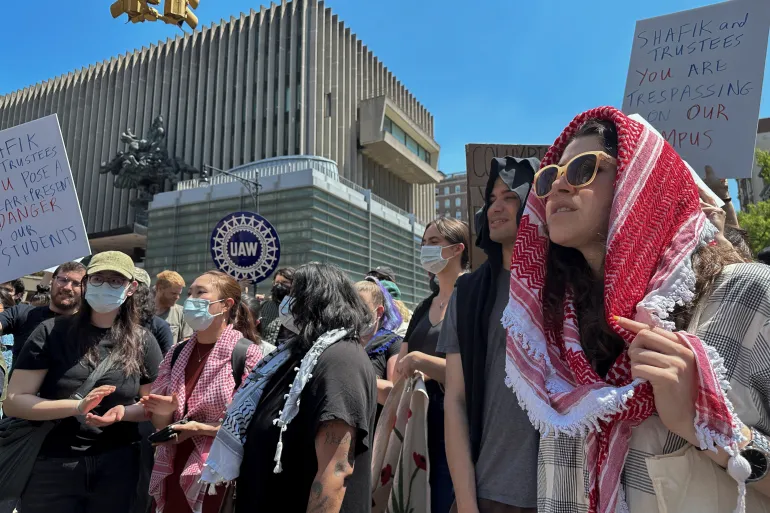
New York City-based Columbia University has agreed to pay $221 million to settle claims by US President Donald Trump’s administration that it failed to curb antisemitism on campus. In exchange, the university will see the reinstatement of billions of dollars in federal funding. This agreement, finalized on Wednesday, follows widespread university campus protests against Israel’s war in Gaza during the spring and summer of 2024 and this year, which drew criticism for allegedly veering into antisemitism.
In February, the government had cut $400 million in federal research funding for Columbia in an effort to compel its administrators to address alleged harassment of Jewish students and faculty. This unprecedented agreement marks a significant victory in Trump’s efforts to assert greater control over higher education, including campus activism, and could establish a precedent for future agreements with other universities.
What’s in the Deal Trump Has Struck with Columbia?
Columbia has agreed to pay $200 million to the government over three years, in addition to making a separate $21 million payment to resolve claims by the Equal Employment Opportunity Commission. In return, the university stated that the “vast majority” of the frozen $400 million in federal funding will be reinstated. Under the deal, Columbia will also regain access to billions of dollars’ worth of current and future grants.
Within 30 days, Columbia is required to appoint an administrator who will report directly to the university president and be responsible for overseeing the deal’s compliance. This oversight includes ensuring that the institution discontinues programs that promote “unlawful efforts to achieve race-based outcomes, quotas [and] diversity targets.”
Additionally, Columbia must review its Middle East curriculum to ensure it is “comprehensive and balanced” and appoint new faculty staff to its Institute for Israel and Jewish Studies. Columbia confirmed that the agreement establishes Bart Schwartz, from the compliance firm Guidepost Solutions, as an independent monitor who will report to the government on its progress every six months. The university is also expected to compile a report for the monitor to ensure its programs “do not promote unlawful DEI [diversity, equity, and inclusion] goals.”
Why Have They Come to This Agreement?
Columbia stated that the agreement formalizes already-announced reforms aimed at addressing harassment of Jewish students and staff. These reforms include the hiring of additional public safety personnel, changes to disciplinary processes, and efforts to foster “an inclusive and respectful learning environment.”
The dispute between Columbia and the Trump administration began after Jewish students and faculty complained of harassment on campus by pro-Palestinian demonstrators. Conversely, pro-Palestinian advocates accused critics of often wrongly conflating opposition to Israel with hatred of Jews.
Columbia’s acting president, Claire Shipman, described the agreement as “an important step forward after a period of sustained federal scrutiny and institutional uncertainty.” She added, “The settlement was carefully crafted to protect the values that define us and allow our essential research partnership with the federal government to get back on track. Importantly, it safeguards our independence, a critical condition for academic excellence and scholarly exploration, work that is vital to the public interest.” Trump hailed the settlement as “historic” in a post on his Truth Social platform, stating, “Numerous other Higher Education Institutions that have hurt so many, and been so unfair and unjust, and have wrongly spent federal money, much of it from our government, are upcoming.”
How Have Students and Activists Reacted?
The student activist group Columbia University Apartheid Divest (CUAD) vehemently criticized the settlement as “a bribe.” On X, the group wrote, “Imagine selling your students out just so you can pay Trump $221 million dollars and keep funding genocide.”
CUAD further added that Columbia’s disciplinary actions against students this week, including suspensions and expulsions, “hugely” exceeded the precedent for non-Palestine-related demonstrations. The non-governmental organization Palestine Legal accused Columbia of “weaponizing claims of antisemitism to punish those calling for freedom for Palestinians.”
The group posted on X, “It is clear that Columbia’s desire to create a community ‘where all feel welcome’ doesn’t extend to students who call for an end to Israel’s genocide.” Hasan Piker, a left-wing activist, political commentator, and critic of Trump, remarked that the US president was “underwater on everything and Columbia is still caving to Trump on everything,” suggesting that “it seems like some of these institutions were looking for the pretext to go right.”
What Steps Has Columbia Already Taken to Pacify the Trump Administration?
In March, Columbia had agreed to a list of demands laid down by Trump in return for negotiations to reinstate its $400 million federal funding. Trump had revoked this funding a month prior, citing “a failure to protect Jewish students from antisemitic harassment.”
Among other concessions, the university agreed to ban face mask coverings during protests and to install 36 campus police officers with special powers to arrest students. Earlier this month, Columbia adopted a controversial definition of antisemitism drafted by the International Holocaust Remembrance Alliance (IHRA). This definition has been criticized by some for allegedly conflating criticism of the state of Israel and Zionism with antisemitism.
Critics have warned that this definition could be used to stifle dissent and curb academic freedom. In a letter sent to the United Nations in 2023, 60 human and civil rights organizations urged against the use of the IHRA definition. They wrote, “The IHRA definition has often been used to wrongly label criticism of Israel as antisemitic, and thus chill and sometimes suppress, non-violent protest, activism and speech critical of Israel and/or Zionism, including in the US and Europe.”
On Tuesday, Columbia also announced it would suspend, expel, or revoke degrees for nearly 80 students who participated in a Butler Library demonstration on its campus on May 7, 2025, and a “Revolt for Rafah” encampment on May 31, 2024, during the university’s annual alumni weekend.
During these protests, students demanded that the university’s $14.8 billion endowment cease investing in weapons manufacturers and other companies that support Israel. Protest organizer and former student Mahmoud Khalil, 29, was the first person to be detained during the Trump administration’s push to deport pro-Palestinian activists who are not US citizens. The school also confirmed it would no longer engage with the pro-Palestinian group CUAD.
Which Other Universities Has Trump Set His Sights On, and Why?
The Trump administration is focusing its attention on 10 universities it considers notable in its campaign to eradicate antisemitism. These institutions include: Columbia; George Washington University; Harvard; Johns Hopkins University; New York University; Northwestern; the University of California, Berkeley; the University of California, Los Angeles; the University of Minnesota; and the University of Southern California.
Columbia University was the first college to experience a funding cut. However, several Ivy League schools have faced or been threatened with funding reductions since Trump assumed office in January 2024. More than $2 billion in total funding was frozen for Cornell, Northwestern, Brown, and Princeton universities.
In April, the administration also threatened to freeze $510 million in grants to Brown University over alleged violations “relating to antisemitic harassment and discrimination.” Harvard University was the first—and so far, the only—major higher education institution to defy Trump’s demands and fight back in federal court.
This week, Harvard argued in federal court that the Trump administration had illegally cut $2.6 billion in funding, characterizing these actions as politically motivated attempts to reshape the institution.
Are Deals with Other Universities Expected As Well?
It is believed that some other universities are also in discussions with the Trump administration, suggesting that more deals may be forthcoming. Specifically, U.S. news outlets have reported that officials from the Trump administration and Harvard are continuing negotiations, despite the ongoing court case initiated by Harvard.
In June, Trump posted on social media that “if a Settlement is made on the basis that is currently being discussed, it will be ‘mindbogglingly’ HISTORIC, and very good for our Country.”
