

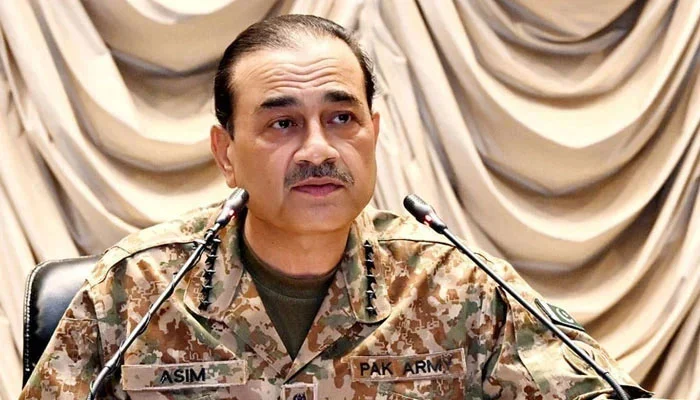
The Director General of Inter-Services Public Relations (ISPR), Lt Gen Ahmed Sharif Chaudhry, has categorically dismissed reports suggesting that Chief of Army Staff (COAS) Field Marshal Syed Asim Munir intends to become the country’s president. In an interview with the British journal The Economist, the military spokesperson labeled these reports as “nonsense.” This clarification follows similar statements from Prime Minister Shehbaz Sharif, who in July had strongly refuted rumors that President Asif Ali Zardari might be asked to resign or that the COAS had any presidential ambitions.
The Prime Minister had described such claims as “mere speculation” and assured the public that the reports circulating in certain media outlets were untrue. Speaking to The News, he stated unequivocally, “Field Marshal Asim Munir has never expressed any desire to become the president, nor is there any such plan underway.” He emphasized the relationship between President Zardari, Field Marshal Asim Munir, and himself is one of mutual respect, all focused on the common goal of Pakistan’s progress and prosperity.
Previously, Interior Minister Mohsin Naqvi had also condemned what he called a “malicious campaign” targeting President Zardari, Prime Minister Shehbaz Sharif, and the Army Chief. In a statement on his official X handle, Naqvi, who is considered close to the top military leadership, said, “We are fully aware of who is behind the malicious campaign.” He further clarified, “I have categorically stated that there has been no discussion, nor does any such idea exist, about the president being asked to resign or the COAS aspiring to assume the presidency.”
Meanwhile, in response to a question about how Pakistan would react if India repeats an act of aggression, DG ISPR Lt Gen Ahmed Sharif Chaudhry stated that Pakistan’s response would involve striking deeper into India. “We’ll start from the east,” he said, adding, “They [India] also need to understand that they can be hit everywhere.”
The two nations had previously engaged in military confrontation in May, triggered by an April attack on tourists in Indian Illegally Occupied Jammu and Kashmir (IIOJK) that New Delhi blamed on Islamabad. In retaliation for the Indian aggression, Pakistan’s armed forces launched a large-scale military action, “Operation Bunyan-um-Marsoos,” targeting several Indian military sites across multiple regions. Pakistan claimed to have shot down six Indian fighter jets, including three Rafales, and dozens of drones. After 87 hours, the conflict ended on May 10 with a ceasefire agreement brokered by the US.
The ceasefire was first announced by US President Donald Trump on social media, following talks with both sides. However, India has disagreed with Trump’s assertion that his intervention and threats to sever trade talks were the cause. In contrast, Pakistan has acknowledged Trump’s efforts and formally nominated him for the 2026 Nobel Peace Prize, citing his role in de-escalating tensions between Islamabad and New Delhi.
