

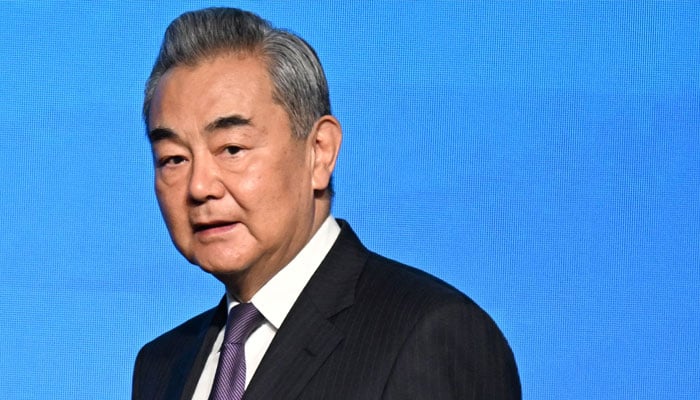
China’s top diplomat, Wang Yi, is set to begin a visit to Europe on Monday, a trip Beijing characterizes as highlighting the relationship’s role as an “anchor of stability” in a tumultuous global environment. Wang Yi’s itinerary includes stops at the European Union’s headquarters in Brussels, as well as France and Germany, as China aims to bolster its ties with the bloc to counterbalance its superpower rival, the United States.
However, significant points of contention persist, notably economic imbalances, including a substantial $357.1 billion trade deficit between China and the EU. Beijing’s strong links with Russia, despite the ongoing war in Ukraine, also remain a deep source of friction. Chinese foreign ministry spokesman Guo Jiakun stated on Friday that “the world is undergoing an accelerated evolution of a century-old change, with unilateralism, protectionism and bullying behaviour becoming rampant” – a thinly veiled criticism directed at the United States under President Donald Trump.
In this context, Guo emphasized that Beijing and the European bloc must “keep the world peaceful and stable, safeguard multilateralism, free trade, international rules, fairness and justice, and act firmly as anchors of stability and constructive forces in a volatile world.”
During his visit, Wang will engage in “high-level strategic dialogue” with his EU counterpart, Kaja Kallas, at the bloc’s headquarters in Brussels. In Germany, he is scheduled to hold discussions on diplomacy and security with Foreign Minister Johann Wadephul, marking his first visit since Berlin’s new conservative-led government assumed power in May. In France, Wang will meet with Minister for Europe and Foreign Affairs Jean-Noel Barrot, who visited China in March.
The war in Ukraine is expected to be a prominent topic on the agenda, as European leaders have consistently condemned what they perceive as Beijing’s support for Moscow. While China has maintained a neutral stance regarding Russia’s more than three-year conflict with Ukraine, Western governments argue that Beijing’s close ties have provided crucial economic and diplomatic backing to Moscow, urging China to exert more pressure on Russia to end the war.
Trade Tensions
Relations between Europe and China have also become strained in recent years as the EU seeks to adopt a firmer stance against what it labels as unfair economic practices by Beijing. Following the European bloc’s imposition of tariffs on Chinese electric vehicle imports, China retaliated with its own duties, including those on French cognac. A source within the French economy ministry informed AFP that an agreement on cognac has been reached with Beijing but is yet to be formally approved by the Chinese commerce ministry, with finalization partially linked to the EU’s ongoing negotiations concerning EVs.
Tensions escalated this month after the EU banned Chinese firms from government medical device purchases exceeding five million euros ($5.8 million). This action was taken in retaliation for limitations Beijing places on access to its own market. The latest move in trade disputes between the 27-nation bloc and China encompasses a broad spectrum of healthcare supplies, ranging from surgical masks to X-ray machines, representing a market valued at 150 billion euros within the EU. In response, China accused the European Union of “double standards.”
Another contentious issue involves rare earths. Since April, Beijing has mandated licenses for the export of these strategic materials from China, which accounts for nearly two-thirds of global rare earth mining production and 92% of refined output, according to the International Energy Agency. These metals are critical components in various products, including electric car batteries, and industries have voiced criticism regarding China’s licensing procedures. China’s commerce ministry indicated this month that it has proposed establishing a “green channel” to facilitate the export of rare earths to the EU.
