

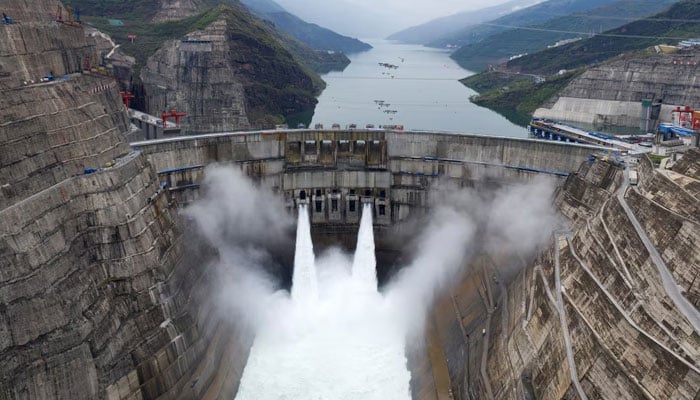
China has commenced construction on what it asserts will be the world’s most extensive hydropower project, a monumental undertaking valued at $170 billion, projected to generate sufficient electricity annually to power the United Kingdom. This ambitious scheme significantly surpasses the mighty Three Gorges Dam, currently the largest in the world. Following Premier Li Qiang’s unveiling of the project, Chinese construction and engineering stocks experienced a notable surge.
For Beijing, this endeavor promises clean energy, job creation, and a vital economic impetus for a decelerating economy. However, for downstream nations, it rekindles lingering anxieties about water security: the Yarlung Zangbo transforms into the Brahmaputra in India and Bangladesh, serving as a vital lifeline for millions.
What Exactly Was Approved by China?
The plan entails the construction of five dams along a 50km stretch where the river dramatically drops 2,000 meters off the Tibetan Plateau. Initial power generation is anticipated in the early-to-mid 2030s. Beyond this and the substantial price tag, China has disclosed minimal information regarding the project’s construction methodology.
Why Are Neighboring Countries Apprehensive?
This scarcity of information exacerbates concerns regarding water security in India and Bangladesh, both of which depend on the Brahmaputra for irrigation, hydropower, and potable water. Earlier this year, the Chief Minister of Arunachal Pradesh, a state bordering China, stated that the dam could potentially reduce 80% of the river’s flow through the Indian state while concurrently risking inundation in downstream regions like the neighboring Assam state.
According to Michael Steckler, a professor at Columbia University, in addition to water, the dam’s construction will also lead to a decrease in sediment flowing downstream. This sediment carries vital nutrients essential for agricultural activities on downstream floodplains.
Sayanangshu Modak, an expert on the India-China water relationship at the University of Arizona, suggests that the lack of transparency from Beijing has fueled speculation that the dam could be weaponized to restrict water supply during future conflicts, especially given the border war fought between India and China in this region during the 1960s.
“The construction of the Yarlung Zangbo hydropower project is a matter within the scope of China’s sovereign affairs,” Beijing’s foreign ministry stated on Tuesday, adding that the dam would provide clean energy and aid in flood prevention. The ministry further elaborated, “China has also conducted necessary communication with downstream countries regarding hydrological information, flood control, and disaster mitigation cooperation related to the Yarlung Zangbo project.” India’s foreign and water ministries did not respond to requests for comment.
Will It Deprive India of Water?
Modak, however, argues that the dam’s impact on downstream flows has been overstated. This is partly because the majority of water entering the Brahmaputra originates from monsoon rainfall south of the Himalayas, rather than from China. He also clarified that China’s plans involve a “run-of-the-river” hydropower project, implying that water will flow normally along the Brahmaputra’s usual course.
India itself has proposed two dams on the Siang River, its name for the Yarlung Zangbo. One of these, an 11.5-gigawatt project in Arunachal Pradesh, is poised to become India’s largest if it proceeds. Modak added that these proposals are partly an assertion of India’s claims on the river and a bolstering of its position should China ever seek to divert the water. He stated, “If India can show that it has been using the waters, then China cannot unilaterally divert.”
Disputes Are Common
Disagreements over dams and water security are not unprecedented. Pakistan has accused India of weaponizing shared water supplies in Indian Illegally Occupied Jammu and Kashmir (IIOJK) after New Delhi suspended its participation in the Indus Waters Treaty (IWT), which governs water sharing between the two nations. In Egypt, a prominent politician was once caught on camera proposing to bomb a contentious Nile River dam planned by Ethiopia during a protracted dispute over the project.
Earthquake and Extreme Weather Vulnerabilities
The proposed dam will be constructed in an earthquake-prone zone that is also susceptible to landslides, glacial-lake floods, and severe storms. A recent surge in dam building in the area raised safety concerns among experts following a devastating earthquake in Tibet earlier this year. A much smaller hydropower project on a nearby tributary has been restricted to four-month construction windows due to significant engineering challenges posed by high altitudes and harsh winters.
