

Washington, D.C.
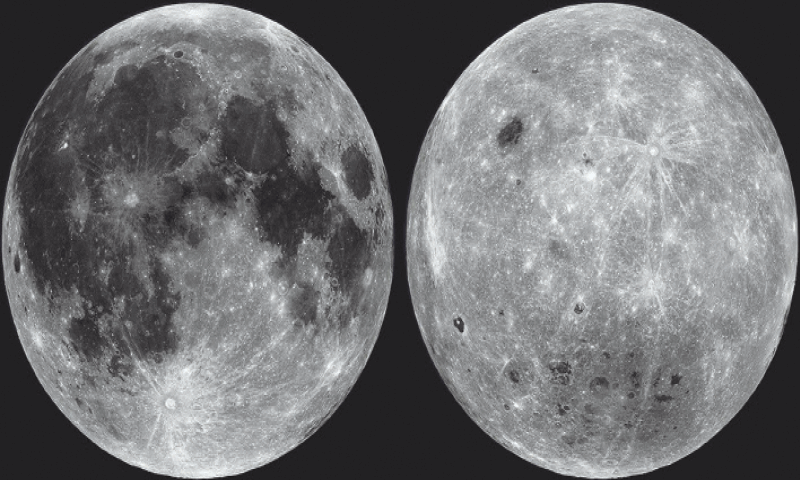
The moon is often characterized as “two-faced” due to the stark surface differences between the side perpetually facing away from Earth and the side we always see. Now, analysis of rock and soil retrieved in 2024 by China’s Chang’e-6 robotic lunar spacecraft reveals that these differences run deep into the moon’s interior.
Scientists determined that the chemical makeup of minerals in the material obtained from a location on the moon’s farside indicates it formed from lava within the lunar mantle about 60 miles (100 km) beneath the surface some 2.8 billion years ago, crystallizing at approximately 2,000 degrees Fahrenheit (1,100 degrees Celsius).
Crucially, researchers compared this to data from 33 previously studied samples retrieved from the nearside during NASA Apollo missions and a 2020 Chinese mission. They found that the Chang’e-6 sample—the only one ever acquired from the farside—formed in the lunar interior at a temperature about 180°F (100°C) cooler than the nearside samples. The scientists believe this thermal difference between the two sides persists to this day.
“Our results demonstrate the existence of thermal asymmetry between the nearside and farside mantle,” said geoscientist Yang Li of University College London and Peking University, who led the study published in the journal Nature Geoscience.
Li added that this finding “takes us one step closer toward understanding the dichotomy of the moon.” He noted that the moon exhibits dramatic surface differences between its two sides concerning volcanism, crust thickness, and topography.
A Geochemical Explanation for Lunar Asymmetry
The moon’s farside is characterized by a thicker crust—the planet’s outermost layer—and is significantly more mountainous and cratered. It appears this side was historically less volcanic than the nearside, resulting in fewer dark patches of basalt, the rock formed from ancient lava flows. Conversely, the nearside surface is smoother and largely covered in dark volcanic plains.
The Chang’e-6 landing site in the South Pole-Aitken Basin, an immense impact crater, is an area with the thinnest crust on the moon, a feature that proved useful for finding evidence related to past volcanism.
The researchers hypothesize that the moon’s farside interior may be cooler than the nearside because it contains a smaller concentration of elements such as uranium, thorium, and potassium. These elements release heat through radioactive decay.
Some scientists have long theorized that this uneven internal distribution of heat-releasing elements may have been caused by a massive asteroid or some other celestial body smashing into the farside early in the moon’s history, thus impacting its long-term geological and thermal evolution.
