

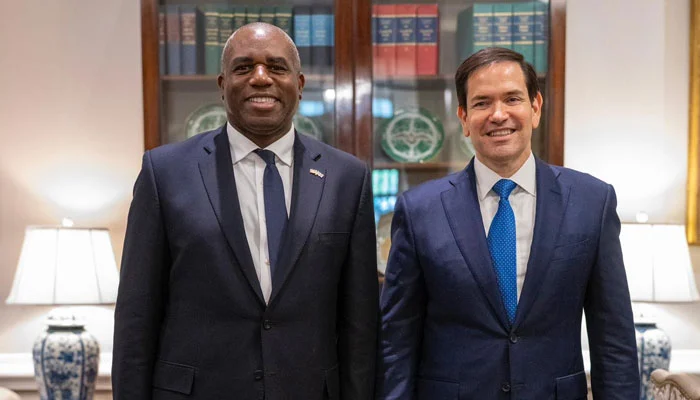
Britain’s Foreign Secretary David Lammy has expressed that a chance remains to achieve a peaceful resolution concerning Iran’s nuclear program. Speaking in advance of critical discussions in Geneva, Lammy indicated a two-week window for a diplomatic solution to emerge and to prevent the worsening of the situation in the Middle East. He urged all involved parties to act swiftly to avert a broader conflict.
Lammy’s remarks followed a meeting at the White House with US Secretary of State Marco Rubio and special envoy Steve Witkoff. These discussions were held ahead of Friday’s scheduled talks in Geneva, where Lammy will meet with Iranian Foreign Minister Abbas Araghchi, accompanied by his French, German, and EU counterparts.
This diplomatic initiative arises as European nations advocate for de-escalation in the context of Israel’s bombing campaign against Iran’s nuclear program, and as US President Donald Trump deliberates whether to participate in strikes on Tehran.
“The situation in the Middle East remains perilous,” Lammy stated in a press release from the UK embassy in Washington. “We discussed how Iran must make a deal to avoid a deepening conflict. A window now exists within the next two weeks to achieve a diplomatic solution,” he asserted. The British minister further added, “Tomorrow, I will be heading to Geneva to meet with the Iranian foreign minister alongside my French, German and EU counterparts.” He concluded, “Now is the time to put a stop to the grave scenes in the Middle East and prevent a regional escalation that would benefit no one.”
The US State Department confirmed that Lammy and Rubio had “agreed Iran can never develop or acquire a nuclear weapon.”
European Impetus for Diplomatic Engagement
Araghchi had previously confirmed his attendance, stating he would “meet with the European delegation in Geneva on Friday,” as reported by Iranian state news agency IRNA. The discussions are slated to include Lammy, French Foreign Minister Jean-Noël Barrot, German Foreign Minister Johann Wadephul, and EU foreign policy chief Kaja Kallas.
Trump has publicly declared that he is still evaluating military action against Iran’s nuclear facilities, while Israel continues its air strikes and Tehran retaliates with missile attacks. France, Germany, Britain, and the European Union were all original signatories of the 2015 nuclear agreement with Iran (the JCPOA), from which Trump withdrew during his first presidential term.
Kallas, coordinating with key European powers, has consistently maintained that diplomacy remains the optimal path to prevent Iran from developing a nuclear weapon. On Wednesday, French President Emmanuel Macron indicated that European nations intend to propose a negotiated resolution to end the Iran-Israel conflict. He instructed his foreign minister to collaborate with “close partners” on such an initiative.
Barrot has maintained regular communication with his German and British counterparts since Israel commenced its large-scale air strikes on Iran last Friday. “We are ready to take part in negotiations aimed at obtaining from Iran a lasting rollback of its nuclear and ballistic missile programmes,” Barrot affirmed.
Israel maintains that its air campaign is solely designed to prevent Iran from acquiring nuclear weapons. Iran is currently enriching uranium to 60 percent, significantly exceeding the 3.67 percent limit stipulated by the 2015 accord, though still below the 90 percent required for a nuclear warhead. Tehran consistently denies any intention of developing nuclear weapons.
