

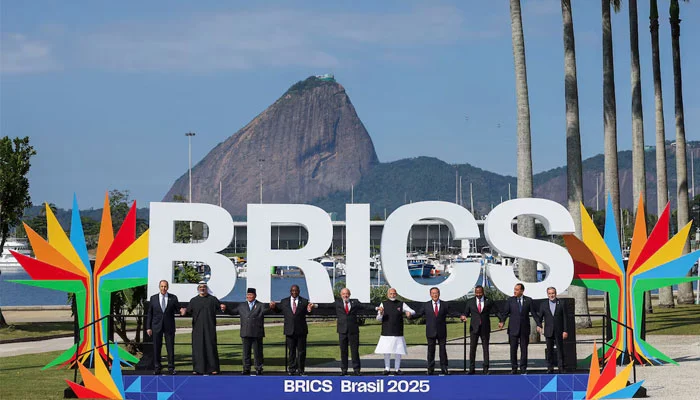
During their summit on Sunday, leaders of the BRICS group of developing nations condemned attacks on Iran, Gaza, and Kashmir. The bloc positioned itself as a defender of multilateral diplomacy, while indirectly criticizing US military and trade policies.
With forums like the G7 and G20 groups of major economies facing challenges from internal divisions and the disruptive “America First” approach of US President Donald Trump, the expansion of BRICS has created new opportunities for diplomatic coordination.
In his opening remarks at the Rio de Janeiro meeting, Brazilian President Luiz Inacio Lula da Silva drew a parallel with the Cold War’s Non-Aligned Movement, a group of developing nations that resisted joining either side of a polarized global order. “BRICS is the heir to the Non-Aligned Movement,” Lula told leaders. “With multilateralism under attack, our autonomy is in check once again.”
Lula also highlighted to business leaders on Saturday that BRICS nations now represent more than half the world’s population and 40% of its economic output, while warning against rising protectionism.
The original BRICS group convened leaders from Brazil, Russia, India, and China at its first summit in 2009. The bloc later added South Africa and, last year, included Egypt, Ethiopia, Indonesia, Iran, Saudi Arabia, and the United Arab Emirates as members. This marks the first summit of leaders to include Indonesia.
“The vacuum left by others ends up being filled almost instantly by the BRICS,” noted a Brazilian diplomat requesting anonymity. While the G7 still wields considerable power, the diplomat added, “it doesn’t have the predominance it once did.”
However, questions remain about the shared goals of an increasingly heterogeneous BRICS group, which has expanded to include regional rivals alongside major emerging economies. This year’s summit saw Chinese President Xi Jinping opt to send his prime minister in his place, and Russian President Vladimir Putin participated online due to an arrest warrant from the International Criminal Court.
Still, several heads of state, including Indian Prime Minister Narendra Modi and South African President Cyril Ramaphosa, gathered for discussions at Rio’s Museum of Modern Art on Sunday and Monday. More than 30 nations have expressed interest in participating in BRICS, either as full members or partners.
Growing Clout, Increasing Complexity: BRICS’ Evolving Global Role
The expansion of BRICS has added diplomatic weight to the gathering, which aspires to speak for developing nations across the Global South, strengthening calls for reforming global institutions such as the United Nations Security Council and the International Monetary Fund.
“If international governance does not reflect the new multipolar reality of the 21st century, it is up to BRICS to help bring it up to date,” Lula stated in his remarks, which also highlighted the perceived failure of US-led wars in the Middle East.
In a joint statement released on Sunday afternoon, the leaders condemned military attacks against Iran’s “civilian infrastructure and peaceful nuclear facilities under full safeguards of the International Atomic Energy Agency.” The group expressed “grave concern” for the Palestinian people over Israeli attacks on Gaza and condemned what the joint statement called a “terrorist attack” in India-administered Kashmir.
On trade, the joint statement warned that the the “indiscriminate rise in tariffs” threatens global trade, continuing the group’s veiled criticism of Trump’s US tariff policies. The group voiced its support for Ethiopia and Iran to join the World Trade Organization, while urging the urgent restoration of its ability to resolve trade disputes.
The leaders’ joint statement also backed plans to pilot a BRICS Multilateral Guarantees initiative within the group’s New Development Bank to lower financing costs and boost investment in member states, a development first reported by Reuters last week.
Brazil, which will also host the United Nations climate summit in November, has leveraged both gatherings to underscore how seriously developing nations are addressing climate change, contrasting with Trump’s decision to curb US climate initiatives. According to two sources familiar with discussions about funding global forest conservation, China and the UAE signaled during meetings with Brazilian Finance Minister Fernando Haddad in Rio that they plan to invest in a proposed Tropical Forests Forever Facility.
