

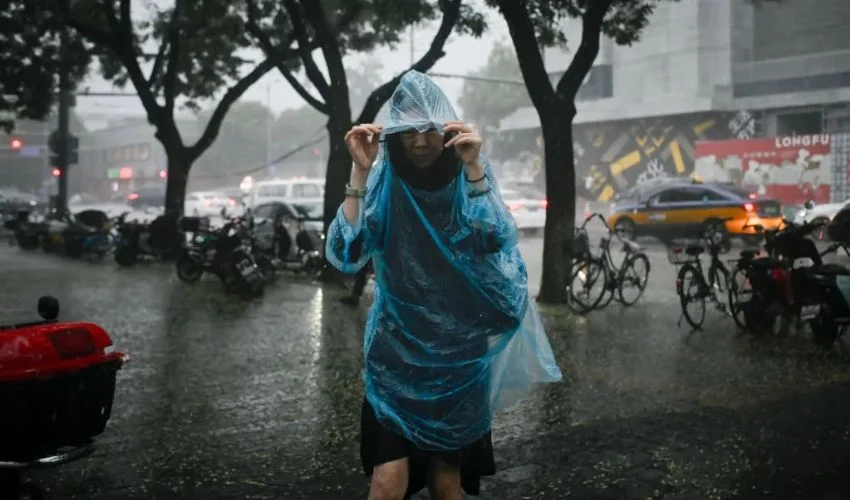
During a deadly flood in Beijing last month, rural hotel owner Cui Jian and his guests were stranded on a rooftop in a downpour for a night before being rescued the next day. Beijing’s northern Huairou and neighboring Miyun districts received a year’s worth of rain in a single week, causing flash floods that devastated villages and killed 44 people, making it the deadliest flood since 2012.
For most villagers in Huairou, the authorities’ most severe weather warning came too late, as they were already asleep. Cui, whose ten properties he had spent $4.87 million renovating were submerged, noted, “In the past, they closed scenic areas and campsites, evacuated tourists and relocated villagers. If you warn people in time, that’s good, but if not, it’s a natural disaster.”
The floods revealed major flaws in the rural emergency response infrastructure for Beijing, which has a densely populated urban core surrounded by several rural districts. The disaster also highlighted that historically-dry Beijing, home to 22 million people, is ill-prepared for a future that experts say will be increasingly wet. Since 2012, the Chinese capital has experienced three major deluges that forecasters said were “once-in-a-hundred-year” events, and climate experts warn of a growing risk of unprecedented disasters.
Chinese experts are increasingly urging city planners to prioritize “ecological resilience” due to the damaging effects of climate change. Zhou Jinfeng, Secretary-General of the China Biodiversity Conservation and Green Development Foundation, stated, “The current understanding of the climate crisis and its future challenges is insufficient, which naturally leads to insufficient deployment and planning.”
While two Beijing districts hit by the 2023 floods have issued long-term reconstruction plans focusing on “climate-adaptive city construction,” most recently commissioned infrastructure projects in the capital do not prioritize climate adaptation. A Chinese government database showed that only three Beijing infrastructure projects in the last five years mentioned “ecological resilience” in their procurement tenders, while hundreds of tenders mentioning “climate change” were mostly for research at state scientific institutes.
Ecological resilience, according to Zhou, involves restoring natural river embankments, reducing the use of concrete, and increasing biodiversity. In a notable shift from decades of rapid urbanization, a top-level urban planning meeting in July emphasized building “livable, sustainable, and resilient” cities.
This year, northern China’s rainy season started its earliest since records began in 1961, and several Beijing rivers experienced their largest-ever recorded floods. Official data showed that citywide rainfall in June and July surged 75% from a year earlier. The director of China’s National Climate Center linked this to a “significant northward expansion of China’s rain belt since 2011,” a shift toward “multiple, long-term, sustained cycles of rainfall” in the traditionally arid north.
“Sponge Cities”
China has taken some steps to combat urban flooding through “sponge city” projects, which began in 2015. These initiatives transform concrete-laden cities with hidden drainage infrastructure like permeable pavements, sunken rain gardens, and modern sewage systems. The concept, which originated in China, mimics a sponge’s ability to absorb and release rainwater.
In Beijing, new projects include flood control pumping stations and artificial lakes. According to official data, China spent over $403.78 billion on more than 60,000 “sponge city” infrastructure projects in 2024. Authorities aim to cover 80% of urban areas by 2030, though many provinces and major cities are behind schedule.
While new “sponge city” projects worth at least $21.58 million have begun in Beijing this year, experts say these initiatives can’t help the rural fringes. The mountainous landscape makes villages, which often lack emergency infrastructure, more vulnerable to disasters like landslides.
Furthermore, current “sponge city” standards are based on outdated historical rainfall data and are not equipped to handle extreme rainfall, according to Yuan Yuan, a climate and energy campaigner for Greenpeace East Asia. She added that future contingency plans must also include pre-emptive evacuation and improved early warning systems, especially for vulnerable populations with limited mobility. In the recent floods, 31 elderly residents of a nursing home in Miyun, who were not included in evacuation plans, were among the dead.
“It’s necessary to rationally plan the infrastructure needed by local communities and… coordinate risk response plans and countermeasures, to create an integrated system to minimize future losses,” Yuan said.
