

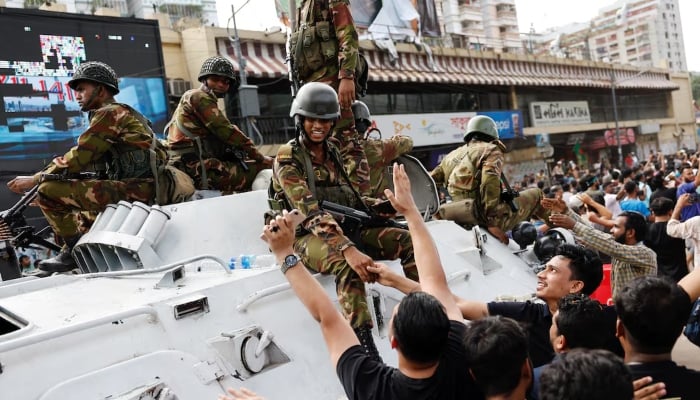
Today, July 1, 2025, marks the one-year anniversary of the student-led protests in Bangladesh that ultimately culminated in the forceful overthrow of Sheikh Hasina’s government. After 15 years of an iron-fisted rule, Sheikh Hasina became the latest leader to be toppled by force since Bangladesh’s independence in 1971.
The Muslim-majority nation, home to approximately 170 million people, now finds itself in a state of political limbo, guided by a caretaker government as it looks towards elections slated for 2026.
Here are five pivotal events that have shaped the South Asian country’s trajectory since the protests began a year ago:
- July 1, 2024: Anti-Government Protests Erupt. University students initiated demonstrations demanding reforms to a public sector job quota system, which they alleged was used to fill civil service positions with Hasina loyalists. The unrest escalated into deadly violence later in July, with police opening fire and clashes intensifying despite a curfew, military deployment, and an internet blackout. The United Nations reported up to 1,400 fatalities during this period of unrest.
- August 5, 2024: Hasina Flees Amidst Uprising. Thousands of protesters stormed Sheikh Hasina’s palace, while millions took to the streets in celebration, with some dancing on armored vehicles and tanks. Hasina fled Dhaka by helicopter to neighboring India, a key ally. Simultaneously, Army Chief General Waker-Uz-Zaman announced the military would form an interim government. Nobel Peace Prize winner Muhammad Yunus returned to Bangladesh at the behest of student protesters to assume leadership as the “chief adviser,” acknowledging a “completely broken down” system of public administration.
- May 24, 2025: Calls for Unity and Reform from Interim Government. The interim government, under Yunus’s leadership, issued a warning that intense political power struggles could jeopardize the progress made. Yunus’s administration called for “broader unity,” cautioning against the risk of “the return of authoritarianism” if comprehensive reforms could not be implemented. The government banned Hasina’s Awami League, pending the outcome of trials for its leaders regarding the deadly crackdown on protesters. The influential Bangladesh Nationalist Party (BNP), considered an election frontrunner, strongly advocated for polls to be held by December 2025, a timeline supported by the military chief. However, Yunus emphasized his commitment to implementing reforms before holding elections and pledged a vote by June 2026.
- June 1, 2025: Sheikh Hasina Faces Trial. Sheikh Hasina was put on trial in absentia, accused of orchestrating a “systematic attack” that constitutes crimes against humanity. The 77-year-old remains in self-imposed exile in India, dismissing the charges as politically motivated. The prosecution of senior figures from Hasina’s government, including the former police chief and ex-interior minister, is a key demand of several political parties vying for power.
- Early 2026: Elections Anticipated. Under considerable pressure from political parties, particularly the BNP, Yunus brought forward his election deadline to early April 2026, indicating he would step down after the polls. The BNP expressed its desire for elections to be held before Ramadan, which commences around February 17, 2026. The interim government suggested that the vote could be moved forward further if “significant” progress is achieved on reforms and the ongoing trials.
Bangladesh, a Muslim-majority nation of approximately 170 million people, is currently navigating a period of political uncertainty under the caretaker government as it strives towards democratic reforms and the eventual holding of general elections.
