

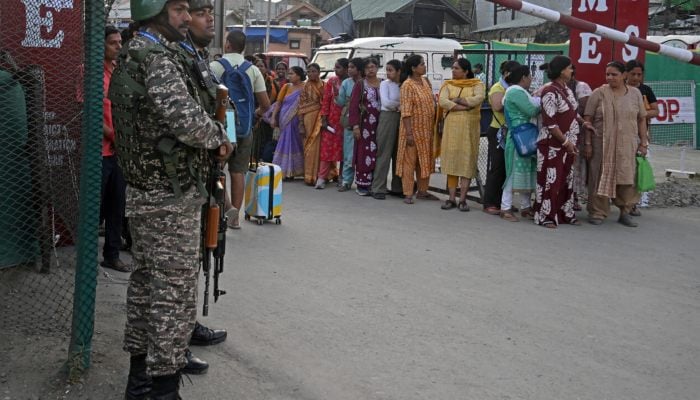
In Indian Illegally Occupied Jammu and Kashmir (IIOJK), a vast month-long Amarnath pilgrimage commenced on Thursday. Many faithful pilgrims began their journey near the very site where a deadly April attack sparked conflict with Pakistan.
Last year, half a million devotees participated in the Amarnath pilgrimage to a sacred ice pillar located within a cave in the forested Himalayan hills above Pahalgam town. Pahalgam was the scene of an incident on April 22 where gunmen killed 26 mostly Hindu tourists.
New Delhi asserted that these gunmen were backed by Pakistan, claims that Islamabad vehemently rejected. This ignited a series of tit-for-tat diplomatic measures that escalated into a four-day conflict. It marked the worst standoff between the nuclear-armed nations since 1999, resulting in over 70 casualties from missile, drone, and artillery fire on both sides before a ceasefire was declared on May 10.
Despite the recent hostilities, pilgrim Muneshwar Das Shashtri, who traveled from Uttar Pradesh state, told AFP that “there is no fear of any kind.” India has significantly ramped up security for the event, deploying 45,000 troops equipped with high-tech surveillance tools to oversee the arduous trek to the high-altitude cave, which is dedicated to the Hindu deity of destruction, Shiva.
“We have multi-layered and in-depth security arrangements so that we can make the pilgrimage safe and smooth for the devotees,” stated VK Birdi, police chief for the Muslim-majority territory.
‘Not Afraid’
At Pahalgam, soldiers have transformed a tented base camp into a fortress, encircled by razor wire. Security personnel stand guard at the top of a mountain ahead of the Hindu pilgrimage, Amarnath, in Chandanwari, IIOJK. — AFP
Troops in newly deployed armored vehicles or from gun positions behind sandbags maintain a close watch, with their efforts boosted by facial recognition cameras. “High-quality surveillance cameras have been installed at all major points along the route,” said Manoj Sinha, the Indian-appointed top administrator for IIOJK.
All pilgrims are required to be registered and must travel in guarded vehicle convoys until they commence their foot journey. Camouflaged bunkers have been erected in the forests along the route, where dozens of makeshift kitchens provide free food. Electronic radio cards pinpoint the exact location of pilgrims.
The trek to the cave, perched at 3,900 meters (12,800 feet) high and approximately 30 kilometers (18 miles) uphill from the last easily motorable track, can take several days. “Whatever the attack that was carried out here, I am not afraid. I have come to get a glimpse of baba (the ice formation),” said Ujwal Yadav, 29, from India’s Uttar Pradesh state, undertaking his first pilgrimage to the shrine. “Such are the security arrangements here that no one can be hurt.”
Sinha has stated that “public confidence is returning,” but acknowledged that pilgrim registration had dipped by 10% this year. Once a modest, little-known ritual attended by only a few thousand mostly local devotees, the pilgrimage has grown significantly since an armed insurgency erupted in 1989. India’s government has since heavily promoted the annual event, which is set to run until August 9.
Freedom fighters opposing India’s control of IIOJK have clarified that the pilgrimage itself is not a target, but have warned they would act if it were used to assert Hindu dominance. In 2017, suspected freedom fighters attacked a pilgrim bus, killing 11 people.
The gunmen responsible for the April 22 killings remain at large, despite an ongoing manhunt by security forces in IIOJK, where India maintains a permanent deployment of half a million soldiers. On June 22, India’s National Investigation Agency announced that two men had been arrested from the Pahalgam area, alleging they had “provided food, shelter and logistical support” to the gunmen.
