

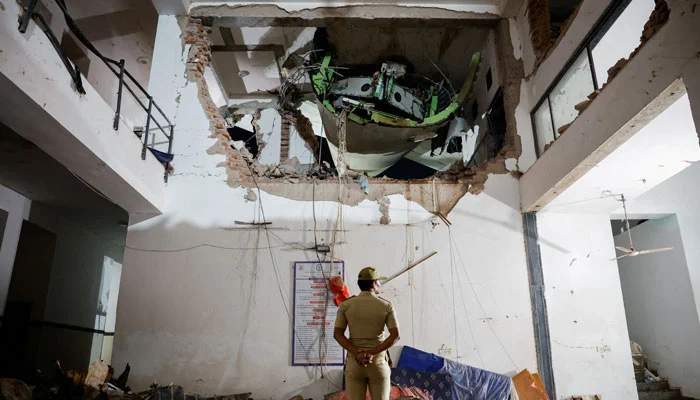
Investigators have successfully downloaded flight recorder data from the Air India Boeing 787 Dreamliner crash that occurred on June 12, killing 260 people. This crucial step, announced by India’s civil aviation ministry on Thursday, brings the investigation closer to understanding the world’s worst aviation disaster in a decade.
The London-bound Dreamliner crashed moments after takeoff from Ahmedabad, India, resulting in the deaths of 241 of the 242 people on board, along with 19 on the ground.
Black Box Recovery and Data Access
The plane’s black boxes – the cockpit voice recorder (CVR) and flight data recorder (FDR) – were recovered swiftly after the accident:
- One was found on the rooftop of a building at the crash site on June 13.
- The other was located in the debris on June 16.
The civil aviation ministry stated that data from the forward recorder was accessed on Wednesday by a team led by India’s Aircraft Accident Investigation Bureau (AAIB), in collaboration with the United States National Transportation Safety Board (NTSB).
“These efforts aim to reconstruct the sequence of events leading to the accident and identify contributing factors to enhance aviation safety and prevent future occurrences,” the ministry said.
International Cooperation and Investigation Focus
NTSB chair Jennifer Homendy expressed hope that the Indian government would swiftly make their findings public for aviation safety and public awareness. She highlighted the “excellent cooperation” between the NTSB team and the Indian government and the AAIB.
The probe into the Air India plane crash, which began losing height after reaching an altitude of 650 feet, is focusing on engine thrust, according to a source with knowledge of the matter. The Wall Street Journal has also reported that investigators believe the Dreamliner’s emergency-power generator was operating when it crashed.
Most air crashes are attributed to multiple factors, and a preliminary report is typically expected about 30 days after the accident.
Recorder Details and Timeline Concerns
Boeing 787 jets are equipped with two GE recorders, one in the front and one at the rear, both recording the same flight data. GE, which manufactured the engines on the Air India 787 and produced the combined flight data and cockpit voice recorder (an “enhanced airborne flight recorder”), has sent experts to India.
The forward recorder has an independent power supply providing 10 minutes of backup power if the plane’s main power source is lost, as per an NTSB report from 2014.
The decision to begin downloading recorder data approximately two weeks after the crash was noted as unusually late by three experts who spoke to Reuters. This delay followed speculation that the black boxes might be sent to the United States for analysis. US aviation safety expert Anthony Brickhouse commented that in such a high-profile crash, investigators would typically have provided an update on the recorders’ status and begun data download sooner, noting that “Normally countries know that the world is watching.”
India had stated last week that the location for the black box analysis was yet to be decided, and has since affirmed that its actions have been taken in full compliance with domestic laws and international obligations in a time-bound manner. The retrieved data is expected to provide critical clues into the aircraft’s performance and cockpit conversations preceding the crash.
