

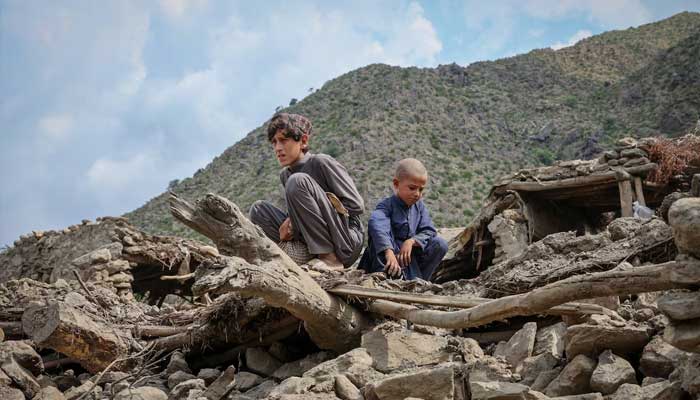
Days after a powerful earthquake in eastern Afghanistan, rescue teams are still struggling to reach survivors, as access to remote areas remains obstructed. A shallow, magnitude-6.0 earthquake hit the mountainous region bordering Pakistan late Sunday, causing mud-brick homes to collapse on families as they slept.
Fearful of the near-constant aftershocks, people are huddling in the open or trying to unearth those trapped under the rubble of flattened buildings. According to the latest toll from Taliban authorities, the earthquake killed at least 1,469 people and injured more than 3,700, making it one of the deadliest in the country in decades. UN refugee chief Filippo Grandi said on X that the quake had “affected more than 500,000 people” in eastern Afghanistan.
The vast majority of the casualties were in Kunar province, with a dozen dead and hundreds hurt in nearby Nangarhar and Laghman provinces. Access remains difficult, as aftershocks have caused rockfalls, hindering passage to already isolated villages and forcing families to stay outdoors for fear that damaged homes will collapse on them.
‘Everyone is Afraid’
“Everyone is afraid and there are many aftershocks,” Awrangzeeb Noori, 35, told AFP from the village of Dara-i-Nur in Nangarhar province. “We spend all day and night in the field without shelter.” The non-governmental group Save the Children said one of its aid teams “had to walk for 20 kilometers (12 miles) to reach villages cut off by rockfalls, carrying medical equipment on their backs with the help of community members.”
The World Health Organization (WHO) said on Wednesday that it was scaling up its emergency response to address the “immense” needs and that it required more resources to “prevent further losses.” The WHO has appealed for $4 million to deliver lifesaving health interventions and expand mobile health services and supply distribution. “Every hour counts,” said Jamshed Tanoli, WHO emergency team lead in Afghanistan, in a statement. “Hospitals are struggling, families are grieving and survivors have lost everything.”
Hamdullah Fitrat, the Taliban government’s deputy spokesman, told AFP that areas that had taken days to reach had finally been accessed. “We cannot determine the date for finishing the operation in all areas as the area is very mountainous and it is very difficult to reach every area.” ActionAid noted that women and girls are particularly vulnerable in emergencies as they face steep restrictions under the Taliban authorities. Residents of Jalalabad, the city nearest to the epicenter, have donated money and goods, including blankets. “I am a simple laborer and I came here to help the earthquake victims because I felt very sad for them,” said resident Mohammad Rahman.
Deepening Crisis
According to the United Nations, around 85% of the Afghan population lives on less than one dollar per day. After decades of conflict, Afghanistan is facing endemic poverty, severe drought, and the influx of millions of Afghans sent back to the country by neighboring nations since the Taliban takeover. The Norwegian Refugee Council cautioned that “forcing Afghans to return will only deepen the crisis.”
This is the third major earthquake since the Taliban authorities took power in 2021, but there are even fewer resources for the cash-strapped government’s response after the United States slashed assistance to the country when President Donald Trump took office in January. Even before the earthquake, the United Nations estimated it had obtained less than a third of the funding required for its countrywide operations.
The Taliban government’s defense ministry said it had organized 155 helicopter flights over two days to evacuate around 2,000 injured people and their relatives to regional hospitals. Fitrat said a camp had been set up in Khas Kunar district to coordinate emergency aid, while two other sites were opened near the epicenter “to oversee the transfer of the injured, the burial of the dead, and the rescue of survivors.”
Afghanistan is frequently hit by earthquakes, with the country still recovering from previous disasters. Western Herat province was devastated in October 2023 by a 6.3-magnitude earthquake, which killed more than 1,500 people and damaged or destroyed over 63,000 homes.
