

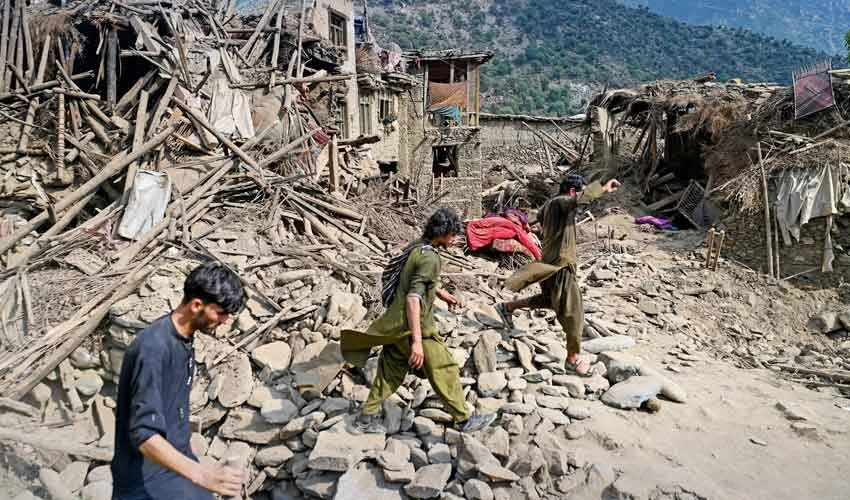
The death toll from Afghanistan’s worst earthquake in years has risen to over 1,400, with thousands more injured. Authorities state that the challenging terrain is significantly hindering rescue efforts in the isolated villages of the country’s mountainous eastern region. According to Taliban administration spokesperson Zabihullah Mujahid, at least 1,411 people have died, 3,124 have been injured, and over 5,400 houses have been destroyed.
The Afghan Red Crescent Society, a humanitarian group working in the region, fears that more people are still trapped under the rubble. The UN coordinator in Afghanistan has also stated that the toll is likely to increase. Afghanistan is prone to deadly earthquakes, especially in the Hindu Kush mountain range, where the Indian and Eurasian tectonic plates converge.
The magnitude 6 earthquake struck around midnight local time on Monday at a shallow depth of 10km (6 miles). The eastern provinces of Kunar and Nangarhar were the worst hit. Ehsanullah Ehsan, the provincial head of disaster management, said that rescue operations were carried out in four severely affected villages in Kunar on Monday, with efforts now focused on reaching more remote mountain areas.
Obstacles to Rescue Operations
“We cannot accurately predict how many bodies might still be trapped under the rubble,” Ehsan said. “Our effort is to complete these operations as soon as possible and to begin distributing aid to the affected families.” The mountainous terrain and severe weather have prevented rescuers from reaching remote areas along the Pakistani border, where the quake flattened hundreds of mud-and-brick homes. Ehsan noted that the main obstacle was vehicle access on narrow mountain roads, and machinery is being brought in to clear the debris.
According to a Reuters witness, on Tuesday, a line of ambulances was on the damaged mountain road trying to reach Kunar villages, as helicopters flew in, delivering aid supplies and transporting the injured to hospitals. Ehsan added that some of the injured have been transferred to hospitals in Kabul and the adjacent province of Nangarhar.
The United Nations Children’s Fund (UNICEF) warned on Tuesday that thousands of children are at risk. UNICEF stated that it is sending medicines, warm clothing, tents, tarpaulins for shelter, and hygiene items such as soap, detergent, towels, sanitary pads, and water buckets.
Taliban soldiers have been deployed to the area to provide help and security. The disaster has further strained the war-torn nation’s Taliban administration, which is already grappling with a sharp drop in foreign aid and the deportation of hundreds of thousands of Afghans by neighboring countries.
Global Aid and Challenges
The rescue and relief work has struggled due to limited resources in the impoverished, war-torn nation of 42 million people and a lack of sufficient global help following the tragedy. So far, Britain has allocated one million pounds ($1.35 million) to support the efforts of the UN and the International Red Cross in delivering critical healthcare and emergency supplies. India has provided 1,000 tents and is moving 15 tonnes of food supplies to Kunar, with more relief materials expected to be sent.
Other nations, including China, the United Arab Emirates, the European Union, Pakistan, and Iran, have pledged assistance, but the aid has yet to arrive. Afghanistan has been hit hard by U.S. President Donald Trump’s decision in January to cut funding to its humanitarian arm USAID and other foreign aid programs. According to diplomats and aid officials, other global crises, along with donor frustration over the Taliban’s policies toward women and restrictions on aid workers, have also contributed to funding cuts.
