

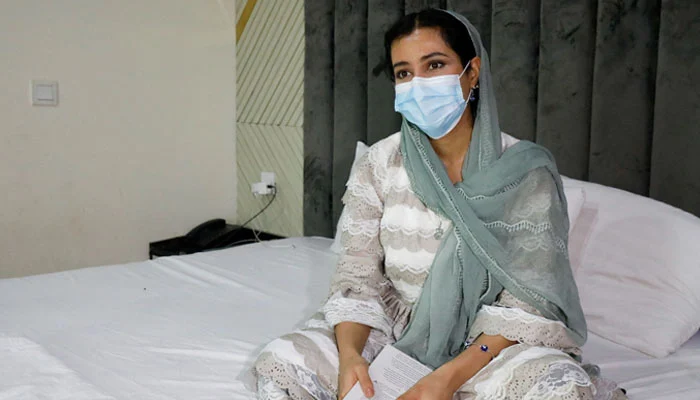
In a confined guesthouse in Pakistan’s federal capital, 25-year-old Kimia, a visual artist and women’s rights advocate, spends her days sketching women – dancing, playing, resisting – in a notebook that now holds the remnants of her hopes. She fled Afghanistan in 2024 after being accepted into a German humanitarian admission program designed for Afghans deemed at risk under the Taliban.
A year later, Kimia finds herself stuck in limbo. Thousands of kilometers away in Germany, a February election dominated by migration debates and a subsequent change of government in May led to the gradual suspension of the program. The new center-right coalition now intends to formally close it. This situation mirrors the plight of nearly 1,660 Afghans cleared for resettlement in the United States, who also found themselves in uncertainty in January after US President Donald Trump took office and suspended refugee programs.
Kimia’s interview at the German embassy, which she hoped would lead to a flight to Germany and the right to reside there, was abruptly cancelled in April. Meanwhile, Germany continues to cover the costs for her room, meals, and medical care in Islamabad. “All my life comes down to this interview,” she told Reuters, requesting to be identified only by her artist name for fear of reprisal. “We just want to find a place that is calm and safe,” she added, referring to herself and the other women at the guesthouse.
The admission program, launched in October 2022, aimed to bring up to 1,000 at-risk Afghans to Germany monthly. These individuals were identified as vulnerable due to their work in human rights, justice, politics, or education, or because of their gender, religion, or sexual orientation. However, fewer than 1,600 arrived in over two years due to various holdups and flight cancellations.
Currently, approximately 2,400 Afghans are awaiting travel to Germany, according to the German foreign ministry, though their prospects remain unclear. NGOs estimate that an additional 17,000 individuals are in the early stages of selection and application under the now dormant scheme. The foreign ministry stated that entry to Germany via the program has been suspended pending a government review, assuring that those already in the program will continue to receive care and housing. It did not respond to Reuters’ inquiries regarding the number of cancelled interviews or the duration of the suspension.
Reuters interviewed eight Afghans residing in Pakistan and Germany, along with migration lawyers and advocacy groups. They described the program’s fate as part of a broader curtailment of Afghan asylum claims in Germany and an assumption that Sunni men, in particular, are not at risk under the Taliban. The German government denies having a specific policy to reduce the number of Afghan migrants. However, approval rates for Afghan asylum applicants dropped to 52% in early 2025, a significant decrease from 74% in 2024, as per the Federal Migration Office (BAMF).
Political Shift and Growing Concerns
Kabul fell to the Taliban in August 2021. Since May 2021, Germany has admitted about 36,500 vulnerable Afghans through various pathways, including former local staff, the government confirmed.
Thorsten Frei, chief of staff to Germany’s New Chancellor Friedrich Merz, stated that humanitarian migration has reached levels that “exceed the integration capacity of society.” He added, “As long as we have irregular and illegal migration to Germany, we simply cannot implement voluntary admission programs.” The interior ministry indicated that programs like the one for Afghans would be phased out, and they are currently reviewing how to implement this.
Several Afghans are now suing the German government over the suspension. Matthias Lehnert, a lawyer representing them, argued that Germany cannot simply suspend their admissions without specific conditions, such as the person no longer being at risk.
Public sentiment in Germany has shifted since former Chancellor Angela Merkel opened the country’s borders to over a million refugees in 2015, partly influenced by several deadly attacks committed by asylum seekers. The far-right Alternative for Germany party (AfD) capitalized on anti-migrant sentiment, achieving a historic second-place finish in February’s election.
Afghans who spoke to Reuters expressed fears of being unfairly associated with the perpetrators of these attacks, potentially endangering their lives if forced to return to Afghanistan. “I’m so sorry about those people who are injured or killed… but it’s not our fault,” Kimia said.
Mohammad Mojib Razayee, a 30-year-old Afghan, flew to Germany from Cyprus in March under a European Union voluntary solidarity mechanism after a year of waiting with 100 other refugees. He stated he was at risk after criticizing the Taliban. Two weeks after seeking asylum in Berlin, his application was rejected. Refugee Mohammad Mojib Rezayee, 29, from Afghanistan speaks during an interview with Reuters in Berlin, Germany on April 23, 2025. — Reuters
He expressed shock at the ruling. A BAMF spokesperson stated that no special protection needs were found in his case. “It’s absurd — but not surprising. The decision-making process is simply about luck, good or bad,” commented Nicolas Chevreux, a legal advisor with the AWO counselling center in Berlin. Chevreux believes Afghan asylum cases have been handled differently since mid-2024, following a mass stabbing at a rally in Mannheim, which injured six people and killed a police officer. An Afghan asylum seeker has been charged and is awaiting trial in that case.
A Future in Doubt
Spending most days in her room, surrounded by English and German textbooks, Kimia asserts that returning to Afghanistan is unthinkable, as her art could make her a target. “If I go back, I can’t follow my dreams — I can’t work, I can’t study. It’s like you just breathe, but you don’t live.”
Under Taliban rule, women are barred from most public life, face harassment from morality police if unaccompanied by a male guardian, and must adhere to strict dress codes, including face coverings. Kimia recounted frantically hiding her artwork when security forces raided homes. The Taliban maintain they respect women’s rights in accordance with their interpretation of Islamic law and local culture, and deny targeting former adversaries.
Hasseina, a 35-year-old journalist and women’s rights activist from Kabul, fled to Pakistan and was accepted into the German program. Divorced and facing threats from both the Taliban and her ex-husband’s family, who she claims have threatened to kill her and abduct her daughter, she insists that returning is not an option.
Marina, 25, fled Afghanistan after being separated from her family. Her mother, a human rights lawyer, managed to reach Germany. Marina has been waiting in Pakistan to join her mother for nearly two years with her baby. “My life is stuck, I want to go to Germany, I want to work, I want to contribute. Here I am feeling so useless,” she expressed.
