

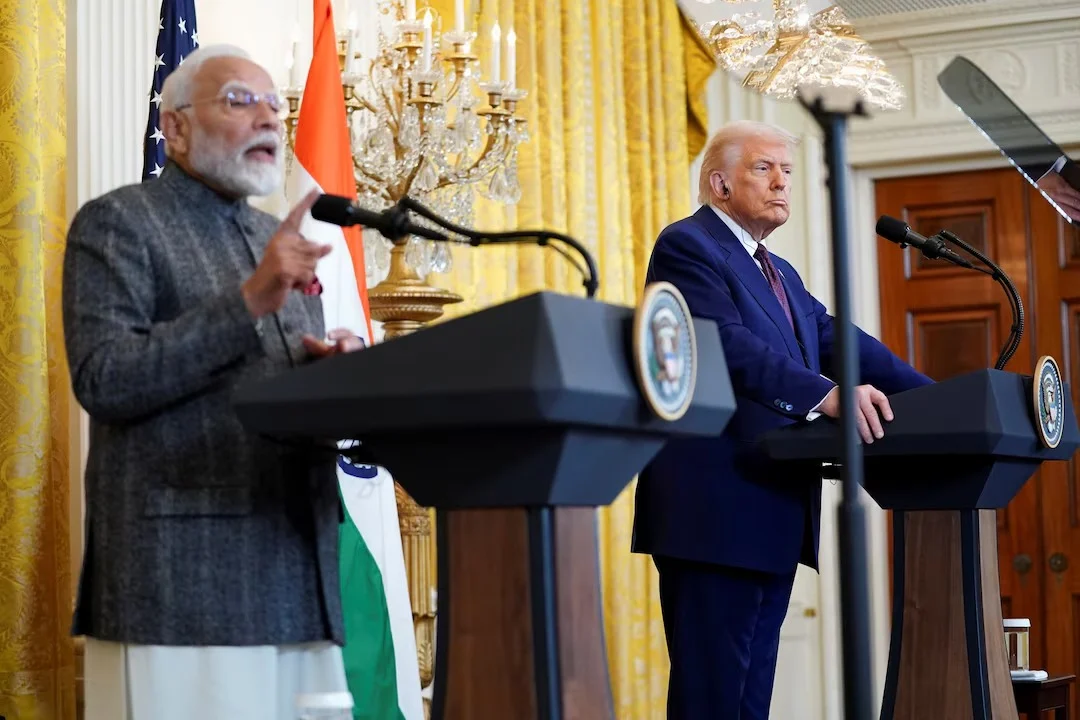
US President Donald Trump’s strong rhetoric and recent actions against India over trade imbalances and its significant purchases of Russian oil are threatening to unravel two decades of diplomatic progress, according to analysts and officials. The growing domestic political pressures in both countries are driving them to take harder positions, potentially derailing other areas of cooperation.
In India, opposition parties and the general public have been pressuring Prime Minister Narendra Modi to take a firm stand against what they perceive as “bullying” by Trump. The US President recently signed an executive order imposing an additional 25% duty on Indian imports, on top of an existing 25% tariff, citing India’s large-scale acquisition of Russian oil.
While India has been a crucial partner for Washington in its strategic competition with China, its trade surplus with the US and close ties with Russia—which Trump is pushing to accept a peace deal with Ukraine—have made it a primary target of the Republican president’s global tariff offensive.
According to two Indian government sources, Trump’s suggestion that India could purchase oil from its arch-rival Pakistan was not well-received in New Delhi. India has also repeatedly rejected Trump’s claims that he used trade as leverage to mediate a recent military conflict between Pakistan and India.
In a notably sharp statement this week, India accused the US of using double standards, pointing out that Washington continues to import Russian uranium hexafluoride, palladium, and fertilizer while singling out India for its oil imports. On Wednesday, India labeled the tariffs “unfair, unjustified and unreasonable” and vowed to “take all actions necessary to protect its national interests.”
However, the sources indicate that New Delhi is aware that any further escalation could harm its interests beyond trade. They noted that unlike China, which has leverage like the supply of rare earth minerals, India lacks the means to force Trump’s hand to improve the terms of a trade deal.
For years, successive US administrations, including Trump’s first, have carefully nurtured relations with India, viewing it as a vital partner in countering China’s growing influence. Analysts, however, believe that Trump’s latest actions have plunged the relationship into possibly its worst phase since the US sanctioned India for its nuclear tests in 1998.
Ashley Tellis, from the Carnegie Endowment for International Peace, stated, “India is now in a trap: because of Trump’s pressure, Modi will reduce India’s oil purchases from Russia, but he cannot publicly admit to doing so for fear of looking like he’s surrendering to Trump’s blackmail.” He warned that “We could be heading into a needless crisis that unravels a quarter century of hard-won gains with India.” Reuters has reported that Indian state refiners have recently begun to decrease their purchases of Russian oil as discounts have narrowed and pressure from the Trump administration has intensified.
Analysts point to another significant challenge: the divergence between India’s priorities and Trump’s political base on issues such as work visas for tech professionals and the offshoring of services. India has long been a major beneficiary of US work visa programs and the outsourcing of software and business services, which is a contentious issue for American workers who have lost jobs.
Evan Feigenbaum, a former senior State Department official, warned that relations with India risk becoming a “football in American domestic politics.” In a LinkedIn post, he highlighted that issues directly affecting India, such as immigration, H1B visas, and offshoring, are among the most “partisan and explosive in Washington.”
Since a 2008 deal on civilian nuclear technology, the two nations have deepened intelligence sharing and defense cooperation, and expanded their collaboration with Australia and Japan through the Quad, a grouping aimed at containing China. However, despite a good rapport between Modi and Trump during his first term, fractures have appeared. The deportation of Indians on military planes with shackled hands and legs in February, just days before Modi’s visit to the US, created public outrage. The relationship was also strained in late 2023 after the US alleged that it had thwarted a plot with Indian connections to assassinate a Sikh separatist leader on American soil, a claim New Delhi has denied.
Sukh Deo Muni, a former Indian diplomat, commented, “The Modi regime’s credibility in the US has gone down,” adding that “maybe there are people who think that India or Modi had to be brought back on track, if not taught a lesson.”
One Indian government source suggested that India needs to gradually repair ties with the US while also strengthening engagement with other nations that have faced similar tariff pressures and aid cuts from the Trump administration, including the African Union and the BRICS bloc.
India has already begun making moves to strengthen its relationships with Russia and China. Russian President Vladimir Putin is expected to visit New Delhi this year, and Russia recently announced that the two countries had discussed enhancing their “particularly privileged strategic partnership” in defense cooperation. India has also increased its engagement with China following years of tension after a deadly border clash in 2020, with Modi planning his first visit to China since 2018.
Aleksei Zakharov, an analyst at the Observer Research Foundation in New Delhi, predicted that “Russia will attempt to exploit the rift between the US and India by proposing the restoration of the Russia-India-China trilateral and new projects in defence.” He added that India will be “mindful of structural factors such as sanctions against Russia and will seek to find a compromise with the Trump administration.”
