

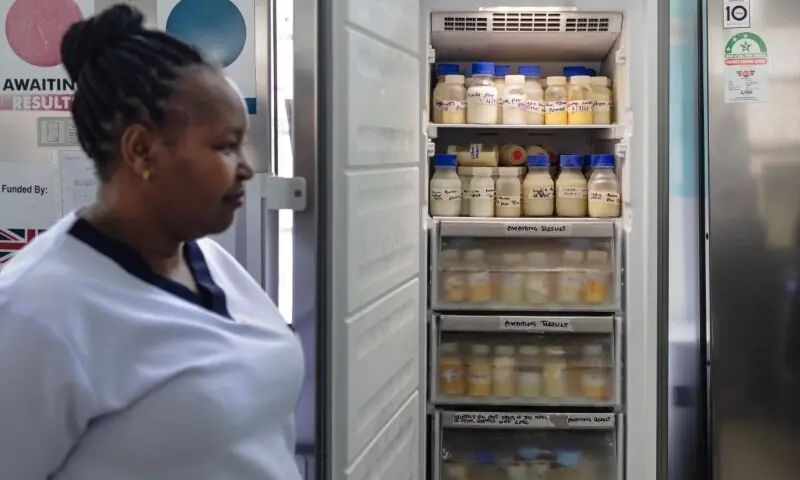
The breastmilk bank at Pumwani Maternity Hospital is one of the very few across sub-Saharan Africa. It is especially helpful for premature babies, of which roughly 134,000 are born each year in Kenya.
Mothers who give birth prematurely are often unable to produce breastmilk and must rely on formula, which can be less nutritious and increases the risk of infection, especially since water is often contaminated. Established in 2019 with the support of British aid money and the NGO PATH, the milk bank in Nairobi allows babies like Grace-Ella to benefit from the generosity of others.
“It was super-exciting,” said Grace-Ella’s mother, 28-year-old Margaret Adhiambo. She added that she had not heard of the program before she delivered prematurely at 30 weeks. “Before I accepted, I was a bit skeptical because it gave me some feeling of guilt like I could not give my daughter my own breastmilk.” But she added, “It helped me because my daughter didn’t starve, at least she got some food.”
Medical Benefits and Growing Demand
Underweight babies face a daunting array of risks, and breastmilk can literally tip the scales in their favor. “When we feed them human milk, we find they are growing faster compared to a baby who is getting formula,” said Muthoni Ogola, the doctor who heads the program.
However, the World Health Organization (WHO) says fewer than half of all infants worldwide are exclusively breastfed. A key advantage of breastmilk is the antibodies passed to the infant, said Pumwani nurse Hannah Wangeci Maina.
She works with the efficiency needed for a maternity ward that cares for at least 90 mothers and babies at a time. “We usually have many mothers lining up to receive the expressed breastmilk,” she said.
