

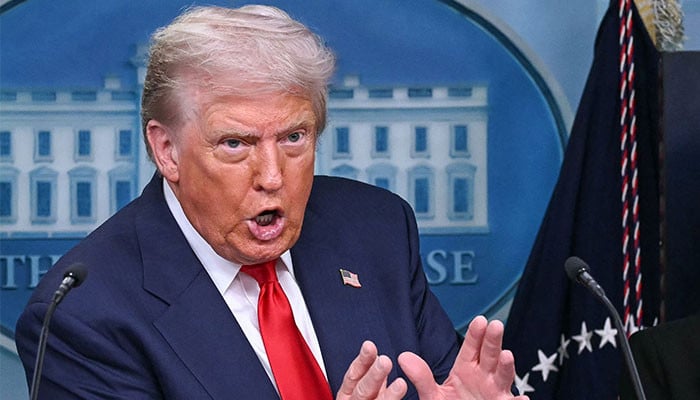
The United States and Iran are reportedly on the cusp of a groundbreaking agreement, with US President Donald Trump revealing the key conditions for a potential deal. In an interview with an American newspaper, Trump stated that the US negotiating team, led by Vice President Mike Pence and including Special Representative Steve Wietkoff, has departed for Islamabad and will arrive in a few hours. Trump emphasized that the primary objective of the negotiations is to ensure that Iran completely dismantles its nuclear program, saying that this is a non-negotiable condition.
Trump also reiterated that the US will not extend the current ceasefire, which expires on Tuesday, and will resume military operations if Iran fails to reach a deal. He claimed that the negotiations are not a game, but rather a serious effort to reach a comprehensive agreement with Iran. Trump expressed his willingness to meet with the Iranian leadership if the negotiations yield a breakthrough, saying that he has no issues with meeting with the Iranian leadership if they are willing to engage in serious talks.
Meanwhile, Iranian officials have expressed skepticism about the US proposal, with Foreign Ministry Spokesman Saeed Khatibzadeh stating that the US has not shown a genuine commitment to peace. Khatibzadeh accused the US of violating the ceasefire agreement by attacking and seizing an Iranian oil tanker, and said that Iran will respond to the US proposals in due course.
In a separate development, Pakistan’s Foreign Minister Shah Mehmood Qureshi held separate meetings with US Ambassador to Pakistan Donald Blome and Iranian Ambassador to Pakistan Seyed Mohammad Ali Hosseini, discussing the arrangements for the next round of talks. Qureshi expressed his country’s commitment to playing a constructive role in the talks, saying that Pakistan wants to see a peaceful resolution to the conflict.
As the situation remains tense, Pakistan has imposed security restrictions in Islamabad and Rawalpindi, with a red zone declared in Islamabad and alternative traffic plans put in place. The US has also taken measures to boost security, with a heavy presence of troops and police in key areas.
The US and Iran have been engaged in a standoff over Iran’s nuclear program, with the US imposing sanctions and Iran retaliating with missile attacks. The conflict has had far-reaching consequences, including a spike in oil prices and a deterioration in relations between the US and its allies in the region.
As the situation remains fluid, international leaders are calling for restraint and a peaceful resolution to the conflict. In a statement, Qatari Foreign Ministry spokesperson said that the Gulf countries are in constant contact with all parties involved in the conflict, adding that this is a regional crisis that requires regional solutions.
The US has also taken steps to boost security, with a heavy presence of troops and police in key areas. The situation remains tense, but diplomats are working behind the scenes to find a peaceful resolution to the conflict.
