

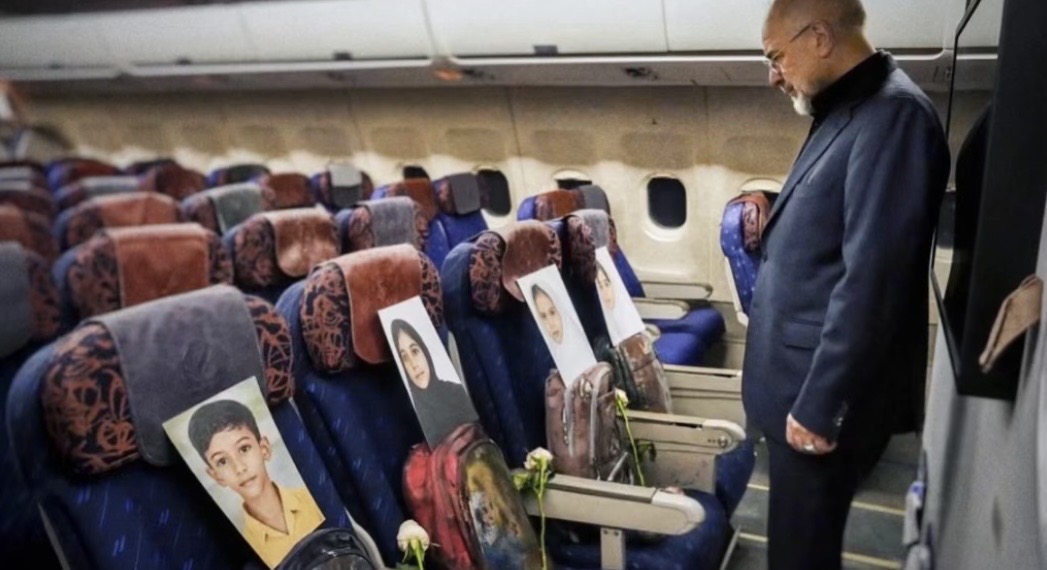
The Schoolbags on Empty Seats
An Iranian Delegation Arrives in Islamabad Carrying the Memory of Children
By Raja Zahid Akhtar Khanzada
I want to ask you something before we begin. Not as a journalist. As a human being who has watched, for too many years, the machinery of power grind the innocent into footnotes.
When you hear the word “diplomacy,” what do you see?
I suspect you see men in suits. Conference rooms. Handshakes performed for cameras. Language so carefully constructed that it communicates nothing while appearing to communicate everything.
What you do not see — what we have trained ourselves not to see — are the schoolbags.
Iran’s senior delegation arrived in Islamabad this week. Abbas Araghchi and his colleagues. On paper, a diplomatic mission. In the newspapers, another round of negotiations over sanctions, frozen assets, the familiar choreography of nations performing the ritual of talking without quite deciding to stop killing.
But on the aircraft that carried this delegation, something was placed on the empty seats.
Schoolbags. And photographs of girls.
The bags belonged to children — Iranian children — killed in the opening strikes of the American and Israeli assault on Iran. Reports place that number at approximately 165 children. One hundred and sixty-five.
I need you to stay with that number. Do not let it pass through you like a statistic. Each one of those children woke up on the last morning of their life. Someone braided their hair, or argued with them about breakfast, or called after them as they walked out the door. They carried those bags to school, or perhaps they were on their way. And then — in the particular, businesslike manner of modern warfare, which we have agreed to call “precision” — they were gone.
The bags remained.
Iran named this diplomatic mission in their memory. There are those who will call this political theater. Perhaps it is. But I have lived long enough to know that the line between theater and truth is thinner than the powerful would like us to believe. When a nation carries its dead children onto a diplomatic aircraft, it is not performing grief. It is refusing to allow the world to look away.
The delegation arrived in two separate aircraft.
Think about what that means. Not the logistics — the meaning. A nation so accustomed to the possibility of betrayal, so schooled by experience in the particular treachery of those who offer peace with one hand and reach for a weapon with the other, that its leaders cannot trust a single aircraft. They have watched America extend the hand of negotiation before. They remember what happened to Qasem Soleimani — not a man you are required to mourn, but a symbol of something you are required to understand: that trust, once destroyed in this particular way, does not reassemble itself through good intentions.
This is what living under the permanent threat of American power does to a people. It does not make them weaker. It makes them careful in ways that break your heart, if you allow it to.
At Islamabad’s airport, the delegation was received by Ishaq Dar and Asim Munir. Civilian and military, standing together in the particular configuration that Pakistanis understand immediately and the rest of the world pretends not to notice. A diplomat and a general. A conversation about peace, flanked by the reminder of where real decisions are made.
Pakistan has positioned itself as a bridge. This is a noble ambition and a dangerous one. Bridges bear weight from both directions, and they are the first things destroyed when patience runs out.
America, at this moment, presents a curious spectacle. Donald Trump speaks with his customary severity, the bluster of a man who has confused volume with authority for so long that he can no longer hear the difference. But beneath the noise, anyone paying attention can detect something else: exhaustion. The American public is tired of a war they did not choose, conducted at a cost — human and economic — they were not consulted about. Inflation does not negotiate. Grocery bills do not honor military strategy. And ordinary Americans, whatever their politics, share the ancient and bipartisan desire to not bury their children in foreign causes.
This is the only leverage that matters. Not diplomacy. Not international law, which has demonstrated, with crushing consistency, its willingness to look the other way when the powerful do the killing. What matters is that America, for reasons entirely domestic and unglamorous, may find itself needing an exit from this particular theater of violence.
That is not peace. But it is an opening. And in the world as it actually exists, openings are what we have.
Iran’s conditions are clear: end the strikes on Lebanon, lift the sanctions, return the frozen assets. These are not the demands of a defeated nation. They are the terms of a people who have decided that if they are going to be bombed either way, they may as well negotiate standing up.
And still, hovering over all of this, is the shadow that haunts every moment when peace becomes genuinely possible: the false flag. The sudden incident. The mysterious provocation that materializes precisely when it is most convenient for those who profit from the continuation of war. History is not subtle on this point. The moments when negotiation comes closest to succeeding are often the moments of greatest danger. Israel’s ongoing operations in Lebanon are a reminder that not every actor at this table wants the table to survive.
I have spent my life watching what happens when the world decides that certain children do not count. I have watched the accounting — the elaborate, sophisticated, institutional accounting by which some deaths are tragedies and others are, at most, regrettable. I have watched the language shift and blur and soften until the boy who was alive yesterday becomes “collateral damage” today, filed under the appropriate heading, mourned in the appropriate manner, and then forgotten in the particular way that power requires the dead to be forgotten.
I am tired of that accounting.
Pakistan is tired. The Muslim world is tired. And increasingly — in the streets of American cities, in the private conversations of American families who did not vote for any of this — America is tired.
The schoolbags are on the seats of that aircraft.
The girls in the photographs have names that most readers of this column will never know. They had futures that no one will be able to fully imagine, because imagination requires a living subject, and these children are gone.
But the bags are there. Someone put them there deliberately, as an act of witness, as a refusal to allow the arithmetic of geopolitics to erase what it has cost.
I want to ask the men who will sit across the negotiating table from one another in Islamabad and the men who will not be in that room but whose decisions will determine what happens in it whether they are capable of being moved by this.
Not strategically moved. Not tactically moved. Moved. In the old-fashioned, human sense of the word.
Because here is what I know, after all these years of watching the world arrange and rearrange itself around the same ancient cruelties:
When negotiations are conducted in the names of children, the world loses its moral license to continue the war. There is no argument not security, not sovereignty, not national interest, not the elaborate architecture of deterrence theory that can survive the image of a schoolbag on an empty seat.
The question the only question is whether we have the courage to let that image do what it is supposed to do.
Whether we will, this time, allow ourselves to be human.
Or whether history will record, once again, that we looked at the faces of the innocent and chose to look away
and called it, as we always do, necessity.
