Islamabad Accord: A Quiet Pause or the Prologue to a Storm?
By: Raja Zahid Akhtar Khanzada
President Donald Trump said two things yesterday, in the same breath, without apparent contradiction. He said negotiations with Iran were going well. He said that if the Strait of Hormuz was not reopened, Iran’s energy infrastructure and bridges would be destroyed. Nobody in the room seemed surprised. Perhaps because we have entered an age where contradiction is no longer a flaw of power, but its language.
On April 7, Iran and the United States announced a two-week ceasefire. The world exhaled. Stock markets climbed. Headlines declared it a victory. But history suggests that wars are often most dangerous at the moment they are believed to be over. This ceasefire is not peace. It is an intermission. A held breath. And on April 22, that breath may be released as a scream.
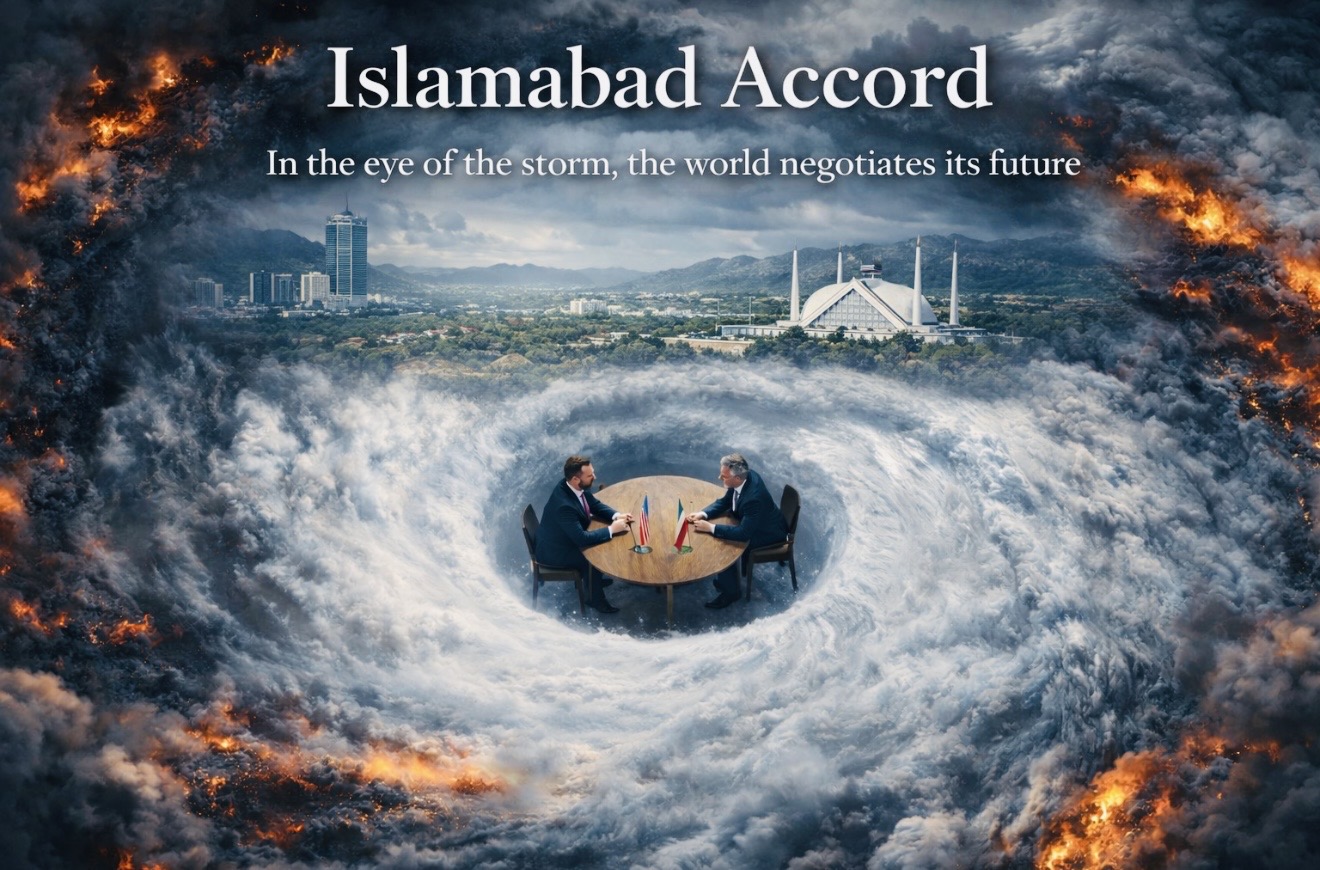
Today, in Islamabad’s Serena Hotel, a meeting is unfolding that may become the highest-level dialogue between Washington and Tehran since the Iranian Revolution of 1979. The American delegation is led by Vice President J.D. Vance, joined by special envoy Steve Witkoff and Jared Kushner, the president’s son-in-law. Iran has sent Parliament Speaker Mohammad Bagher Ghalibaf and Foreign Minister Abbas Araghchi. Pakistan — this unlikely stage upon which the fate of nations is being negotiated — is represented by Prime Minister Shehbaz Sharif, Army Chief General Asim Munir, Foreign Minister Ishaq Dar, and National Security Adviser Asim Malik. The weight of these names is real. But names on a list have never, by themselves, made peace. That requires something rarer. It requires honesty about what the war was actually for.
The negotiations have not yet truly begun, and already the foundation is cracking. Ghalibaf has declared that three clauses of the ten-point framework underpinning these talks have already been violated. Israeli strikes on Lebanon have killed hundreds and wounded thousands. Washington insists Lebanon was never part of the ceasefire. Tehran insists this is the first and most fundamental betrayal. Both cannot be right. Perhaps neither is entirely wrong. What is certain is that the table has been set in bad faith, and everyone seated at it knows it.
Behind that fracture stands the nuclear question — the original wound that no one has yet had the courage to treat honestly. Nearly nine hundred strikes later, Iran’s nuclear program remains. The United States and Israel demand its complete dismantlement. Iran has refused. The cause of the war still breathes — quietly, beneath the language of diplomacy — and a wound left untreated does not heal. It festers.
At the strategic heart of this conflict lies the Strait of Hormuz. One fifth of the world’s oil passes through this narrow corridor of water. When Iran moved to restrict access, oil surged past one hundred dollars a barrel. Markets trembled across every continent. The consequences did not stay in the Middle East — they arrived in the price of bread, of fuel, of the ordinary things that ordinary people need to survive. Iran granted passage only to vessels from China, Russia, India, Iraq, and Pakistan. A political map drawn without a single bullet fired. Allies move freely. Adversaries wait, stranded, in open water.
Trump has since accused Iran of charging tolls on tankers crossing Hormuz and demanded an immediate halt. Iran has made clear that control of the waterway now rests in its hands, to be granted or withheld as leverage demands. Hundreds of ships remain stranded. The global flow of energy hangs in a state of managed uncertainty — managed, that is, by Tehran.
After the death of Ali Khamenei, his son Mojtaba has assumed power. Those who hoped the transition might bring a softer hand have been disabused of that hope. His early signals have been clear: hold the strait, end cooperation with international nuclear oversight. Iran has paid a heavy price in this war — nuclear capacity diminished, commanders lost, infrastructure struck. But it has kept the regime intact, preserved its sovereignty, and dealt a serious blow to the architecture of global scrutiny that was designed to constrain it. In the accounting of nations, that may yet prove to be a strange kind of victory.
The United States, meanwhile, is fighting a war it cannot easily define and may not be able to afford. Its national debt has surpassed thirty-six trillion dollars. Every missile fired is financed by borrowed money — borrowed from a future that grows more uncertain with each strike. The Pentagon has requested an additional two hundred billion dollars in defense funding. At an estimated two billion dollars per day of sustained conflict, that figure suggests preparation not for a brief engagement but for a war measured in seasons. If peace were genuinely within reach, such preparation would be unnecessary. Europe, for its part, has discovered in this crisis how little it controls. Dependent on Middle Eastern energy, its policies have been reactive at every turn — responding to events, never shaping them.
And then there is China.
China has not fired a single shot. It has not deployed a single soldier. Yet it may be, when the history of this moment is written, the most consequential actor of all. According to the New York Times, Beijing played a quiet but critical role in persuading Iran to accept Pakistan’s ceasefire proposal. At the United Nations, when a resolution on protecting navigation through the Strait of Hormuz came to a vote — supported by Bahrain, Saudi Arabia, Qatar, the UAE, and Kuwait, backed by eleven of fifteen council members — China and Russia cast their vetoes. Pakistan abstained. China’s representative argued the resolution failed to capture the “full picture.” What that full picture contains, China did not fully say. But its outline is visible enough.
China is purchasing Iranian oil at discounted rates. It has secured safe passage for its vessels through the very strait it refuses to help reopen for others. Together with Pakistan, it has advanced a five-point peace proposal — positioning itself simultaneously as mediator and beneficiary. This is not inconsistency. This is strategy of a very high order. If the United States prevails, it emerges economically drained, which creates space for China. If it falters, the petrodollar system weakens and the door opens wider for the petro-yuan. Through Belt and Road, BRICS, and the Shanghai Cooperation Organization, China is quietly and methodically assembling the scaffolding of an alternative world order — not through confrontation, but through patience and positioning.
When Athens and Sparta bled each other dry, Macedon grew strong in the silence. When Britain and Germany exhausted each other in the First World War, America rose. History does not always reward the fighter. Sometimes it rewards the one who watches, and waits, and prepares.
Pakistan stands at a crossing point that is both an opportunity and a trap. Its role as mediator rests on something genuine — relationships with Washington, with Tehran, with the Gulf states, maintained over decades of difficult navigation. But this position carries within it the seeds of real danger. A defense alignment with Saudi Arabia. A population of twenty million Shia citizens whose loyalties this war touches deeply. Growing unrest in Balochistan, where Israeli strikes near Iran’s eastern frontier are already stoking instability. An economy too fragile for the shocks that would follow a collapse of these talks. Pakistan is not merely hosting a negotiation. It is standing at the edge of a geopolitical vortex, and one wrong step may leave it in a position from which it cannot easily return.
And beneath all of this — beneath the strategy and the markets and the careful diplomatic language — there is a cost that does not appear in any briefing. In Lebanon, thousands have been killed. Millions have been displaced. Entire generations are growing up in the ruins of a war they did not choose and cannot escape. The rising cost of energy will carry the weight of this conflict into homes far from any battlefield — in Africa, in Asia, in places that have no stake in this fight and no voice in how it ends.
Even those who deal in probabilities rather than principles sense what is coming. On platforms like Polymarket, more than three hundred million dollars have been wagered on the outcome of this war. The probability of a comprehensive peace deal is estimated at between twenty and forty percent. The likelihood of the ceasefire breaking down ranges from thirty to fifty percent. Those who risk real money do not believe in the peace that the diplomats are describing. They are betting, with considerable conviction, on the storm.
Three paths lie ahead. The first is that diplomacy succeeds — that something genuine emerges from Islamabad, that trust is somehow built from the rubble of mutual betrayal. The odds are not favorable. The second is that the conflict continues in its present form: limited, persistent, conducted through proxies and drones and regional flare-ups that never quite become catastrophe but never quite allow for normal life either. This is the most likely path. The third — and the one that should frighten us most — is that a single miscalculation, a single strike, a single moment of poor judgment shatters the fragile balance and sets something far larger in motion. Wars have started for less.
In Islamabad, the streets are being cleaned and the pavements freshly painted. The Serena Hotel has been cleared and secured. The world’s most powerful figures are preparing to sit across from one another in a room that history may or may not remember. But something needs to be said plainly, because plainness is what this moment requires.
A bandage placed over an untreated wound does not produce healing. It produces the appearance of healing, which is a different and more dangerous thing. The wound here — the nuclear question, the Hormuz question, the question of what Iran is permitted to be in the order of nations — has not been treated. It has been covered. And history is full of coverings that eventually gave way.
We are entering an era in which wars are no longer brief and decisive but prolonged, complex, and deliberately ambiguous — in which victory is no longer defined by the defeat of the enemy but by the survival of oneself. In which the greatest strategic triumph belongs not to the nation that fights hardest, but to the one that fights least and gains most. China understands this. The question is whether anyone else is paying close enough attention.
This ceasefire is a pause. Both sides are using it to breathe, to reposition, to prepare for what follows. There is no complete victor here. No complete loser. Only a world in motion, with the balance of power quietly shifting beneath the noise of negotiation and the language of peace.
The question is not how long this ceasefire will hold.
The question is — when it breaks, what kind of world will we find ourselves living in?