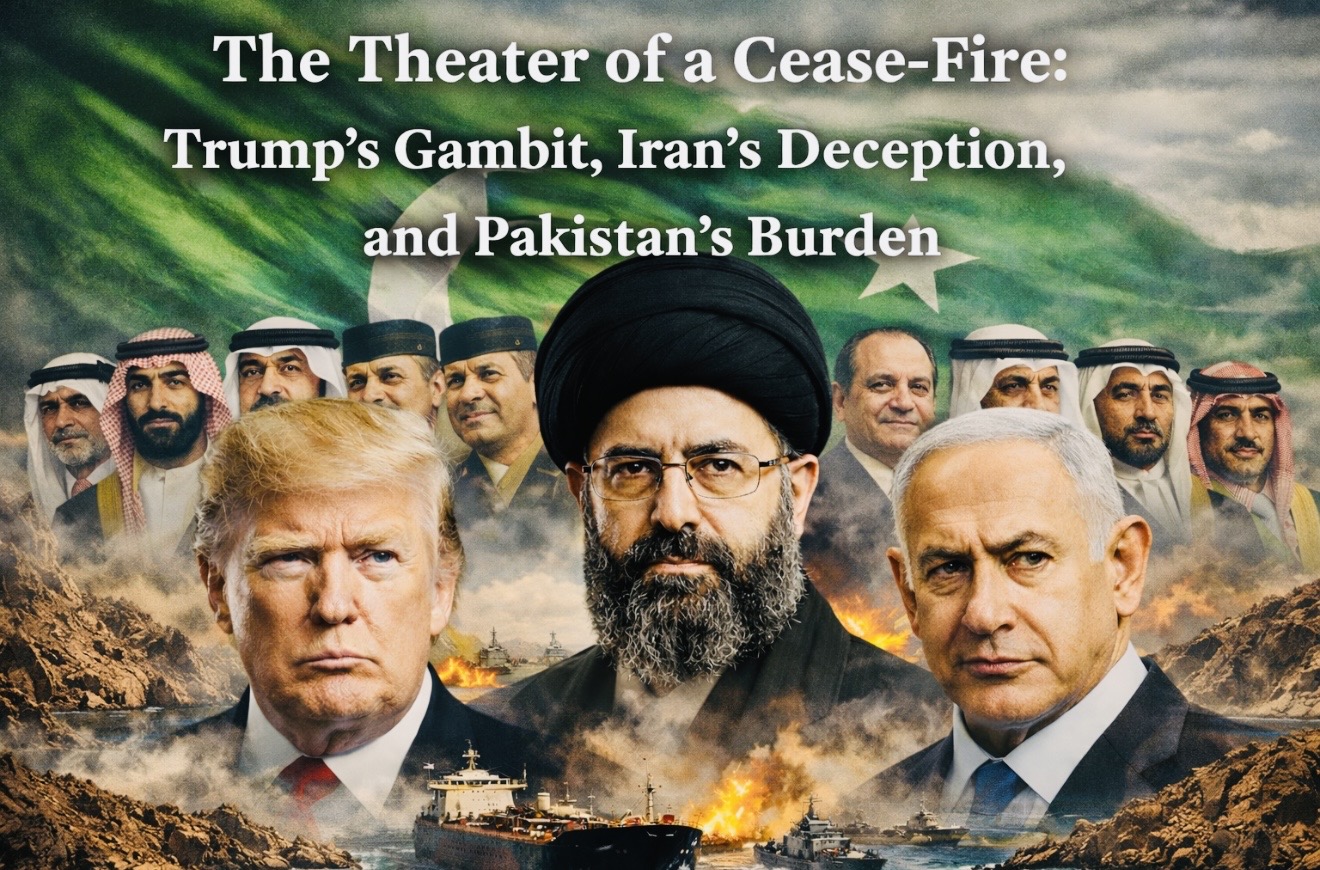
The Theater of a Cease-Fire: Trump’s Gambit, Iran’s Deception, and Pakistan’s Burden
By: Raja Zahid Akhtar Khanzada
Twenty-eight hours before the world exhaled, it held its breath in the particular way that people do when they sense that something enormous and irreversible is being decided without them.
Donald Trump had written a sentence. Not policy, not diplomacy — a sentence, the kind that arrives like a verdict. A civilization, he warned, could be erased before morning, lost to the long record of human memory without so much as a footnote. The words did not read like a presidential statement. They read like the declaration of a man who had confused the machinery of government with the will of God. And the world, accustomed now to this particular confusion, did not know whether to laugh or to begin counting its dead.
Forty-eight hours later, the smoke did not clear to reveal ruin. It cleared to reveal something more familiar, and in its familiarity, more disturbing: a performance.
Trump celebrated. Israel bombed Beirut. A hundred warships sat motionless in the Strait of Hormuz, neither advancing nor retreating, as though the sea itself had grown uncertain of its purpose. And Pakistan — Pakistan stood where it so often stands, at the edge of someone else’s catastrophe, handed a role in a drama whose script it had not been permitted to read in full.
The question worth asking is not whether a cease-fire occurred. Cease-fires, like confessions, can be extracted under conditions that render them meaningless the moment the pressure is removed. The question worth sitting with, the one that does not resolve itself with a press release or a social media post, is this: in a room full of men declaring victory, who paid the price for the performance?
There is a thing that power does, and it has always done it, and we have always permitted it, and we tell ourselves each time that this time will be different. Power inflates the stakes until the air itself seems to tremble. It issues ultimatums in the language of finality. It makes the alternative — resistance, refusal, the ordinary assertion of dignity — appear not merely dangerous but suicidal. And then, when the other party has been sufficiently frightened, it offers a door and calls the door a gift.
Trump’s forty-eight-hour ultimatum was precisely this. Open the Strait of Hormuz, he commanded, or face the kind of destruction that does not leave ruins — only silence. It sounded like the voice of history. It was, in fact, the voice of a man who understood something that his audience was not meant to understand: that he could not afford the war he was threatening.
Oil markets had already begun to unravel. The Strait, through which a fifth of the world’s energy moves each day, was not simply a waterway — it was a nerve, and its severance would send pain through every economy connected to it, including his own. Iran’s allies were not hypothetical. They were already fighting. And Iran’s nuclear material — this is the fact that no amount of rhetoric can dissolve — made the prospect of total war not a clean military calculation but an invitation to a catastrophe without edges.
What Trump issued was not an ultimatum. It was a wager. He bet that Iran, faced with the theater of annihilation, would flinch before he had to act. He was right. But being right about someone’s fear does not make you honest about your intentions.
Diplomacy, in its most cynical form, requires a face that is not your own — someone who can stand before the world and announce a peace without the world asking too precisely what was actually agreed.
For this purpose, Pakistan was chosen.
There is something one must understand about this choice, and it requires a certain willingness to see clearly rather than comfortably. Pakistan was not chosen because of its wisdom, or its geographic proximity to the conflict, or even its longstanding relationship with Iran. Pakistan was chosen because it needed something. And in the arithmetic of geopolitics, need is not a quality. It is a vulnerability. It is the thing that powerful nations locate in smaller ones and then — with the smooth confidence of those who have always done this — use.
Prime Minister Shehbaz Sharif announced the cease-fire with the solemnity of a man who believed he was making history. Perhaps he was. But the history he was making had been outlined by someone else. When he declared that Lebanon was included in the terms — included, he said, explicitly — Israel rejected the claim within hours, and Trump clarified, with the casual brevity of a man correcting a minor misunderstanding, that Lebanon was never part of the agreement.
This is not a small discrepancy. This is the kind of gap that reveals everything about the nature of an arrangement. Either Pakistan was not told the full terms of the agreement it was asked to announce to the world — which is a humiliation dressed as an honor — or it was told, and chose to present a more generous version to its domestic and international audience. Neither possibility reflects the posture of a sovereign actor shaping events. Both reflect the posture of a nation that has learned, through long practice, to make the best of a position it did not choose.
The “Islamabad Talks,” announced for April tenth, placed Pakistan on a stage that glittered with apparent significance. But stages are built by those who control the lights. And the lights, in this arrangement, were controlled elsewhere.
Iran’s own reckoning with what happened carries the particular grief of a nation that has learned, repeatedly, that the agreements it signs are not always the agreements it thought it was signing.
Tehran released a ten-point framework — control of the Strait, the right to enrich uranium, the withdrawal of American forces, the lifting of sanctions, compensation, a comprehensive cease-fire. These were not modest demands. They were the demands of a nation that believed it had negotiated from a position of genuine leverage.
The White House called them, with the contemptuous brevity that Washington reserves for the proposals of those it has already decided to disregard, garbage.
What appears to have happened, in the hours before the deadline expired, is that Iran offered a revised and reduced proposal. Trump accepted it as a basis for negotiation — not as an agreement, not as a resolution, but as a starting point that kept his options open while allowing him to claim, before the morning markets opened, that the crisis had been resolved.
The terms of this revised arrangement were not made clear to Iran. They were not made clear to Pakistan. They were not made clear to the world. Trump himself acknowledged, in the tone of a man who considers transparency a tactical error, that only one set of acceptable points existed, and that these would be determined behind closed doors.
Closed rooms. One must linger on this phrase, because it carries within it the entire history of how powerful nations manage smaller ones. It is in closed rooms that the Doha accord was shaped, and from which the Afghan people emerged to find that the future they had been promised bore no resemblance to the one that arrived. It is in closed rooms that the 2015 nuclear agreement was constructed — and in which, three years later, it was quietly dismantled by the same country that had signed it. It is in closed rooms that assurances are given that will not be kept, and that commitments are made that were never intended to bind.
Iran’s parliament accused Washington of immediate violations: continued bombardment in Lebanon, incursions into Iranian airspace, the denial of enrichment rights. Its foreign minister wrote, with the quiet desperation of a man appealing to an audience he cannot quite locate, that the world was watching.
But the world was watching something else. The world was watching Beirut.
More than five hundred targets struck. More than two hundred and fifty dead. The Lebanese government asked the displaced to stay where they were — wherever they had found shelter, however precarious, it was safer than the roads home. In Sidon, a car caught fire on the seafront. In Tyre, explosions arrived without warning. In the southern suburbs of Beirut, people who had packed their belongings upon hearing news of a cease-fire found themselves caught on highways between hope and ordinance.
Among them was a woman who had been sheltering near the Corniche for six weeks, who had stayed up through the night, who had heard the news and allowed herself, in the way that people who have been afraid for a very long time finally allow themselves, to feel something like relief.
She thought she would go home.
Then the bombs returned.
This woman is not a symbol. She is a person. But her experience contains a truth about power that the press conferences and the social media posts and the triumphant declarations do not contain: that the distance between an announcement of peace and the experience of peace is, for those who live inside the conflict rather than above it, the distance between language and life.
To understand what Trump accomplished, one must resist the temptation to read him as a statesman, because he has never claimed to be one. He is, by his own account and by the evidence of his career, a negotiator. And the logic of negotiation, unlike the logic of governance, does not concern itself with truth. It concerns itself with outcome.
A negotiator inflates the threat. He raises the price of refusal until refusal seems unthinkable. He maneuvers the other party into a position where the only available exit is the one he is offering. And then, when the deal is done — whatever the deal actually contains — he declares it a triumph, because declaration is itself a form of reality in the world he inhabits.
Trump raised the stakes to civilizational extinction. He disturbed the sleep of markets. He drew a rebuke from Pope Leo XIV, who called his language genuinely unacceptable — and who was, in this, speaking for the conscience of those who retain one. He produced, in the space of forty-eight hours, the global sensation of a crisis narrowly averted.
And then he accepted terms he has not fully disclosed, declared it a great day for peace, and watched the markets rise.
Oil prices fell. Applause followed.
But Beirut continued to burn. The Strait remained, in practice if not in declaration, constrained. Iran’s nuclear material remained beneath its soil, untouched by the rhetoric that had swirled above it. And the question that persists — the one that no declaration resolves — is what, precisely, was agreed, and whether whoever agreed to it intends to honor it.
One is compelled, at this point, to ask the question that discomforts those who prefer their geopolitics clean: who will believe the next agreement?
This is not a cynical question. It is an earnest one, and it deserves an earnest answer. We have seen what American commitments look like across time. Iran signed a nuclear agreement in 2015 and watched it abandoned three years later by the same government that had championed it. Afghanistan endured the architecture of the Doha accord and emerged to find that the future it described had no relationship to the future that arrived. Iraq absorbed sixteen years of promises and returned them as rubble and grief.
Each of these betrayals was announced with the language of necessity. Each was explained, to those who required explanation, as a response to circumstances that the original agreement had failed to anticipate. And each left behind populations whose lives had been organized around commitments that turned out to be, in the end, contingent.
This is the inheritance that the current cease-fire enters. It arrives already burdened by the weight of what came before it, and it asks us — Iran, Pakistan, Lebanon, the watching world — to believe that this time the closed rooms will produce something that resembles what was promised in public.
Perhaps they will. History is not entirely without its surprises.
But one is permitted, given the record, to wonder.
Pakistan deserves a reckoning of its own, not because it acted dishonorably, but because the honor it was offered was, at bottom, borrowed. Islamabad built a bridge, facilitated a conversation, stood before the world as the face of a resolution. And for this service, it received: no movement on Kashmir, no relief from the international financial pressures that continue to constrain it, no acknowledgment that the cease-fire it announced — the one that included Lebanon — reflected anything that had actually been agreed.
Pakistan was not used because it was weak. Nations are not used because they are weak. They are used because they have needs that the powerful can identify and quietly incorporate into their own calculations. Pakistan needs American goodwill. It has needed it for a very long time, and the need has not diminished. And so when the moment came to find a face for an arrangement that required a face, Pakistan was available — willing, capable, and, crucially, dependent enough to be useful without being powerful enough to be inconvenient.
This is not an accusation. It is a description of the world as it operates. But a description, honestly rendered, has its own obligations. And the obligation here is to say plainly what the arrangement was: Pakistan was handed a role in a story it had not written, announced terms it had not verified, and will now host talks whose agenda was determined before the invitations were sent.
The stage glitters. The lights are bright. But the script belongs to someone else.
Three men declared victory.
Iran’s Supreme National Security Council announced that nearly all war objectives had been achieved. Donald Trump declared a triumph for global peace. Shehbaz Sharif announced success with humility, the humility of a man who has performed a service and is waiting to learn what it was worth.
All three believe what they said, or believe it enough. This is what makes power so durable — not that it lies, exactly, but that it generates conditions in which the lie and the truth become indistinguishable, in which everyone in the room can claim to have won something, and the only people who cannot make this claim are the ones who were never in the room.
The woman near the Corniche was not in the room.
She was on a highway with her belongings, moving toward a home she thought was finally safe, when the bombs reminded her that safety is a thing that powerful men announce and fragile people inhabit — or fail to.
This is the oldest truth of power, older than diplomacy, older than the language of ultimatums and frameworks and cease-fires and closed-room negotiations. When the powerful celebrate, the cost is distributed among those who were not invited to the celebration. It has always been so. We have always known it. And we have always, at the moment when knowing might require something of us, found reasons to look away.
The question that remains — and it will remain long after the Islamabad Talks have concluded and the next crisis has taken shape — is not whether we believe this particular agreement.
The question is what we intend to do with the knowledge that we no longer can.