

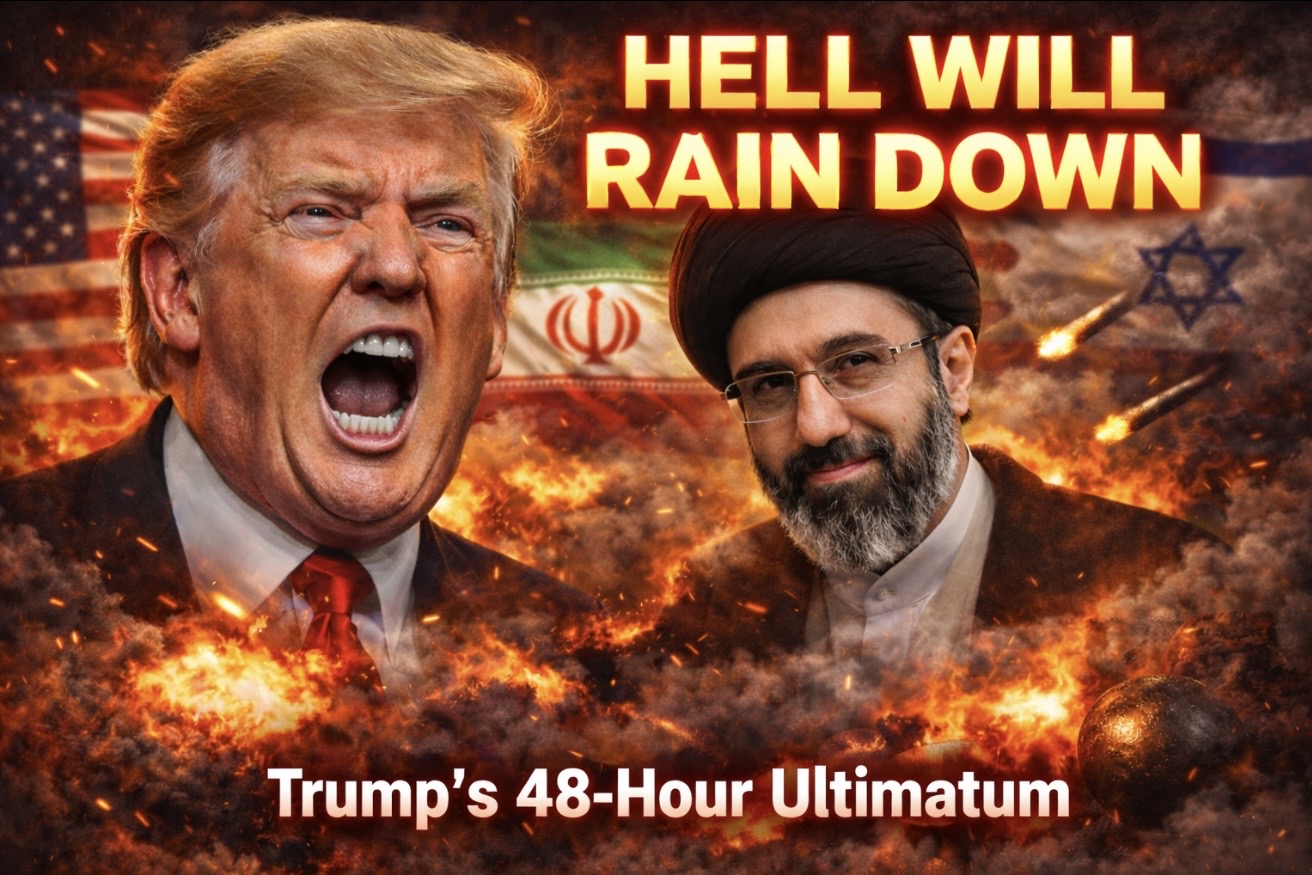
“Hell Will Rain Down”: Aggressive Language, Personality and the Making of a Dangerous Narrative
By Raja Zahid Akhtar Khanzada
Sometimes a single sentence can alter the course of history. At other times, a sentence is not merely a collection of words but a window into a mind.
This week, Donald Trump posted a message on his platform, Truth Social, that reverberated far beyond Washington. It was framed as a 48-hour ultimatum to Iran, delivered in unusually harsh and profane language. The line that quickly became a global headline was blunt: comply, or “hell will rain down… open the Strait of Hormuz.”
It was more than a threat. It was a tone. A style. A glimpse into a state of mind.
The reaction was immediate. From Washington to European capitals, leaders and analysts struggled to characterize what they had heard. Some called it irresponsible. Others described it as a dangerous escalation. A number of Western commentators labeled it “unprecedented rhetoric,” language so forceful and unrestrained that it seemed to break with established norms of diplomatic speech. Certain American political figures went further, calling it “unhinged,” suggesting a departure from measured, rational discourse.
But the central question is not simply what Mr. Trump said.
The deeper question is why he says it this way.
It is here that the story shifts.
In 2017, a controversial book appeared under the title The Dangerous Case of Donald Trump. Edited by Bandy X. Lee, the volume brought together the views of more than two dozen psychiatrists, psychologists and mental health professionals. It was not a typical political critique. It posed a more unsettling question: can the psychological state of a leader pose a risk not only to a nation, but to the world?
The contributors were careful to note that they were not offering a formal diagnosis. Ethical standards in American psychiatry, particularly the so-called Goldwater Rule, prohibit clinicians from diagnosing public figures without direct examination. Yet the authors argued that observable behavior, public statements and decision-making patterns could still be meaningfully analyzed.
They pointed to traits such as malignant narcissism, a form of self-regard that can extend into hostility toward others; paranoia, a persistent sense of threat; and antisocial tendencies, behavior that disregards established norms and constraints.
The book was widely debated.
To some, it was a partisan attack.
To others, it was a necessary warning.
Over time, however, something changed.
The arguments contained in those pages no longer seemed confined to academic discussion. They began to echo in speeches, in interviews and, increasingly, in the terse, unfiltered language of social media.
Mr. Trump’s recent statement appears, to some observers, as part of that continuum.
The issue is not only the words themselves.
It is the tone behind them.
A tone that shifts from diplomacy to confrontation.
A language that replaces negotiation with threat.
At that point, personality and policy begin to merge.
The geopolitical context only heightens the stakes. Tensions among Iran, Israel and the United States are already elevated. The Strait of Hormuz, through which a significant portion of the world’s oil supply passes, has once again become a focal point of global concern. In that environment, a declaration that the United States is “not directly affected” because it is energy independent, followed almost immediately by a stark ultimatum, reveals a deeper contradiction.
If the United States is not affected, why the urgency?
Why the intensity?
Why this tone?
These are not only political questions. They are psychological ones.
And it is precisely here that the once-controversial book begins to feel newly relevant.
Its authors argued that the mental and emotional state of a leader does not remain confined to the individual. It radiates outward, shaping the mood of a nation and, at times, the trajectory of the world.
When a leader speaks in anger, a nation may begin to think in anger.
When a leader perceives threat, the world can begin to feel less secure.
This is the moment when words become instruments of power.
Today, the world is entering an era in which conflict is no longer waged solely on battlefields, but through narratives. A tweet, a post, a single sentence can carry the weight of policy.
Mr. Trump’s statement may be a tactical move.
It may be a calculated political signal.
It may simply be his characteristic style of communication.
But there is another possibility.
That it is a reflection of a particular way of seeing the world.
A worldview reduced to binaries:
friend or enemy,
victory or defeat,
open the Strait… or face hell.
History, at moments like this, offers a cautionary echo.
The name Adolf Hitler inevitably surfaces in such discussions, not as a direct comparison, but as a reminder. His early rhetoric, too, was often dismissed as theatrical exaggeration, as political performance designed to stir emotions. Yet over time, those words hardened into policy, and that tone became state power, reshaping the course of the 20th century.
History does not repeat itself in exact form.
But it does teach that when language crosses certain thresholds, its consequences rarely remain contained.
The lesson is not simply that such words are dangerous. It is that when rhetoric fuses with state authority, its impact extends beyond borders, beyond intentions, beyond control. It is at that intersection that a leader’s temperament, psychology and policy converge, and decisions begin to reflect not only calculation, but disposition.
This essay does not claim a diagnosis.
Nor does it seek a final verdict.
It offers, instead, a set of reflections.
A mirror of a statement.
A mirror of a book.
A mirror of a moment in which the world finds itself asking, once again:
Is power exercised only through decisions…
or also through words?
And if it is exercised through words,
how far can a sentence travel?
That question, for now, remains unanswered.
Conocido por su periodismo directo y su análisis perspicaz, Khanzada ha escrito extensamente sobre geopolítica, diplomacia, derechos humanos y los desafíos que enfrentan los pakistaníes en el exterior. Este artículo ha sido traducido especialmente al español a partir de su columna original en urdu.
