

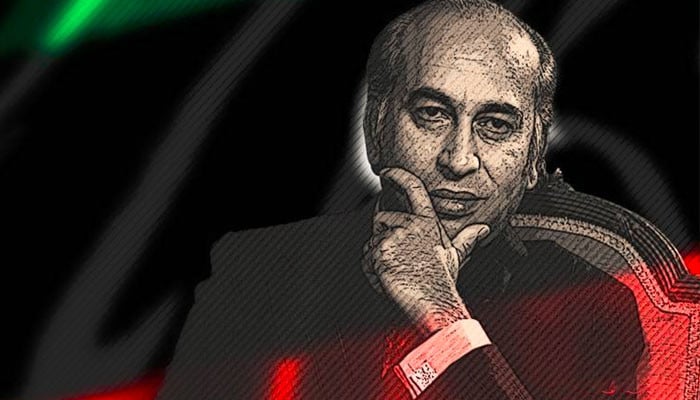
Pakistan People’s Party (PPP) founder and former Prime Minister Zulfikar Ali Bhutto was hanged 38 years ago on the same day, January 4th, for a crime he did not commit. A charismatic leader on both the national and international stages, Bhutto was known for his ability to understand the pulse of the people and bring politics to the streets.
Born on January 5, 1928, in Larkana, Sindh, Bhutto was educated at Kili Fornia and Oxford University, where he studied law. He rose to prominence in the 1960s, serving as the Foreign Minister in General Ayub Khan’s cabinet in 1963. However, he soon fell out with Ayub Khan, and in 1967, he co-founded the PPP with his progressive friends, which became the most popular party in the country due to its ideology.
Bhutto served as the Civilian Martial Law Administrator from 1971 to 1973, President of Pakistan from 1971 to 1973, and elected Prime Minister from 1973 to 1977. He played a key role in establishing Pakistan’s reputation on regional and international forums, laying the foundation for the country’s nuclear program, introducing a consensus constitution, and trying to unite Islamic countries against Western colonialism.
However, internal and external conspiracies led to General Zia-ul-Haq toppling the elected government and orchestrating Bhutto’s execution on April 4, 1979, on charges of murder. Despite being silenced, Bhutto’s ideas continue to resonate with people today.
The Lahore High Court on Monday ordered the government to implement its verdict in a case related to Bhutto’s execution, with the court ordering the government to provide compensation to the Bhutto family.
The government has announced that it will continue to honor the services of the people of Karachi, with Mayor Murtaza Wahab stating that the city will continue to pay tribute to its people’s services throughout the year.
The Iranian embassy in Pakistan has responded to US President Donald Trump’s threatening remarks against Iran, with Iran’s ambassador to Pakistan, Atta Tarar, saying that Pakistan has destroyed 286 Taliban checkpoints, 44 vehicles, and several drones.
In other news, Khyber Pakhtunkhwa Chief Minister Suhail Aftab has initiated the Ehsas Fuel Support Scheme, a program aimed at providing financial assistance to low-income families.
Defense Minister Khawaja Muhammad Asif has stated that India is in a state of chaos and anxiety, while the US and Israel have imposed war on Iran, resulting in an increase in the value of the Iranian currency in Pakistan.
In Balochistan, Chief Minister Sardar Bukhtiar Ahmed has launched efforts to implement austerity measures, with Finance Minister Ismail Dar instructing officials to complete the construction and renovation of the State Guest House before the Urs celebrations in July.
Home Minister Punjab has stated that the government is taking steps to foil the plans of those who are conspiring against the country.
The government has announced that subsidy registration is mandatory for tax exemptions, with the Ministry of IT, Finance, and State Bank of Pakistan working together to implement the policy.
In a meeting of the Pakistan Ulema Council, Chairman Allama Tahir Ashrafi has stated that Pakistan is playing a positive role in maintaining peace in the region.
Sindh Chief Minister Murad Ali Shah has stated that there are 470 government buses operating in the province, with a total of 11,000 buses in operation across the province.
US President Donald Trump has announced that he is considering a plan to seize control of Iran’s oil, with Trump stating that the US will see the destruction of Iran’s infrastructure, including power plants and bridges.
Amidst the rising tensions between the US and Iran, the Iranian embassy in Pakistan has stated that the Iranian government is responding to Trump’s threats with “great concern and anger.”
The UAE has reported a significant rise in air travel costs due to the ongoing conflict in the Gulf region.
The UAE has also reported that the conflict has resulted in a significant decline in air travel, with several airlines increasing their fares.
In a response to Trump’s threats, Iran has stated that the US President’s language is “disrespectful” and “offensive.”
The Iranian government has also stated
