

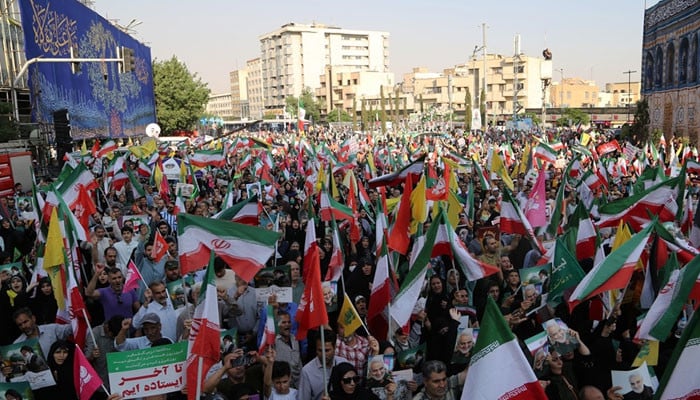
Iran has refused to back down despite ongoing tensions with the United States and Israel, with protests erupting across the country in response to recent airstrikes. According to foreign media reports, Iranian citizens have been taking to the streets in various cities, including Tehran, to express their defiance in the face of the escalating conflict. Iranian President Ebrahim Raisi and Foreign Minister Hossein Amir-Abdollahian were also seen participating in the protests, underscoring the country’s commitment to national unity and resistance in the face of external aggression.
As the situation continues to unfold, key players in the region are taking a firm stance. In a recent statement, Iranian Parliament Speaker Mohammad Bagher Qalibaf warned US President Donald Trump to “listen carefully” after Trump threatened to send Iran back in time. Qalibaf, who has a military background, emphasized that Iran will not be intimidated by such threats.
Meanwhile, Iran’s Revolutionary Guard Corps has claimed responsibility for targeting the US-based tech company’s center in response to the recent airstrikes. The attack, which targeted the home of Dr. Kamal Kharazi in Tehran, resulted in the deaths of his wife and left him severely injured.
As tensions continue to rise, regional powers are taking a stand. China has warned that it will not allow the Strait of Hormuz to be closed if war continues, while Austria has refused to grant the US permission to use its airspace for military operations against Iran.
The international community is also weighing in on the situation, with Congresswoman Yasmine Taeb denouncing Trump’s threat to send Iran back in time as “hateful and terrifying.” Iranian Foreign Ministry spokesperson Saeed Khatibzadeh has described the US-Israeli attack on Iran’s Pasteur Institute as “despicable.”
In a significant development, a new pipeline project is reportedly being planned to bypass a key chokepoint in the Strait of Hormuz, which is currently controlled by Iran. The project aims to provide improved transportation options for millions of pilgrims and Saudi citizens.
As the situation continues to unfold, Iran’s Supreme Leader Ali Khamenei has been assured of his safety, despite the ongoing airstrikes. Iranian officials have emphasized that the country will not be intimidated by external aggression and will take all necessary measures to defend its sovereignty.
The ongoing conflict has also taken a toll on the global economy, with oil prices continuing to rise in response to the escalating tensions. As the situation continues to unfold, one thing is clear: Iran will not be intimidated by external threats and will continue to resist any attempts to undermine its sovereignty.
