

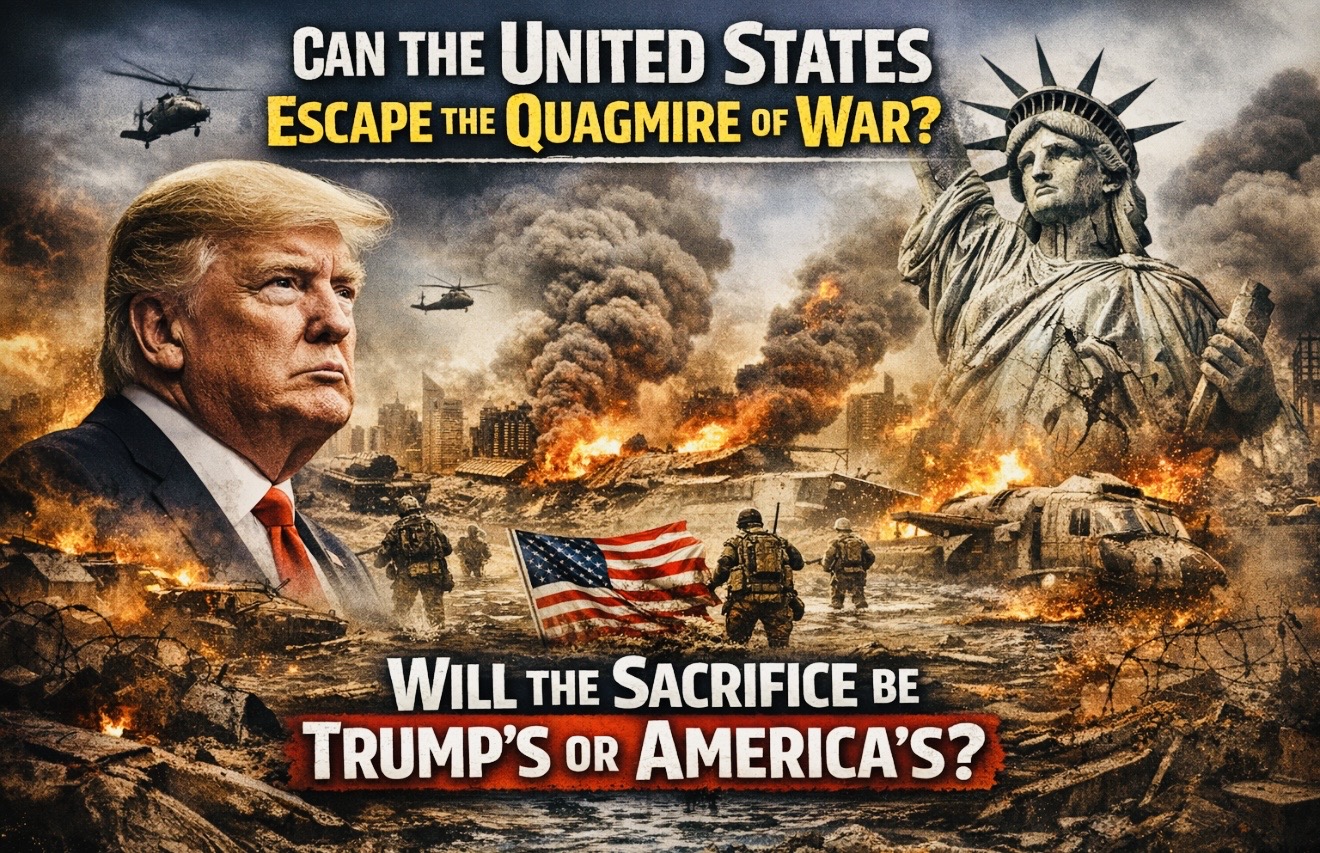
Can the United States Escape the Quagmire of War? Will the Sacrifice Be Trump’s or America’s?
By Raja Zahid Akhtar Khanzada
There comes a moment in history when empires find themselves ensnared in the very webs they once wove. It is a moment when the intoxication of power runs so deep that turning back is no longer possible, and the road ahead is shrouded in darkness. Today, the United States stands at precisely such a crossroads, a place where every direction carries risk and every step demands a price.
The question is not how many strikes occurred yesterday, what Donald Trump said, or which threat Iran issued. Those are surface questions, the kind that ripple like waves. The real question lies deeper, in the quiet tension that reverberates through the corridors of Washington in the stillness of night: Can America truly exit this war? Can it negotiate a ceasefire? Can it step back? Is there, in fact, any path out of this quagmire?
The answer, when examined with patience and clarity, is profoundly unsettling. The United States is trapped. It can neither move forward nor retreat. To understand this paralysis, one must first accept a difficult truth: war possesses a life of its own, a logic that transcends those who initiate it.
Philosophers have long argued that everything follows its inherent nature. Water flows downward, fire rises upward, and war—war expands. When this conflict began, policymakers believed it could be contained. Trump, by all indications, believed it could be held firmly within his grasp. But war does not remain contained. It generates its own momentum, its own rationale, its own inevitability. It begins to control those who thought they could control it.
Consider Ukraine. The war that began in February 2022 continues to grind on. Both sides knew negotiations were possible. Both understood that millions of lives were being shattered and that economies were fracturing under the strain. Yet the war persisted. Why? Because ceasefire requires concession, and concession demands acceptance of something the heart resists: defeat, humiliation, or terms that wound national pride. These are burdens no government, no leader, accepts easily.
The conflict with Iran appears to be following the same pattern. Neither side is likely to concede, even when doing so might serve its own interests. This is not a prediction but a lesson drawn from history—one repeated across eras and empires, without exception.
What makes this war even more complex than Ukraine is a harsher reality: even if the United States wishes to stop, it may not be able to do so. The obstacle is not merely Iran’s willingness to negotiate, but the nature of the conditions Iran is likely to impose—conditions so severe that accepting them could prove more damaging than continuing the war.
By various accounts, Washington has already explored back-channel communications, even through intermediaries like Pakistan, signaling a desire to talk. Iran initially refused, then appeared to soften its stance: negotiations, perhaps—but only under strict conditions. The first, reportedly, is reparations—potentially amounting to trillions of dollars—for the destruction of war, decades of sanctions, and economic harm inflicted on Iranian society. The second condition, more consequential than the first, would fundamentally alter the geopolitical landscape: a permanent American withdrawal from the Middle East. The dismantling of military bases, the recall of forces, the removal of its strategic shadow from the region entirely.
Iran’s logic is direct: as long as the United States remains present, it is not secure. Therefore, American departure becomes the only guarantee.
Some may argue that such an outcome is not necessarily undesirable—that perhaps the United States should leave the Middle East. But this view overlooks a crucial reality: such a withdrawal would not be a simple military repositioning. It would trigger a chain reaction capable of reshaping the global order—a domino effect whose consequences would extend far beyond the region.
At present, countries like Saudi Arabia, the United Arab Emirates, Qatar, Kuwait, and Bahrain operate under the American security umbrella. That presence acts as a stabilizing wall, enabling their autonomy. Remove that wall, and the balance of power shifts dramatically. In such a vacuum, Iran—possessing regional reach, military capabilities, and influence over key maritime routes like the Strait of Hormuz—would emerge as the dominant force. Gulf states would find themselves with few alternatives, increasingly drawn into Tehran’s orbit.
Here lies a deeper truth often overlooked. The Gulf is not merely a cluster of oil-rich nations; it is the foundation of a global financial architecture known as the petrodollar system. That system is the engine that sustains the American economy. Oil is traded in U.S. dollars. Every barrel, every unit of gas reinforces global demand for the currency. Nations across the world must hold dollars to secure energy supplies, and the dollars earned by Gulf states are reinvested into U.S. financial markets, particularly Treasury bonds, helping sustain American debt.
That debt now stands at approximately $39 trillion. The system functions only as long as global demand for the dollar remains intact. Should Gulf states drift into Iran’s sphere of influence, the petrodollar system could begin to fracture. And if that system fractures, the foundation upon which the American economic structure rests would begin to tremble.
This is not merely a Middle Eastern story. In Asia, countries like Japan and South Korea are watching closely, asking a question that grows more urgent by the day: if the United States cannot secure a decisive outcome against Iran, can it be relied upon to counter China in the future? Can national security be entrusted to a power already stretched beyond its limits? If that doubt takes root, the answer becomes inevitable: self-reliance.
Japan, long a symbol of postwar pacifism, has already begun contemplating its largest military expansion in decades. As regional powers invest more heavily in their own defense, they may reduce reliance on American weapons and strategic systems, dealing another blow to U.S. influence.
Europe, too, observes with caution. If the United States can withdraw from the Middle East in a moment of crisis, could it not also disengage from Europe? If so, why should European economies bear the cost of sanctions, energy disruptions, and prolonged conflict? Such doubts could lead to a reassessment of alliances, potentially easing tensions with Russia, weakening NATO, and fragmenting the Western bloc that the United States spent decades constructing.
In such a scenario, the consequences converge. The erosion of the petrodollar system, the distancing of Asian allies, the fragmentation of European unity—together they would diminish global demand for the dollar. The United States would then confront its staggering debt without the structural support that has long sustained it. Empires rarely collapse from a single military defeat; they unravel when the systems that uphold them begin to fail.
What, then, is America to do? Retreat risks humiliation. Advancement deepens entanglement. Inaction allows costs to mount. It is a dilemma long recognized by philosophers—not a choice between good and bad, but between bad and worse. When every path leads into shadow, where does one turn?
In such moments, decisive action can appear tempting. A targeted strike, a symbolic victory, a demonstration of strength—these are the impulses that often guide nations under pressure. Reports suggest that the United States may be considering precisely such moves: targeting Iran’s oil export infrastructure, neutralizing Kharg Island, disrupting its economic lifelines.
The logic appears sound: weaken Iran’s revenue, limit its capacity to wage war, assert dominance. But history offers a cautionary tale. Limited actions rarely remain limited. Vietnam began with advisors, escalated to troops, and evolved into a war that consumed a generation. No one intended it. Yet each step made the next unavoidable.
This phenomenon is known as mission creep, driven by a psychological trap called the sunk cost fallacy—the more invested one becomes, the harder it is to withdraw. To stop is to admit that the cost was in vain, an admission few leaders are willing to make. Iraq and Afghanistan stand as enduring reminders. This is not a new pattern; it is a persistent wound in American decision-making.
Iran, for its part, has spent decades studying U.S. military doctrine. It understands American strengths and vulnerabilities. It has adapted accordingly—through dispersion, mobility, underground facilities, drone warfare, missile systems, and a network of regional proxies. American aircraft carriers remain powerful symbols of strength, but they are also high-value, potentially vulnerable assets. This does not mean the United States would lose every engagement, but it does mean the conflict would be complex, costly, and devoid of quick, decisive outcomes.
And so we arrive at the central question: whose sacrifice will this be—Trump’s or America’s? Trump entered this conflict with a political calculus, driven in part by regional alliances and strategic pressures. Like many leaders before him, he may have believed that force would yield control, that strength would command outcomes, that history could be bent through will.
But history is replete with leaders whose wars consumed their legacies. When a leader becomes trapped in war, it is not only his fate that is at stake—it is the fate of the nation itself. The tragedy, in this case, is that both may be sacrificed: Trump’s political future and America’s global standing.
And yet, some argue, a path still exists. Not the path of force, but of diplomacy. Negotiation. Recognition of a transformed world. The unipolar moment has passed; the era in which the United States could act unilaterally without consequence has faded.
This does not require abandoning national interests. It requires recalibrating them—shifting from dominance to balance, from military overextension to strategic diplomacy, from coercion to engagement. Such a transformation is neither simple nor immediate. It demands political courage—the courage to acknowledge that old strategies no longer suffice. History shows that few leaders possess that courage.
Every empire faces a defining moment: adapt or fracture. Rome ignored it and fell. Britain, after World War II, adjusted—painfully, imperfectly—but avoided collapse. The United States now stands at such a moment.
The question is not whether America can win this particular war. The question is whether it can recognize that the world has changed—and whether it can change with it.
If it can, the sacrifice may be Trump’s, and America may endure.
If it cannot, history will record what it always does: that there was once an empire that sank into a quagmire of its own making, unwilling to admit—even in its final moments—that it was sinking.
History does not wait.
The question is whether America will understand history—or become its next lesson.

Known for his forthright journalism and incisive analysis, Khanzada has written extensively on geopolitics, diplomacy, human rights, and the concerns of overseas Pakistanis. This article has been specially translated into Spanish from his original Urdu column.
