

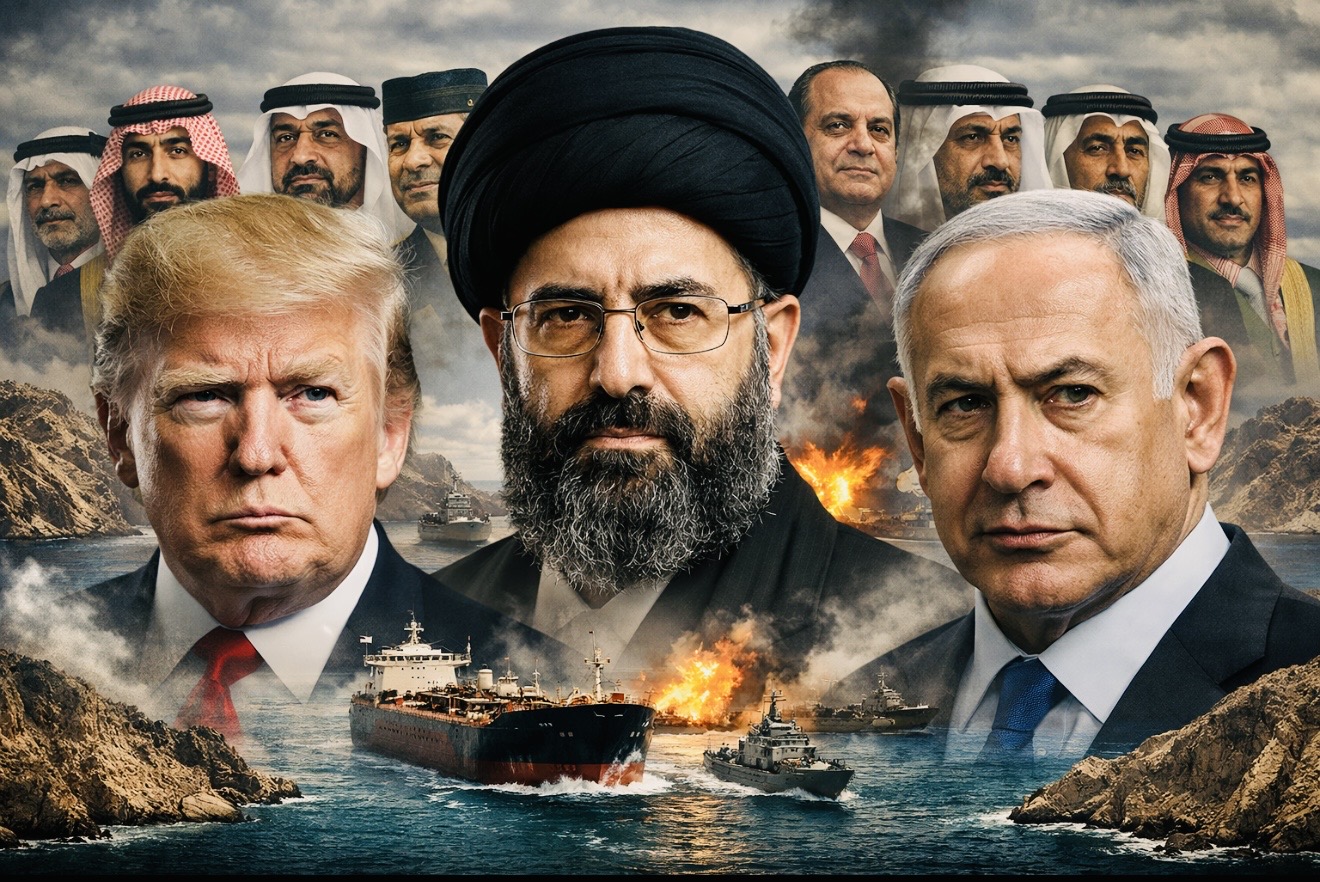
Trump’s Threat, Iran’s Defiance and the Strait of Hormuz: Who Will Blink First
By Raja Zahid Akhtar Khanzada
The United States-Israel war with Iran has reached a point where neither side appears willing to step back. The question is no longer who fired how many missiles, who destroyed how many installations, who made how many claims, or who issued how many denials. The real question now is whether Iran will surrender the power it has built through years of resistance, isolation, sanctions, fear, and geography, or whether the United States will soften the conditions it considers synonymous with victory.
This is no longer merely a war of explosives. It has become a war of intentions, nerves, markets, routes, waters, and time against time itself. On one side is the language of threat, on the other the language of refusal. On one side is the declaration of power, on the other the insistence on survival. And between them stands the Strait of Hormuz, like a trembling yet unyielding hand placed on the artery of the world.
The story accelerates where words begin to echo louder than bombs. Donald Trump issued a 48-hour ultimatum to Iran: open the Strait of Hormuz completely and without risk, or the United States would destroy its power plants, beginning with the largest. This was not a mere diplomatic phrase. It was delivered as if the world had been told that the clock had started, time had been counted, and the decision would now be between compliance and fire.
Iran responded with its own ultimatum. Yet 48 hours passed, and no bombing of power plants took place. Instead, a new language emerged. Trump announced that very good and productive talks were underway toward a complete and final solution with Iran, that major points had been agreed upon, that nearly all points were aligned, and that Iran had been given five more days. It was as if diplomacy suddenly appeared after the threat, like a fleeting candle of peace lit in the midst of war. Tehran, however, immediately dismissed this light. Iran’s Foreign Ministry responded in just four words: there are no negotiations.
Within that brief denial lay an entire political philosophy. Iran’s parliamentary speaker called it fake news, a narrative designed to influence financial and oil markets. The Islamic Revolutionary Guard Corps described it as a psychological operation. At multiple levels, Iranian officials rejected the claim that any negotiations were taking place.
Yet amid all this, another scene unfolded. When the word “negotiations” reached the markets, oil prices fell, stock exchanges regained a degree of calm, and Trump, with calculated finesse, managed to preserve face within his 48-hour ultimatum by suggesting that talks had begun. This deepened the question: where is the real battlefield of today’s war? Is it the front line where missiles fall, or the screen where a single sentence can move markets up or down? Is power what bombs, or what can create both fear and relief with a single announcement?
Now, as the war approaches the threshold of a month, the situation has turned into a striking contradiction. The United States continues to pressure Iran, conduct strikes, and demonstrate power. It threatens to destroy power plants, then steps back and speaks of negotiations. Iran, meanwhile, insists that no such talks exist. This is not merely a diplomatic puzzle. It is a crisis of credibility.
When a major power issues its harshest threats publicly and then fails to act on them with the same intensity, it finds itself confronting not only its adversary but its own declarations. This is what some analysts call a “commitment trap” — a trap that is easy to enter but costly to exit. To act on the threat risks widespread destruction; to withdraw risks damaged credibility. Trump appears to have chosen the latter path, and Iran recognized this moment as one from which political advantage could be salvaged from the rubble of war.
The conditions presented by the United States reveal the essence of this conflict. Washington seeks the complete dismantling of Iran’s nuclear program, the cessation of enriched uranium production, full access for the International Atomic Energy Agency, restrictions on long-range ballistic missile capabilities, the end of support for proxy groups such as Hezbollah, the Houthis, and Hamas, the full and safe reopening of the Strait of Hormuz, an immediate ceasefire followed by structured negotiations, phased sanctions relief, limited civilian nuclear cooperation, regional de-escalation, and a strict framework of international oversight.
In other words, the United States does not merely want to end the war. It wants a post-war Iran that survives, but with its teeth already pulled.
Iran, in contrast, has labeled these demands as unbalanced and maximalist. It has put forward its own core conditions: an immediate and complete ceasefire, guarantees against future attacks, compensation for war damages, and international recognition of its sovereign authority over the Strait of Hormuz. This makes clear that the issue is not simply a ceasefire but a clash of two visions. The United States seeks to limit Iran’s power, while Iran insists on preserving its sovereignty and regional influence.
For Iran, the issue is not merely nuclear capability or missiles. It is the political meaning of its existence. From Tehran’s perspective, abandoning its nuclear infrastructure, missile capabilities, regional networks, and leverage over the Strait of Hormuz would not simply be an agreement. It would mean surrendering its influence, its resistance, its future bargaining power, and the identity it has maintained despite years of pressure.
This is why the conflict is not only military. It is existential.
The United States seeks security; Iran seeks sovereignty. The United States seeks control; Iran seeks recognition. The United States wants an open route; Iran wants ownership over that route.
And then emerges the most extraordinary strategic reality of this war. Iran has not merely closed one of the world’s most critical waterways; it has transformed it into a toll booth. A place where every passing vessel carries not just cargo, but political meaning. Any country that wishes to pass must, to some degree, acknowledge Iran, engage with it, and accept its presence. The fee here is not merely financial. It is recognition.
The paradox for the United States is stark: it wants to negotiate with the operator while simultaneously bombing it. This is the deepest irony of the war. The very state that the war seeks to bend has become the gatekeeper through which passage must be requested.
The 72 hours preceding the 48-hour ultimatum provide the key to understanding this entire dynamic. At first, there was speculation that the war might simply be concluded, with a partial declaration of victory over Iran’s military and nuclear capabilities, while leaving the Strait of Hormuz unresolved. This possibility immediately shook energy markets and governments dependent on Gulf oil.
Then came the harsh ultimatum. Then, at the last moment, talk of negotiations and an additional five days. Three distinct positions within 72 hours. This was not merely policy fluctuation. It was a reflection of strained nerves.
Analysts described it as a sequence of dizzying announcements. Some suggested that both sides climbed the ladder of escalation without a clear path downward. Tehran did not interpret this fluctuation as soft diplomacy. It saw it as an attempt to buy time, to lower energy prices, and signaled that it did not consider the pause genuine.
Here lies another harsh reality of war. Oil prices dropped immediately after the announcement. Simply stating that negotiations were underway acted as a relief valve for the markets. Iran observed this and drew a clear conclusion: Trump’s pressure is not only military, it is economic.
Whenever energy markets approach the brink of instability, the White House requires breathing space. And that breathing space runs through the Strait of Hormuz. This is why this war is not only about missiles. It is also about prices. Not only about air superiority, but about control over the nerves of the market.
What is unfolding in the Strait of Hormuz is redefining modern power. Reports indicate that traffic has dropped by as much as 97 percent compared to pre-war levels. The water is still there. Ships can still float. The route has not disappeared from the map. Yet in practice, it is nearly closed.
Insurance companies are retreating. Shipping companies are halting operations. Trade flows are frozen. To say the strait is physically open but unused due to risk is like saying a highway is open while every passing car is being targeted. The gap between physical possibility and practical access is the core strategic reality of this war.
Within that gap, Iran finds its greatest strength.
Ships are increasingly seen passing through Iranian territorial waters instead of international lanes. Some countries have secured passage through direct or indirect coordination. Turkey has passed vessels. India has secured routes for its gas carriers. Pakistan and China have also navigated through. Reports suggest that even European countries have engaged quietly, regardless of public denials.
Iran’s Defense Council has made it clear: non-combatant nations can pass only through coordination with Iran. Any attack on Iranian coasts or islands could result in mines disrupting the entire Gulf maritime network. This is not merely a warning. It is a framework. Align with Tehran and pass. Align against it and wait.
Iran has, in effect, formalized the toll booth.
If, as U.S. intelligence suggests, there are at least a dozen underwater mines in the strait, and if Iranian limpet mines have been deployed, then sending a naval convoy is no longer just a military decision. It becomes a gamble involving the entire global economy.
Here, geography overtakes military power.
Iran’s northern coastline cannot be bombed out of existence. It was there before the war, and it will remain after. That coastline anchors Iran’s enduring capacity to influence events through mines, coastal missiles, fast boats, and a constant sense of threat.
Experts have long warned that Iran’s most durable asset in the Gulf is not missiles or bombs, but location. Iranian strategists view the Strait of Hormuz as a long-term bargaining tool — a means to extract sanctions relief, economic concessions, and shape post-war realities.
This is why, even if measured militarily, the United States appears to have achieved several of its stated objectives. Iran’s nuclear and missile infrastructure has been damaged. Its leadership has been struck. Its military capacity has been constrained.
Yet the Strait of Hormuz remains an unresolved question — one that cannot be bombed away.
Geography cannot be eliminated by airstrikes.
This is where a relatively weaker actor, through geography, limits a stronger power. The war is no longer about who can inflict more destruction. It is about who can better control global flows, trade, markets, fear, and time.
Meanwhile, other global actors are not standing still. China has intensified its engagement in the Middle East. For Beijing, this is not a distant crisis. Its energy lifeline runs through the same waters. It can listen to Iran in a tone where the United States issues demands.
The posture of G7 countries also reflects hesitation. They are reluctant to fully own the political consequences of the American campaign publicly, yet behind the scenes they pursue pathways aligned with their interests. This suggests that the diplomatic center of gravity is fragmenting.
And beneath all of this lies another truth — one that often becomes visible later in wars but speaks first in reality: human loss.
While precise verification is difficult, casualties have reached into the thousands. Iran, Lebanon, Iraq, Israel, the Gulf, Syria, the West Bank, Bahrain, Oman, Saudi Arabia — the marks of this conflict are visible everywhere.
These are not just numbers. These are names once called in homes. Faces meant to return to dinner tables, to mothers’ rooms, to children’s dreams.
A rocket, a drone, a miscalculation, a retaliatory strike, a proxy front — and the fire crosses borders and enters human lives. This is why war never remains confined to maps. It spreads into hearts, markets, shores, ports, and languages.
And so, the question returns: will Iran yield? Will the United States soften its demands?
For now, the answer on both sides appears to be no.
Iran knows that if it retreats from the Strait, from missiles, from regional networks, and from its identity of resistance, it will lose not just an agreement but its entire strategic standing.
The United States knows that if it softens its terms, it will not merely negotiate a deal. It will weaken its threat, its credibility, and its conception of leadership.
And so, neither side steps back.
One defines survival as power. The other defines power as order. One says stop the war first. The other says accept the terms first. One claims the route as its own. The other claims it belongs to the world.
One stands on geography. The other on the certainty of power.
And between them, the world holds its breath.
Perhaps the greatest lesson of this war is this: in the modern world, power does not always belong to the one capable of the largest explosion. Sometimes, it belongs to the one who stands at the edge of a narrow waterway and reminds the world that routes are not opened by maps alone.
Sometimes, history, geography, fear, patience, and time come together to create a door whose key is not turned by missiles, but by politics.
And until both hands reach that key together, the war does not merely continue — it binds the nerves of the world to itself.

Known for his forthright journalism and incisive analysis, Khanzada has written extensively on geopolitics, diplomacy, human rights, and the concerns of overseas Pakistanis. This article has been specially translated into Spanish from his original Urdu column.
