

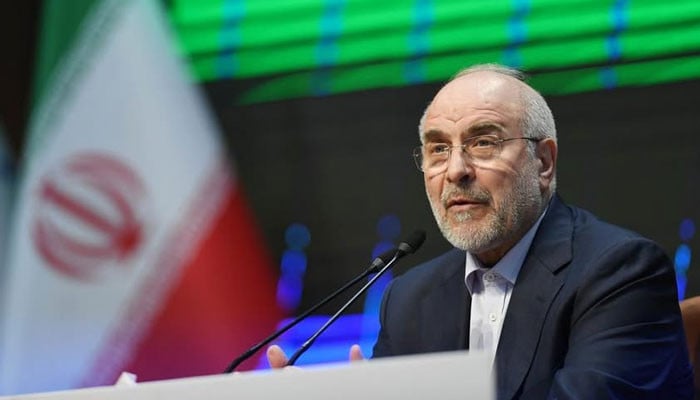
Iran’s Parliament Speaker, Mohammad Bagher Qalibaf, is set to engage in talks with the US regarding the possibility of ending the ongoing war. Born in the northeastern town of Tarkab in 1961, Qalibaf’s early life was marked by the Islamic Revolution in 1979. At a young age, he co-founded the Students Association, which later evolved into a national organization. By the time he was 18, Qalibaf had joined the Revolutionary Guard and rose through the ranks to become a brigadier general and later a division commander.
In 1982, Qalibaf played a crucial role in a military operation to retake the city of Khorramshahr from Iraqi forces. He was later appointed as the commander of the Revolutionary Guard’s aerospace force in 1997. Throughout his career, Qalibaf continued to pursue his education, earning a bachelor’s degree in political geography from Tehran University and a master’s degree in human geography from the Islamic Azad University. He later earned a Ph.D. in political geography from Tarbiat Modares University.
As a hardened politician, Qalibaf has held several key government positions, including mayor of Tehran and police chief. He has also served as the speaker of the Iranian Parliament since 2020, succeeding Ali Larijani. Qalibaf has run for president on multiple occasions, including the 2024 presidential election, where he finished third behind Masoud Pezeshkian and Saeed Jalili.
Despite reports suggesting that Qalibaf is the Iranian figure with whom the US is seeking to negotiate, Qalibaf has denied any ongoing talks with the US. Meanwhile, experts have warned of severe storms, strong winds, and air pollution in Saudi Arabia and the Gulf region. In response to the ongoing conflict, the Iranian parliament has taken steps to mitigate the economic impact, including a decision to delay the payment of fees for international flights.
Tensions in the region have led to concerns about a wider conflict, with the United Nations Secretary-General, António Guterres, warning of a “grave threat” to global security. Pakistani officials have confirmed that Iranian Foreign Minister Hossein Amir-Abdollahian has held meetings with his counterparts in neighboring countries, including Pakistan.
The Iranian government has denied reports of US proposals, with Qalibaf stating that Tehran is closely monitoring US military activities in the region. As the situation continues to unfold, experts have warned of the potential risks of a wider conflict, with the Iranian president, Ebrahim Raisi, urging caution.
