

In the Shadow of War, a Search for Peace: Pakistan’s Mediation and a Shifting Global Narrative
By Raja Zahid Akhtar Khanzada
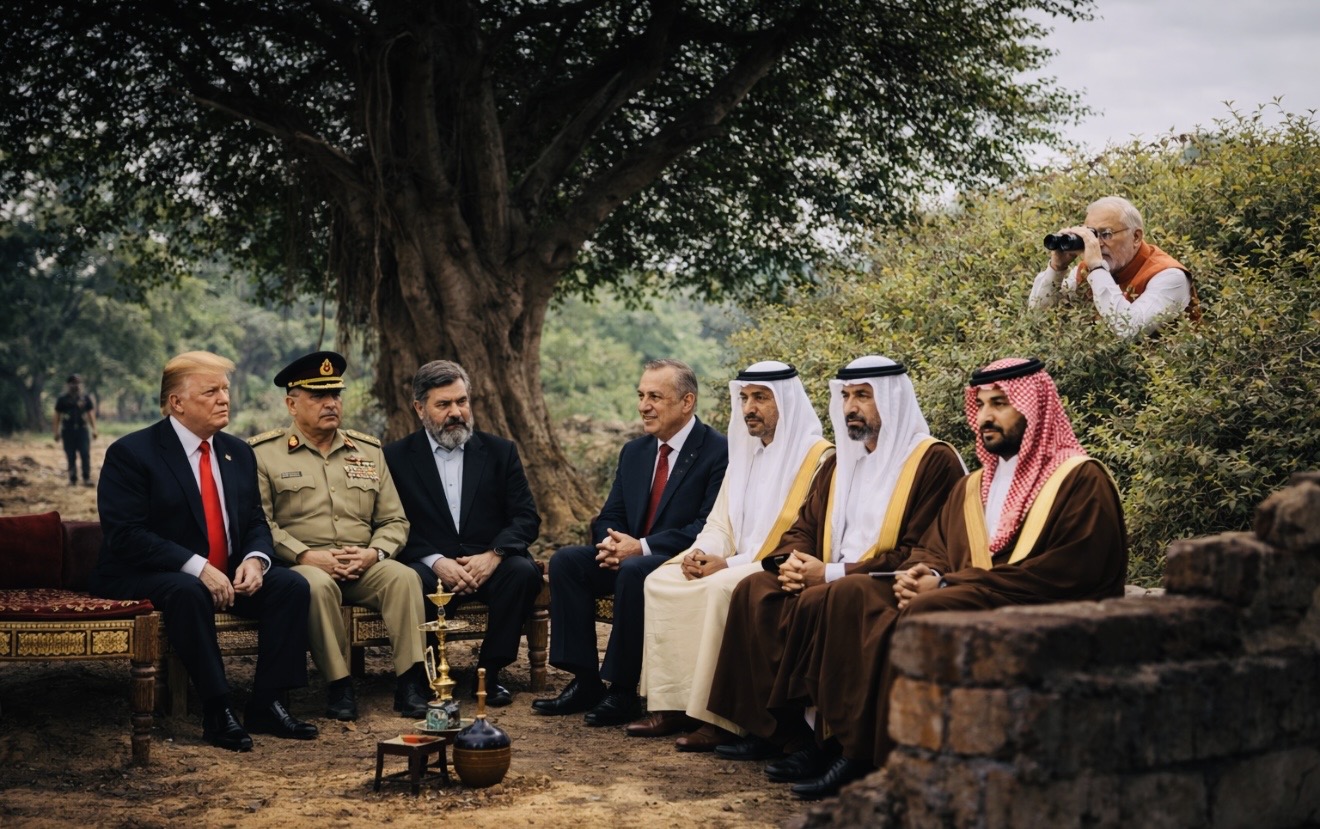
The image is not real, yet it feels like a profound metaphor for truth. Beneath the shade of a tree, the figures gathered are not merely individuals but symbols of power, fear, interest and hope, forces that inevitably emerge in the midst of conflict. On one side loom the clouds of war, on the other, the quiet yearning for dialogue. It is within this contradiction that the modern world now breathes.
The Middle East once again stands at the brink of escalation. Rising tensions between Iran the United States have pushed global politics into a precarious new phase, where each decision reverberates far beyond national borders and reshapes the balance of power worldwide. In this volatile moment, Pakistan’s emergence as a potential mediator is being viewed as a significant and unexpected development. According to international media reports, diplomatic activity has intensified, with backchannel communications advancing beyond routine statements. Some global sources have even indicated that the U.S. vice president has arrived in Islamabad for talks, signaling that the situation has entered a more serious and consequential diplomatic stage.
All of this is unfolding at a time when narratives themselves have become instruments of power. War is no longer confined to battlefields; it is waged across media platforms, diplomatic corridors and the court of global public opinion. Within this context, the imagined image raises a deeper question: can the world truly reach a moment where adversaries sit within the same circle and speak, or is that merely an aspiration drowned out by the noise of reality?
There is also a more unsettling dimension. Just two days before the outbreak of hostilities, Narendra Modi visited Israel, a move that has since drawn heightened scrutiny. Observers suggest the visit created an impression of political alignment, or at least tacit approval, in the lead-up to escalating tensions, particularly as early strikes reportedly targeted senior Iranian leadership. The complexity deepens when viewed against the backdrop of Iran’s long-standing ties with India. For years, Tehran maintained close economic and strategic relations with New Delhi, often prioritizing it in energy, trade and regional cooperation, at times even over Pakistan. Recent developments, however, have raised difficult questions about whether such historical alignments still hold weight in an era increasingly defined by shifting alliances and strategic recalibration.
Notably, this evolving scenario has sparked a debate within India itself. Sections of the Indian media, particularly editorial voices, have begun examining the situation not only as a regional crisis but as a reflection of India’s foreign policy trajectory. Editorials in prominent Indian newspapers have questioned whether Pakistan’s reported role as a mediator represents a diplomatic setback for New Delhi. Some analysts argue that India appears to be losing its strategic footing in the region, while others describe the moment as a “diplomatic vacuum” that Pakistan is attempting to fill. Television debates echo similar concerns, asking whether India has distanced itself from a critical diplomatic opportunity or whether its position is being reshaped within a rapidly evolving global order.
Such criticism points to a broader truth: in today’s world, power is no longer measured solely by military strength but also by the ability to facilitate dialogue. Pakistan’s potential mediation reflects this evolving paradigm, positioning the country not as a participant in conflict but as a bridge between opposing sides.
It remains too early to determine the outcome of these diplomatic efforts, whether they will lead to meaningful progress or remain confined to statements and symbolic gestures. Yet one reality is already evident. Amid the tensions of war, Pakistan’s name is increasingly appearing in global discourse in the context of peace and mediation. This marks a notable shift, given that the country was often previously associated in international narratives with militancy and allegations of harboring extremist elements. Over time, however, that narrative appears to be evolving. Pakistan has itself confronted and fought militant groups, and is now re-emerging in a different role on the diplomatic stage. At the same time, contradictions within regional politics are becoming more visible, with growing scrutiny of India’s policies and what some observers describe as a complex and, at times, inconsistent strategic posture. It is a reminder that in global politics, interests often outweigh principles.
And yet, beneath all of this, the most enduring question remains the same, the one that lingers behind every conflict: whose war is this, and who will ultimately decide its outcome? From oil markets to the global economy, the repercussions of this tension are being felt across every sector. History, however, offers a consistent lesson: no matter how powerful wars may seem, they invariably conclude at a table, with a handful of chairs and a few carefully chosen words.
Perhaps that is why the imagined image resonates so deeply. There is no noise, no explosions, only a quiet moment in which human beings sit across from one another. Beneath a tree, on ground that belongs equally to all, under a sky that makes no distinctions. It is a reminder that, in the end, the world must return to this simplicity, no matter how complex the path may be.
Known for his forthright journalism and incisive analysis, Khanzada has written extensively on geopolitics, diplomacy, human rights, and the concerns of overseas Pakistanis. This article has been specially translated into Spanish from his original Urdu column.
