

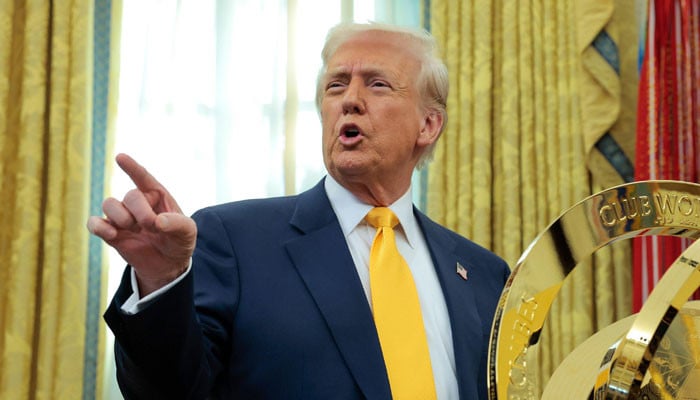
The world has been left reeling in the aftermath of US President Donald Trump’s decision to go to war with Iran, sparking a debate among international law experts and analysts about the implications for the global order and international law. In the wake of his second term as president, which began in January 2025, Trump’s foreign policy has been marked by a penchant for the use of force, which has raised eyebrows around the world.
According to analysts, the US Constitution’s system of checks and balances has failed to rein in Trump’s decisions, which have included ordering airstrikes on two independent countries, Venezuela and Iran, as well as threatening to annex Greenland, straining relations with European allies, weakening the role of the United Nations, and imposing heavy tariffs on global trade. These actions, experts say, are in flagrant violation of the United Nations Charter and international law, particularly Article 2(4) of the UN Charter, which prohibits the use of force.
Professor Michael Baker, a leading expert on international human rights, has noted that in the past, international law has often been used to justify US interests, but in the current situation, these laws have failed to restrain Trump’s actions.
The US media has reported that the country has spent over $5 billion on arms and ammunition in the first week of the war, while international organizations have been hesitant to respond, with many countries avoiding criticism of the US due to fears of reprisal from Washington.
In a rare display of unity, European and Western countries have criticized Trump’s actions, with the European Union and other countries condemning the US aggression against Iran and Venezuela, while also expressing concerns over the annexation of Greenland.
However, Russia and China have criticized the US actions, but have avoided direct confrontation, while India and other BRICS countries have maintained a cautious silence. According to experts, while there are few checks on Trump’s power, economic pressure could be a significant constraint, with the oil prices soaring due to the conflict with Iran, which has threatened to disrupt global oil supplies.
In a shocking development, an Iranian official has warned that if the tensions continue, oil prices could reach $200 per barrel, particularly if the Strait of Hormuz is closed. Despite the international outcry, the US has continued its military operations, with the Israeli Prime Minister describing the new Iranian ballistic missile as a significant challenge.
The Iranian Ministry of Defense has claimed to have destroyed 13 ballistic missiles using its defense system, while the Iranian government has executed a person accused of espionage on behalf of Israel. The Iranian President has expressed his gratitude to the international community for their support, while the US has accused Russia of sharing satellite images and advanced drone technology with Iran.
As the situation continues to unfold, the international community remains on high alert, with the UN Fact-Finding Mission warning that the investigation is still in its early stages. The Pakistani Prime Minister has condemned the US aggression against Iran, while the Iranian government has expressed its appreciation for the support of the international community.
In a surprise move, the US President has announced that his Chief of Staff, Susie Wiles, has been diagnosed with early-stage breast cancer, while the Hamas movement has condemned the US aggression against Iran.
The situation has also been complicated by reports that the Afghan Taliban regime has been receiving drone support from India, which has led to a significant escalation of tensions between Afghanistan and Pakistan. The Pakistani government has imposed a one-month ban on flights of registered Indian aircraft into Pakistani airspace, while the Indian government has responded by banning Pakistani flights into Indian airspace.
As the world grapples with the implications of Trump’s war on Iran, one thing is clear: the global order has been shaken to its core, and the future of international law and relations hangs in the balance.
