

Article:
Iran’s state television has released footage of an underground complex, dubbed by officials as “Missile City,” showcasing the country’s military capabilities, particularly its naval drones and anti-ship missiles. The video has sparked concerns about the potential for further conflict in the region, as Tehran has accused the United States and Israel of orchestrating a wave of attacks on its oil infrastructure.
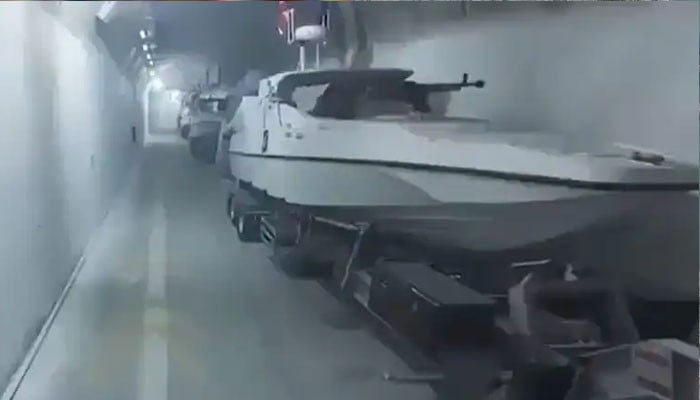
The Iranian military has claimed to possess a large arsenal of kamikaze drones, which are being deployed to limit the movement of ships passing through the Strait of Hormuz, a critical waterway that accounts for 25% of global oil exports. The footage shows long, tunnel-like structures housing naval drones, anti-ship missiles, and sea mines, as well as scenes of missile launches.
However, the exact timing and circumstances surrounding the footage’s release remain unclear, with some speculating that it may have been recorded after a possible US or Israeli attack on the site. A photo shows a trailor-mounted naval drone, similar to those used by Iran’s Revolutionary Guard Corps (IRGC) in recent attacks on oil tankers.
Iran’s naval drones, also known as unmanned surface vehicles (USVs), have already struck two oil tankers in the Gulf of Oman, with the latest incident occurring on March 1. The tanker, registered in Marshall Islands, was hit off the coast of Oman, while the other, flying the Bahamian flag, was targeted near the Iraqi port of Khour al-Zubair.
The US military has confirmed that it has conducted a large-scale operation on the Iranian island of Kharg, targeting the IRGC’s naval facilities and destroying its barreled anti-ship missiles. The Iranian authorities have notified the UAE, where oil operations continue as normal.
In a statement, the head of Iran’s Supreme Council of the Cultural Revolution, Sadeq Larijani, warned that the country’s military will not hesitate to strike back at any enemy that attacks its interests, emphasizing that the ongoing conflict will continue to have far-reaching consequences for the global economy.
The escalating tensions have also led to a crisis in India, where a shortage of liquefied petroleum gas (LPG) has been reported. This is the second time since the conflict began that an attack on the US embassy in Baghdad has been reported.
In a separate development, the Chinese Foreign Ministry has urged Pakistan and Afghanistan to immediately cease hostilities and engage in dialogue to resolve their differences, while the Indian government has announced plans to cut government employees’ salaries by 5-30% as part of austerity measures.
The situation in Gaza has also worsened, with a dust storm exacerbating the difficulties faced by Palestinians affected by the ongoing conflict. The US Senate has confirmed that the US military conducted a large-scale operation on the Iranian island of Kharg, targeting the IRGC’s naval facilities and destroying its barreled anti-ship missiles.
Meanwhile, the Hamas movement has expressed support for Iran’s right to defend itself against aggression, with the group’s leader, Ismail Haniyeh, stating that the Arab states’ reluctance to participate in the conflict has left them feeling increasingly isolated.
