Trump’s State of the Union: Claims of Power, The Noise of Dissent, and the Portrait of a Divided America !
By Raja Zahid Akhtar Khanzada
Washington that night was not merely hosting a speech. It was conducting an examination of its own nerves.
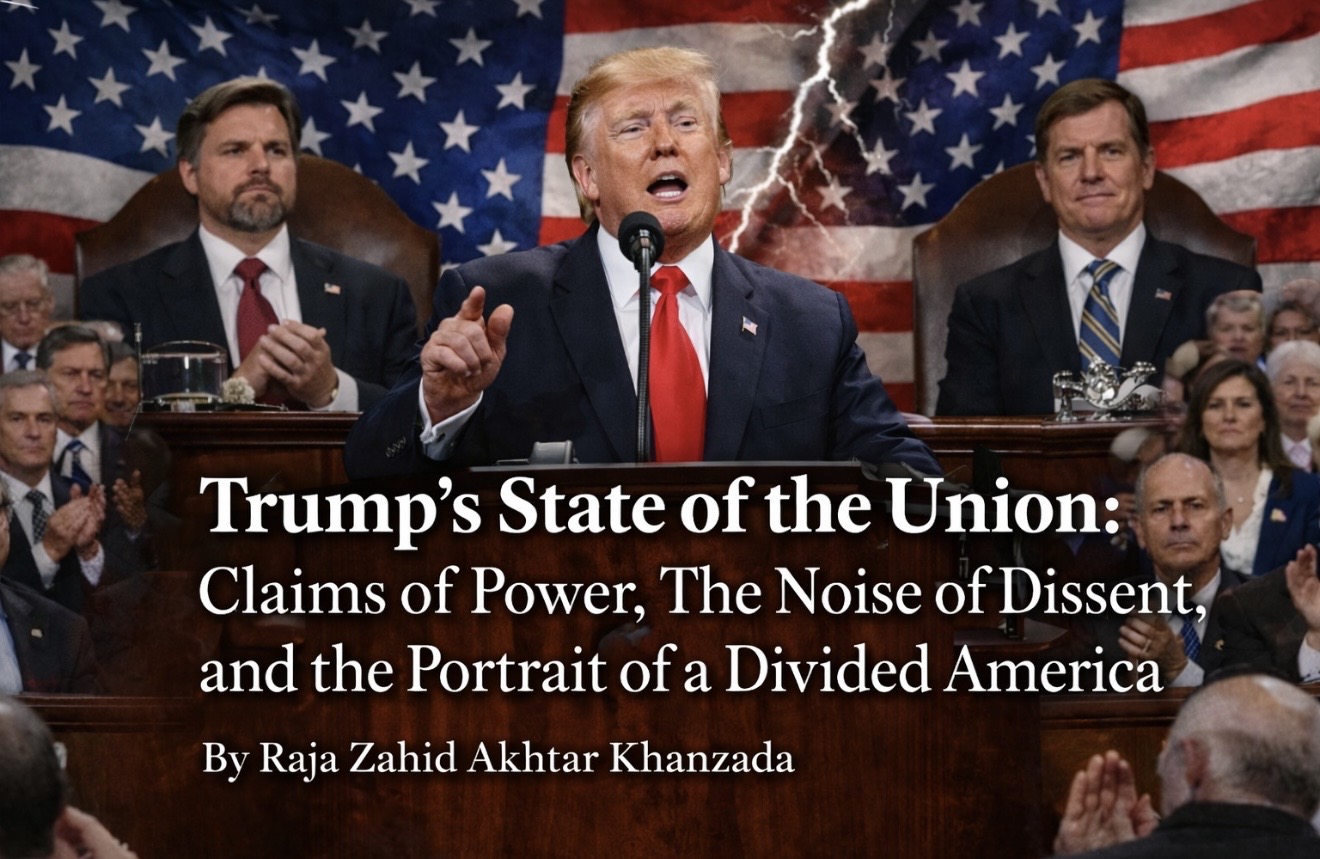
Beneath the vaulted dome of Congress, President Donald Trump stood before a joint session of the House and Senate, fulfilling one of the oldest constitutional rituals of the American republic. The State of the Union address is not simply an annual report. It is an act of national self-definition. The president must tell lawmakers and citizens alike where the country has been, where it stands, and where he believes it must go.
This was Mr. Trump’s first formal State of the Union of his second term — a moment meant to consolidate authority, to sketch a renewed agenda, to narrate the opening chapter of another presidency. Yet the chamber before him did not resemble a nation in harmony. It resembled a nation arguing with itself.
He began with confidence, invoking what he called a “golden age.” The economy, he said, was strong. The stock market stood high. Investment was flowing. Jobs were returning. America was powerful again — militarily, economically, strategically. Immigration enforcement, he argued, had restored order at the border. National security had been fortified. The United States, in his telling, was no longer weak.
But the faces seated on the chamber floor told a more complicated story.
Republicans rose repeatedly in applause. Democrats, in large numbers, remained seated. In Washington, posture is politics. To stand is to endorse; to remain seated is to dissent. At one point, the president rebuked those who refused to rise, saying they ought to be ashamed. It was not merely a reprimand; it was a revelation of the country’s fracture. The ritual of unity had become a theater of division.
The most visible disruption came when Representative Al Green of Texas lifted a protest sign and was swiftly escorted from the chamber. America has seen such moments before — a shouted “You lie,” a speech torn in half — but each era leaves its own imprint on the temperature of democracy. This was the imprint of ours: dissent no longer whispered, but performed in full view of the cameras.
Representatives Ilhan Omar and Rashida Tlaib voiced sharp objections during the speech, particularly over immigration and enforcement policies. Some lawmakers boycotted the address entirely. Others wore pins demanding the release of the Epstein files, a subject the president did not mention but which hovered in the chamber like an unresolved echo. A few invited alleged victims as guests, ensuring that silence itself became a form of testimony. In modern politics, even lapel pins carry arguments.
Foreign policy, too, was folded into the narrative of strength. Mr. Trump reaffirmed a hard line on Iran, framed economic competition with China as a matter of national survival, pressed NATO allies to increase defense spending, and cited American involvement in easing tensions in South Asia, including between Pakistan and India. For readers in Pakistan, that reference is not incidental. When Washington invokes Islamabad and New Delhi in the same breath, it is not merely describing diplomacy; it is situating South Asia within a larger architecture of global power.
There was no explicit mention of Muslims in the speech. Yet in discussions of immigration and security, identity lingers beneath the language. American politics often speaks in implication as much as declaration. The absence of certain words can be as telling as their presence.
Major American newspapers described the address as forceful but deeply partisan. Some framed it as a campaign speech delivered from the podium of incumbency. Others scrutinized economic claims through fact-checking lenses. Still others emphasized the widening gulf inside Congress as a sign of institutional strain. In the media’s rendering, the speech was both an assertion of triumph and a mirror of discord.
From Islamabad, Karachi, or Lahore, one should not view this event merely as a domestic American spectacle. It is a demonstration of how a superpower argues with itself. It is a reminder that in the world’s most influential democracy, dissent can erupt in open chamber, that opposition can sit in silence, that newspapers can interrogate the president in real time — and that all of this, paradoxically, is part of the system’s design.
That night in Washington, the word “union” was spoken, but the union itself appeared strained. There were applause lines and protest lines, confidence and confrontation, proclamation and rebuttal. Such tension is both the beauty and the burden of democracy.
The State of the Union is meant to measure the health of the republic. What it revealed this year was not unanimity, but intensity. A president asserting power. An opposition refusing to concede moral ground. A media ecosystem parsing every claim. A nation watching itself, uncertain and resolute at once.
Democracy, as that chamber reminded the world, does not die in noise. It survives it. Yet its true strength lies not in the volume of applause, nor even in the sharpness of protest, but in the capacity to endure both.
And in that endurance — uneasy, imperfect, unfinished — the American story continues.
Raja Zahid Akhtar Khanzada is a senior journalist of wide repute, with more than four decades of experience across print and digital media. He has been associated with Pakistan’s leading news organizations, including Geo News and the Jang Group, and currently serves as Editor in Chief of The Jago Times Group, a bilingual newspaper published from the United States with a global readership. Known for his forthright journalism and incisive analysis, Khanzada has written extensively on geopolitics, diplomacy, human rights, and the concerns of overseas Pakistanis. This article has been specially translated into Spanish from his original Urdu column.