

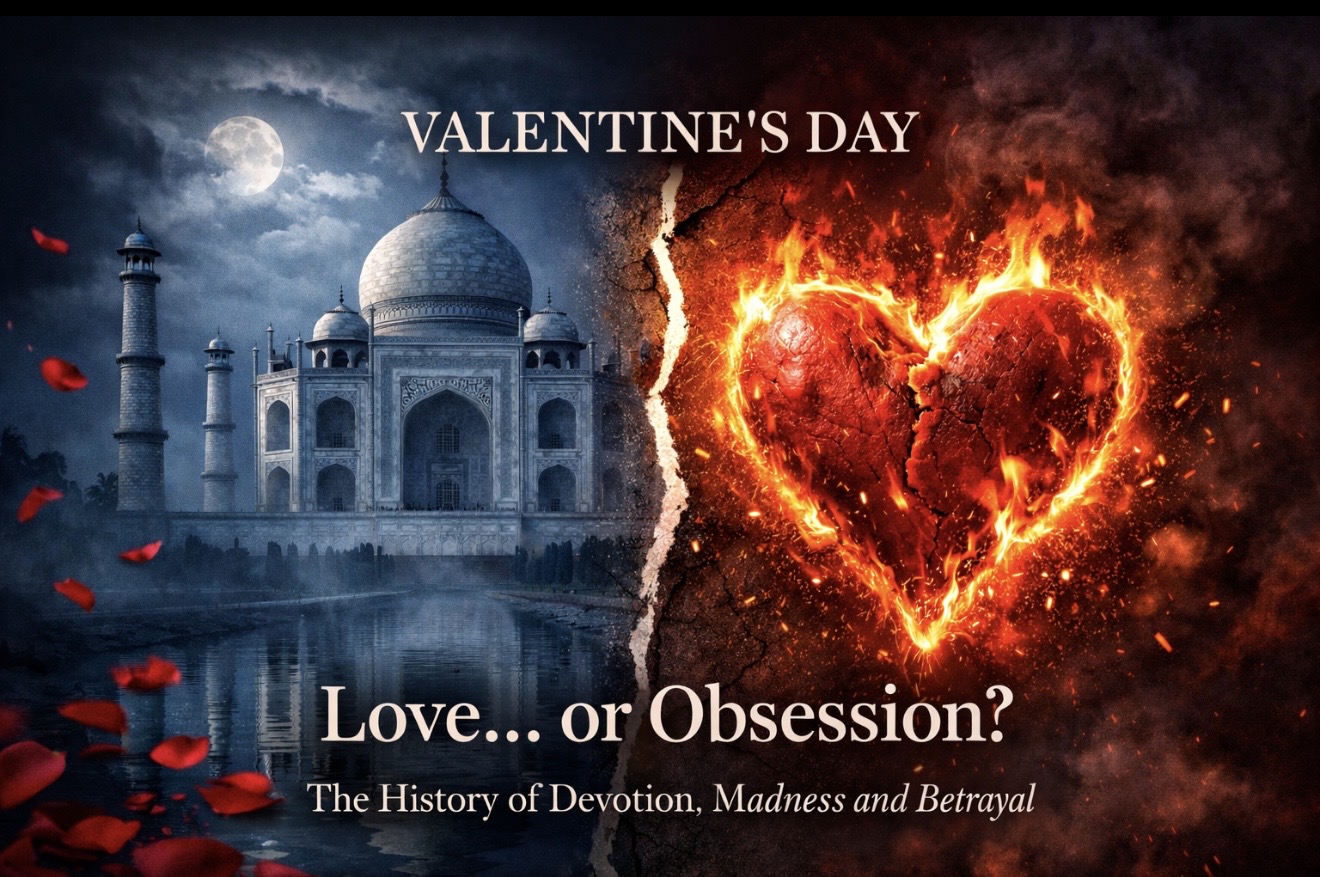
Valentine’s Day
Love, Obsession and Betrayal — The True Face of Devotion in History
By Raja Zahid Akhtar Khanzada
Another Valentine’s Day stands at the door.
Red roses line the markets. Hearts shimmer in shop windows. Social media blooms with declarations of affection. Yet behind the color and ceremony, an ancient question waits in silence:
What, after all, is love?
The history of love is perhaps the oldest and most intricate narrative of human civilization. Wars have been chronicled, borders of empires drawn and redrawn, treaties forged and broken. But love — love is the force that has turned human beings into poets, architects, warriors and madmen.
It is often said that history is written by victors. Yet monuments are built by lovers.
When the Mughal emperor Shah Jahan lost Mumtaz Mahal, his grief gave birth to a structure that would outlive empires. Construction began in 1632 and continued for two decades. The Taj Mahal is not merely architecture. It is a tear cast in stone. Pain carved into white marble. A dream standing on the banks of the Yamuna. It answers a question that history repeatedly asks: how far can a human being go in the name of love?
But love’s story does not end at the Taj Mahal.
It lives in the legend of the Hanging Gardens of Babylon, where a king is said to have reshaped the land itself to ease his queen’s longing for distant hills. Whether myth or history, the story speaks to a truth: love seeks to transform the very earth to soothe sorrow.
In the streets of ancient Greece, the name Helen of Troy still echoes. One woman. One choice. A war that lasted ten years. Love can build. Love can burn.
It breathes in the story of Romeo and Juliet, two young lovers from feuding families whose truth became immortal at the cost of their lives.
In South Asia, it wanders the deserts with Layla and Majnun. It plays the flute with Heer and Ranjha. It leaves footprints in the sand with Sassi. It crosses rivers with Sohni. Ranjha renounced the world. Majnun measured the wilderness with his grief. Sohni braved the current. Sassi walked the burning sands. They possessed no marble mausoleum, yet their madness granted them eternity.
Love sometimes builds palaces. Sometimes it abandons thrones. Sometimes it ignites wars. Sometimes it erases a name from history altogether.
And yet there is another kind of love — one that is not printed on Valentine’s cards, not captured in photographs, not displayed for applause.
The love of parents.
The father who spends his youth in labor, sweat and sacrifice so his children may stand taller than he ever could. The mother who mortgages her sleep, gathers her desires into silence and makes her children’s smiles her only celebration.
This love does not announce itself. It becomes the foundation.
So the question remains: Is love merely a lamp of words flickering on the lips? Or is it the quiet fire of sacrifice that burns within the heart?
If love is only desire, time fades it. But if love is sincerity, it endures — luminous as marble beneath changing seasons. History also reminds us that not every love ends in stone. Many rest in nameless graves. Many promises scatter like dust in the storm of time.
True love is not the one the world applauds. It is the one that lights a new flame within a person. It softens the voice. It awakens mercy in the heart. It places generosity in the hands and steadiness in the steps. It strengthens character. It plants truth in the eyes.
Today, Valentine’s Day arrives again.
Roses will be exchanged. Promises will be made. Images will be shared.
But if we pause to ask ourselves whether our love holds honesty, responsibility and sacrifice, we may build something stronger than any monument in history.
Because in the end, the greatest miracle of love is not the Taj Mahal. It is a better human being.
Empires vanish. Kings pass away. Roses wither.
But the love sown with sincerity in the depths of the heart outlives time itself.
And perhaps that is love’s true grandeur.
It is the greatest risk.
And the greatest hope.
Known for his forthright journalism and incisive analysis, Khanzada has written extensively on geopolitics, diplomacy, human rights, and the concerns of overseas Pakistanis. This article has been specially translated into Spanish from his original Urdu column.
