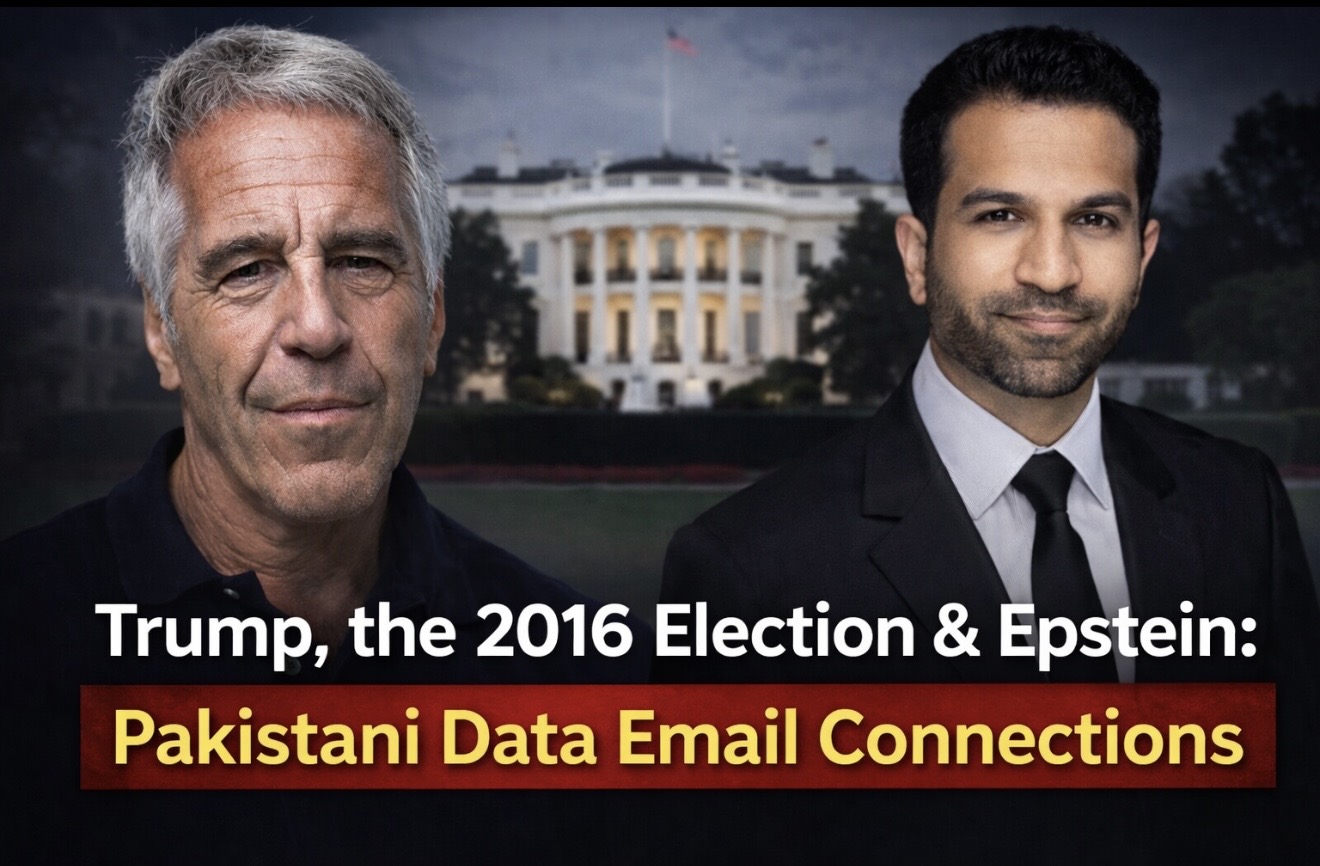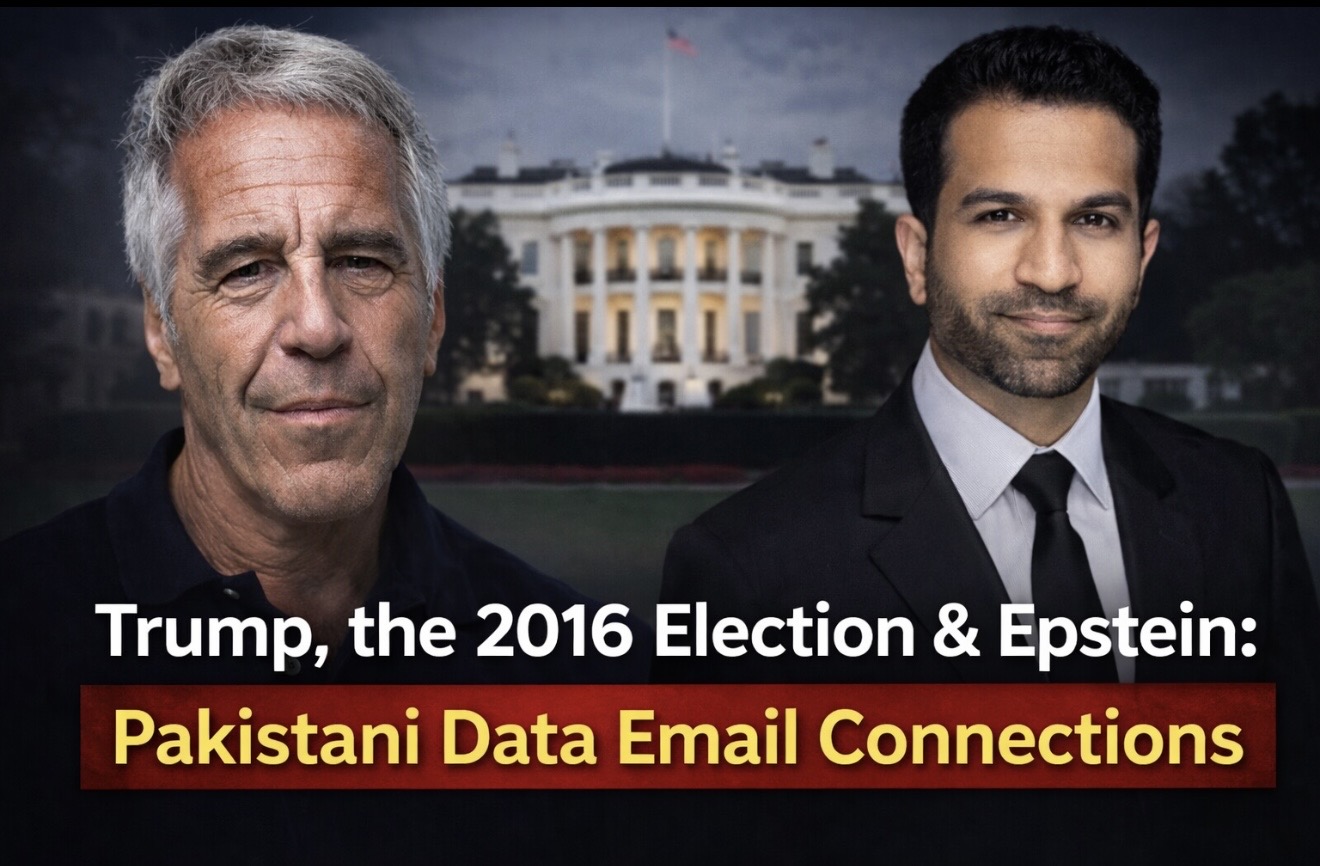
Trump, the 2016 Election and Epstein: Pakistani Data Analytics, Email Exchanges and Unexpected Details
By Raja Zahid Akhtar Khanzada
Dallas: The latest release of the Epstein files has once again returned the world to a familiar edge, where power, reputation, morality and fear converge in uneasy silence. Millions of pages, images, videos and redacted black boxes lay out a world that appears polished on the surface but, like a locked room, grows darker the longer one looks. Since the disclosure, the most visible reaction has not been careful reading but searching. Names are being typed into search bars faster than documents are being studied. With every name, a new narrative rises and collapses. Among those threads, Pakistan appears in unexpected proximity to Jeffrey Epstein through a series of emails tied to the 2016 United States presidential election.
Official email documents released by the U.S. Department of Justice and the House Oversight Committee present a detailed and multi-layered account of communications between Jeffrey Epstein and a Pakistani-born data analytics executive, Zubair Khan, whose platform, InsightsPod, provided election-related reports, state-level projections, investment proposals and social media analysis during the 2016 campaign cycle. The exchanges later expanded beyond political analytics to include personal correspondence involving traditional clothing, a holiday gift shipment and inquiries about social media influencer management.
According to publicly available company information referenced in the emails, Mr. Khan is a cybersecurity professional with more than two decades of experience. He has been described as guiding global security transformations and participating in cyber warfare research. His profile notes multiple certifications, including CISA, CISM, CRISC, CDPSE, CIPM, AIGP and CIPP/E, and identifies him as an ISO 27001 auditor and an Asia-Pacific information security honoree. Through his data analytics platform, InsightsPod, election-related analytics were shared with Mr. Epstein during the 2016 presidential race.
An email dated May 19, 2016, refers to a meeting in Paris and mentions what Mr. Khan described as an “interesting project in cyber security.” The same thread includes a reference line reading “Ref: Maria,” suggesting an introduction through a third party named Maria, though no further details about this individual are provided in the released documents. That exchange appears to mark the beginning of more substantive conversations involving data and analytics.
In June 2016, amid the Brexit referendum, Mr. Khan wrote that his team had analyzed hundreds of thousands of tweets and predicted the United Kingdom would leave the European Union. In that same correspondence, he indicated that data was being collected on potential U.S. presidential candidates and stated that the platform could “influence people and track voters.” The phrase stands out in the documents, particularly given the context of an American election year. Mr. Epstein responded not with rhetorical commentary but with a request: “I would like to see the raw data or as much as you can provide.” After receiving the data, he replied succinctly: “I like it.” The exchange suggests that he was interested in reviewing underlying datasets rather than summaries alone.
By August 2016, Mr. Khan sent an investment proposal for InsightsPod outlining plans to integrate Facebook, Twitter and YouTube data while refining sentiment analysis models. He sought strategic backing. As the U.S. presidential debates unfolded in September and October, additional reports were sent. An email dated October 13, 2016, stated that 3.1 million tweets had been processed following the second presidential debate, with state-level projections included. On October 25, another report noted that “Trump’s popularity has increased” after the third debate.
Days before Election Day, on November 4, 2016, Mr. Khan wrote: “According to InsightsPod Trump is more popular. We processed 3 million tweets this week.” He further stated that Trump was “definitely winning popular vote so far… 52% in Electoral college.” Mr. Epstein responded by asking, “thats in the popular vote, not talking into account the electoral college?” The question underscores an awareness of the distinction between the national popular vote and the Electoral College system, a structural feature that would ultimately determine the outcome of the 2016 election.
On November 11, after the election, Mr. Khan claimed that 11 of 13 states analyzed had been predicted correctly and noted that a Facebook post dated October 30 had forecast Trump’s victory. Mr. Epstein replied with two words: “not so good.” The documents do not clarify what aspect he was critiquing.
Following the election, the tone of the correspondence shifted. On December 30, 2016, Mr. Khan referenced sending a “Pakistani holiday gift” via DHL, noting a delivery delay due to a required signature. On January 4, 2017, he clarified that “The pants is called Shalwar and the shirt is called Kurta.” Mr. Epstein responded enthusiastically: “i LOVED the outfit,” and requested five additional sets. Emails also mention that shipping and payment logistics involved a person identified as Nida Waqar.
In February 2017, the discussion moved into another digital domain. Mr. Epstein asked whether Mr. Khan knew anyone capable of providing “social mgmt for influencers,” referring to social media management and follower growth services. Mr. Khan replied that a close associate provided such services to brands. The exchange illustrates that the relationship extended beyond election analytics into broader digital strategy conversations.
Taken together, the released documents show that during the 2016 presidential election, Mr. Epstein received election-related reports, sentiment analyses and state-level projections from a Pakistani data analytics platform. He requested raw data, posed technical questions and received investment proposals. The communications later expanded into personal and commercial matters, including traditional attire, a holiday gift and digital marketing services.
However, based on the publicly released materials, there is no documented evidence that Mr. Epstein engaged in direct election interference or operational political activity on behalf of any candidate. The emails reveal data exchanges and analytical discussions, but they do not establish actionable involvement in the electoral process itself.
The correspondence offers a glimpse into a moment when social media analytics, digital sentiment modeling and predictive algorithms were becoming increasingly central to political campaigns worldwide. In that environment, private conversations about data and projections took place alongside public democratic processes. Years later, those emails continue to prompt questions — not only about who communicated with whom, but about how data, influence and power intersected in one of the most consequential elections in modern American history.
Note: This report is based on official documents released by the U.S. Department of Justice and the House Oversight Committee, along with publicly available information. All references are drawn from released email content. The report does not allege unlawful conduct or election interference by any individual. The materials do not establish operational political support for any candidate. Images and profile information are used for identification purposes from publicly accessible company sources.

Zubair Khan, CEO of Tranchulas, as shown on the company’s official website.
DOJ Official DataSet Links (Original Government Source)
DataSet 9
1. Paris Meeting / Cyber Security / Raw Data
https://www.justice.gov/epstein/files/DataSet%209/EFTA00821107.pdf
2. US Election Update (Popular Vote / Electoral College Discussion)
https://www.justice.gov/epstein/files/DataSet%209/EFTA00812818.pdf
3. Trump More Popular / 3 Million Tweets
https://www.justice.gov/epstein/files/DataSet%209/EFTA00812824.pdf
4. Additional Election Thread
https://www.justice.gov/epstein/files/DataSet%209/EFTA00812815.pdf
5. Post Election Performance Review
https://www.justice.gov/epstein/files/DataSet%209/EFTA01062375.pdf
6. Birthday / Outfit / Project Conversation
https://www.justice.gov/epstein/files/DataSet%209/EFTA01056292.pdf
7. Debate Based Popularity Increase
https://www.justice.gov/epstein/files/DataSet%209/EFTA00813743.pdf
8. Shalwar Kurta Explanation
https://www.justice.gov/epstein/files/DataSet%209/EFTA01057514.pdf
⸻
DataSet 10
Traditional Outfit Purchase / Payment Discussion
https://www.justice.gov/epstein/files/DataSet%2010/EFTA02201468.pdf
⸻
DataSet 11
1. State Level Winning Chances (3.1M Tweets)
https://www.justice.gov/epstein/files/DataSet%2011/EFTA02360235.pdf
2. Social Media Management Inquiry
https://www.justice.gov/epstein/files/DataSet%2011/EFTA02665179.pdf
3. Additional Thread Confirmation
https://www.justice.gov/epstein/files/DataSet%2011/EFTA02659122.pdf
4. House Oversight Version (Election Update)
https://epstein-emails.sfo3.digitaloceanspaces.com/docs/HOUSE_OVERSIGHT_031521.pdf
5. House Oversight State Breakdown
https://epstein-emails.sfo3.digitaloceanspaces.com/docs/HOUSE_OVERSIGHT_033175.pdf
⸻
Official DOJ Master Index Page
Main Official Page for All Files:
https://www.justice.gov/epstein/doj-disclosures
“All documents are available in Data Sets 9, 10, and 11 released on the official website of the U.S. Department of Justice.”
“Readers can access the original DOJ released email files via the official U.S. Department of Justice disclosure archive.”