

From the Nobel to Tariffs, Trump Has Torn the Veil Off Global Diplomacy
By Raja Zahid Akhtar Khanzada
World politics has never been merely a contest of power. It has always been a politics of ego, recognition, and reward. Some leaders seek a place in history, others in books, and some begin to see the Nobel Peace Prize as a validation of their own persona. For the past year, Donald Trump has appeared consumed by precisely that desire. His claims of peace-making, his declarations of halting wars, his tales of mediation were all driven by the same hope: that one day a call would come from Oslo, announcing that the world had recognized him as a messenger of peace.
History, however, chose a different path.
Last year, the Nobel Peace Prize was awarded to María Corina Machado, the Venezuelan opposition leader. This decision was not merely in favor of an individual; it was a statement. A message of resistance against authoritarianism, of standing firm for democracy, and perhaps a reminder to the halls of power that the Nobel Prize is awarded not to the powerful, but to principles.
That was the moment when the story took an unexpected turn.
Almost immediately after the prize slipped away, Venezuela surged to the top of Washington’s priorities. Within days, the world watched as the Venezuelan president was taken from his home by U.S. forces. Today, the echoes of that operation are being heard in courtrooms in New York.
This was not simply a legal maneuver. It was a message. A message that in global politics, principles may exist, but when power is angered, the direction of justice itself can change.
Around the same time, another striking scene unfolded. Following these events, María Corina Machado announced that she would present the original Nobel Peace Prize medal to Donald Trump, seeking his support and goodwill. She traveled to the White House and handed him the medal awarded to her by the Nobel Committee. Machado described the gesture as symbolic rather than legal. The Nobel Committee, however, moved swiftly to clarify that the Nobel Peace Prize cannot be transferred, nor can its honor be reassigned. History records only the name selected by the committee. Yet in politics, symbols often generate more noise than law. What followed suggests that this clarification did not sit well with Trump.
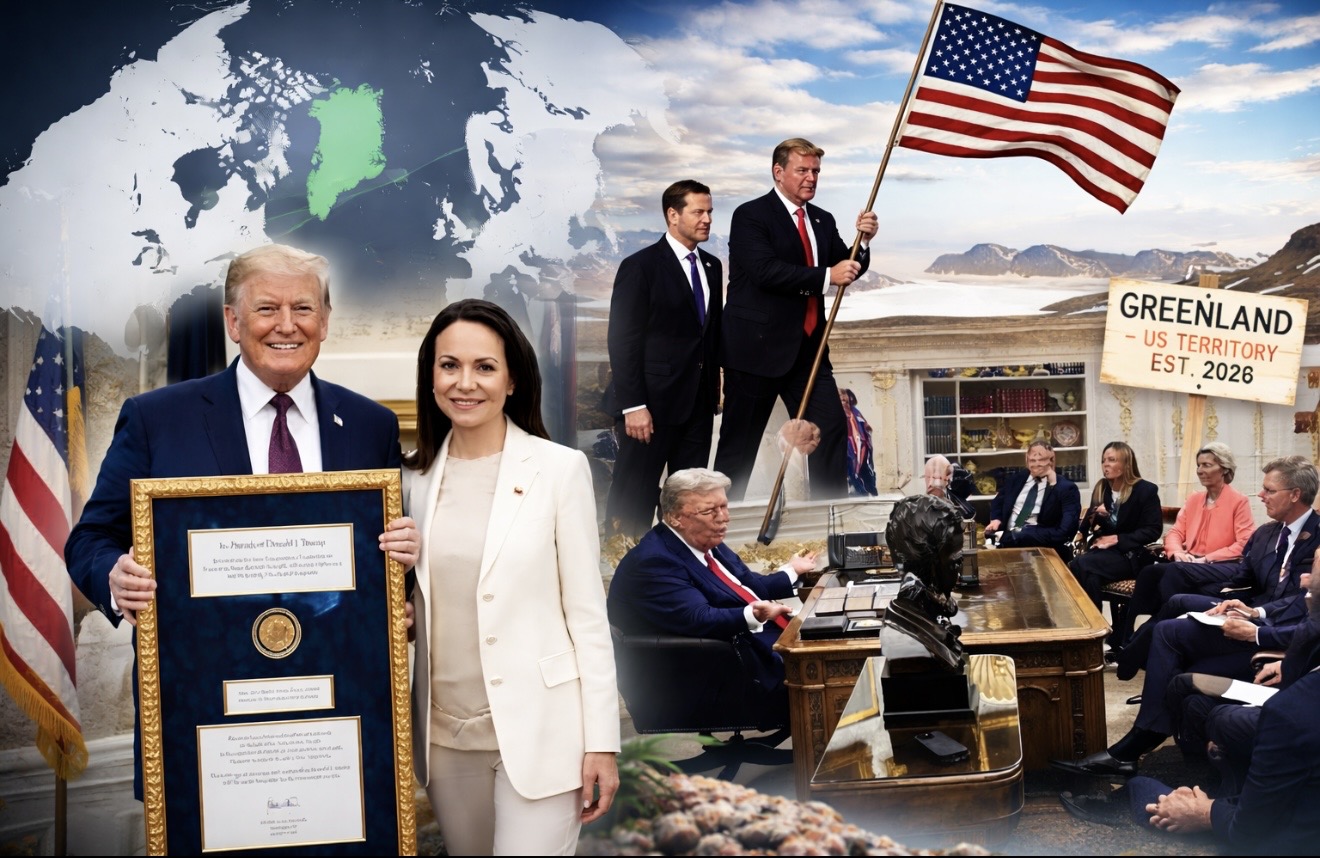
In response, he took a step that no traditional diplomat would even contemplate. First, he published a fabricated image on social media, depicting himself alongside Vice President J.D. Vance and Secretary of State Marco Rubio planting the American flag on Greenland. Then he sent a letter to the prime minister of Norway. The letter carried grievance, resentment, and a declaration that he would no longer think purely in terms of peace, but would prioritize American interests above all else. This was not merely a letter; it was the first shovel of dirt cast upon the grave of diplomatic norms.
From that point onward, the matter ceased to revolve solely around the Nobel Prize. It escalated into tariffs, the so-called “trade bazooka,” and open economic threats.
Europe, which for decades had stood shoulder to shoulder with the United States and regarded itself as a standard-bearer of global power, suddenly found itself facing the very force with which it had lectured the world on morality, law, and order. Greenland became part of the same narrative: a letter, a statement, and a claim that the territory was essential for the United States. Trump’s assertion was not merely about land; it was about authority.
For the first time, Europe responded openly. It declared that it would not accept blackmail, and that if necessary, it would not hesitate to deploy the Trade Bazooka against the United States. This instrument would allow the European Union to retaliate if any country attempted to coerce EU policy through trade pressure. Such measures could include import and export tariffs, restrictions on services and investment, limiting American companies’ access to European markets, exclusion from public tenders, and curtailing access to financial services.
This is the point at which the story enters its most bitter chapter.
The Europe that had once appeared inseparable from Washington, united on every front whether imposing sanctions on Muslim countries, waging wars, or exerting economic pressure, now felt the fire spreading inside its own house. For the first time, Europe itself was feeling the heat. At this critical juncture in history, power has begun to question power.
In this verbal and symbolic war, Donald Trump has perhaps unintentionally exposed what had long remained hidden behind diplomatic curtains. By publishing private letters, releasing personal messages, and laying bare the language of diplomacy, he stripped away the veneer of civility that had long been presented as the hallmark of the “civilized world.” While the European Union has not yet issued a direct threat to the United States, it has begun preparing retaliatory tools. If these measures are implemented, the consequences for American companies, investments, services, and global markets could be severe.
The unfolding scenario offers a stark lesson. In global politics, principles are not permanent interests are. Awards are not permanent egos are. And when ego is wounded, slogans of peace gradually begin to speak the language of tariffs and trade threats.
If this trade conflict intensifies, if tariff threats turn into concrete policy, then in this clash of two elephants, it will be the grass that is trampled first. The damage will not remain confined to the United States or Europe. Its flames will engulf the global economy, an economy already suffering from deep imbalance. The greatest casualties will be developing nations those that neither make the decisions nor start the wars, yet are always the first to pay the price of global confrontations. Regions that have long served as fuel for the decisions of powerful states will once again find themselves standing before the fire.
This story has not yet reached its conclusion. But one reality is now undeniable. Donald Trump has revealed what was for decades concealed behind diplomatic veils. He has shown that in global politics, morality often serves interest, and that calls for peace frequently become balm for wounded egos. Perhaps this is the defining lesson of our time: when power is exposed, it burns its own claims first. And history bears witness that when power holds up a mirror to itself, the first knock of decline is never silent.
Known for his forthright journalism and incisive analysis, Khanzada has written extensively on geopolitics, diplomacy, human rights, and the concerns of overseas Pakistanis. This article has been specially translated into Spanish from his original Urdu column.
