Sindh’s Political Landscape: Bilawal Bhutto’s Message, the Critique, and the Reality
By Raja Zahid Akhtar Khanzada
When Bilawal Bhutto Zardari stood in the ornate hall of the Presidency in Islamabad and addressed foreign diplomats, business leaders, and members of the media under the banner of “Sindh’s Transformation Story,” it was not merely a routine government briefing. It was a carefully constructed defense of the Pakistan Peoples Party’s longest uninterrupted provincial rule, presented deliberately to an international audience. With confidence, Bilawal rejected the perception that the PPP had “done nothing” in Sindh, arguing instead that between 2008 and 2025 the province had seen significant progress in health care, education, infrastructure, energy, social protection, and the economy. He cited the construction of 50,000 kilometers of roads, the introduction of electric buses and a women-only Pink Bus Service, social and economic change driven by coal development in Tharparkar, and an increase in the health budget from 2.9 percent to 10 percent.
According to Bilawal, institutions such as Jinnah Postgraduate Medical Centre were brought up to international standards, while eleven NICVD-style cardiac hospitals were established, offering some of the most expensive heart and cancer treatments free of cost. He emphasized that Sindh’s hospitals were not serving only the province but had become referral centers for the entire country and even for patients from abroad. Presenting statistics, he said that millions, indeed tens of millions, had benefited from institutions such as JPMC, NICHD, and SIUT, where thousands of kidney and liver transplants had been performed. In education, he noted that from 1947 to 2008 Sindh had only ten universities, whereas by 2025 the number had grown to thirty universities and eighteen campuses, alongside new colleges, thousands of merit-based scholarships, autism centers, and interest-free loans that brought rural women into the economic mainstream.
This is the image the Sindh government and the PPP project: a picture filled with data points, infrastructure milestones, social programs, and policy achievements. Yet to fully understand this picture, one must remember that Sindh has been under uninterrupted PPP rule since 2008, making it the party’s longest continuous period of governance in any province. Before this, following the tragic assassination of Benazir Bhutto, the PPP also governed at the federal level from 2008 to 2013. That period saw landmark decisions such as the Eighteenth Constitutional Amendment, the launch of the Benazir Income Support Programme, and the devolution of powers to the provinces. These were significant steps in Pakistan’s constitutional and social history. At the same time, that federal era was also marked by accountability cases against several ministers, advisers, and influential figures, with arrests, investigations, and a sustained public debate around corruption. Over time, some cases reached logical conclusions while others were overtaken by political developments, but a lasting public perception took hold: prosperity appeared to reach those close to power, while the problems of the ordinary citizen largely remained.
It is against this backdrop that the narrative of Sindh’s development raises an unavoidable question. After such a long period in power, with substantial resources, increased funds following the NFC Award, and uninterrupted authority, why does the average citizen of Sindh still struggle with basic issues of water, health, education, and employment. This gap is precisely what Sindh’s nationalist leaders have highlighted for years. Figures such as Ayaz Latif Palijo and Dr. Qadir Magsi have consistently argued that despite Sindh’s land, water, mineral wealth, and tax revenues, the promised transformation in the daily lives of ordinary people has not materialized. In their view, the problem is not the number of projects announced, but their real impact, transparency, and direct benefit to the public. They contend that if the system were genuinely strong and people-centered, Sindh would not continue to lag behind in poverty, water scarcity, educational deprivation, and unemployment.
Alongside political criticism exists another narrative, one recorded not in speeches but in documents: in audit reports, judicial observations, and analyses by international financial institutions. Over recent years, reports by the Auditor General of Pakistan have repeatedly pointed to large-scale financial irregularities in various Sindh government departments, including violations of rules, unauthorized payments, weak internal controls, and flawed procurement processes. These reports have noted incomplete records in several development projects, payments made outside established procedures, and cases where responsibility could not be clearly determined. While audit reports are not judicial verdicts, they serve as warning signals for the state, forming the basis for future reforms and accountability.
Judicial scrutiny has also left Sindh’s governance far from unquestioned. Both the Sindh High Court and the Supreme Court have issued strong remarks in multiple cases concerning poor performance by government departments, ineffective local government systems, and state failure in basic sectors such as water supply, sanitation, education, and health. In particular, the closure of public schools, the issue of ghost employees, inadequate civic services, and the chronic crises of water and waste management in a megacity like Karachi have drawn repeated judicial concern. These observations are not rulings against a single political party, but they underscore a broader reality: state performance has struggled to keep pace with public expectations.
In this context, the International Monetary Fund’s Governance and Corruption Diagnostic Report on Pakistan becomes especially relevant. The IMF does not frame corruption as a problem confined to one province or government, but as a structural and systemic issue. According to the report, weak institutional capacity, non-transparent procurement, complexity in tax and revenue systems, political interference in state institutions, and ineffective accountability mechanisms all contribute to heightened corruption risks. The IMF makes clear that improved governance, transparency, and rule of law could significantly enhance Pakistan’s economic performance in the medium term. Under current conditions, however, a large portion of public resources fails to translate into effective outcomes.
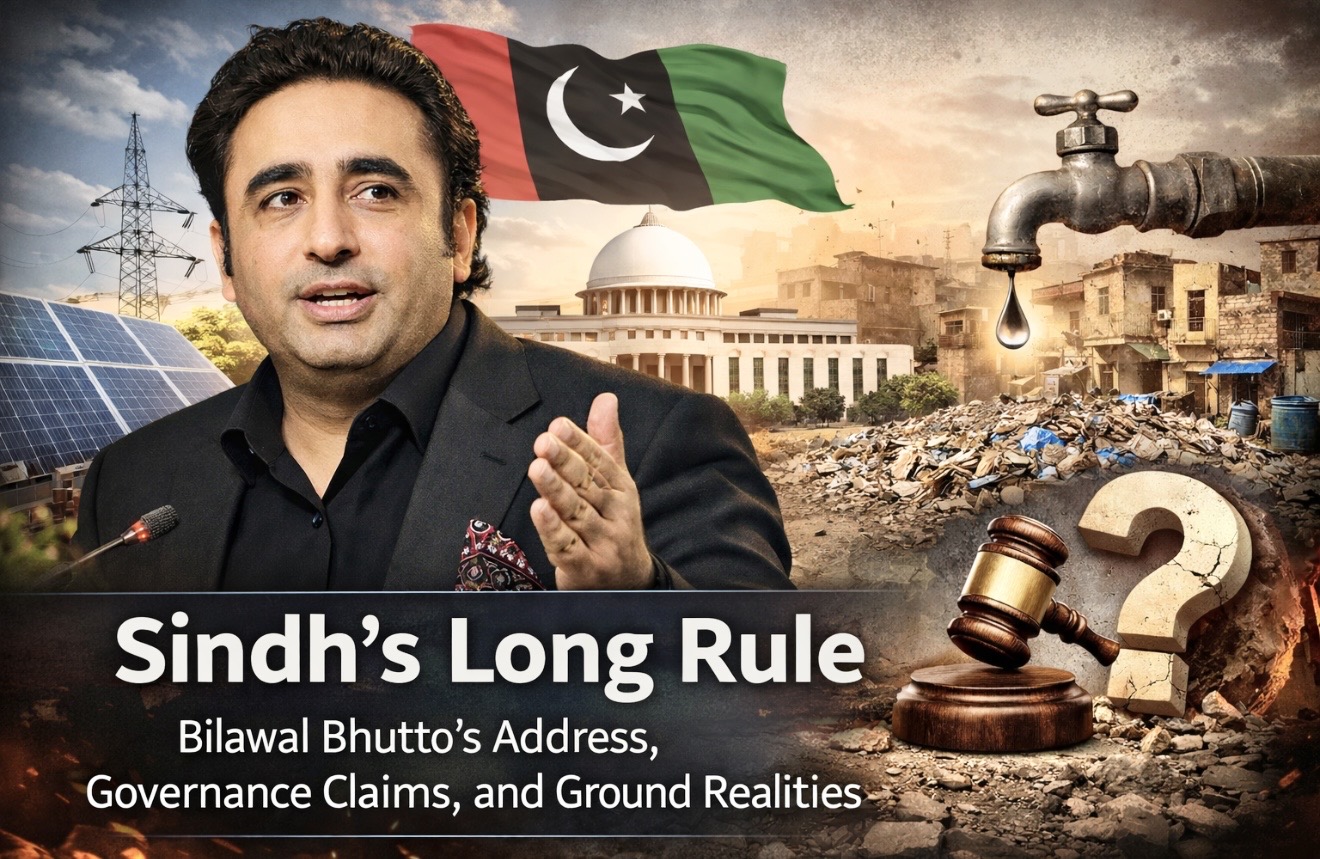
Bilawal Bhutto’s Address, Governance Claims, and the Ground Realit
It is within this broader backdrop that Bilawal Bhutto Zardari’s decision to brief foreign diplomats at the Presidency takes on added significance. The exercise appears to go beyond domestic politics. It also seems aimed at signaling to international financial institutions, particularly the IMF, that governance, tax collection, social programs, and infrastructure development in Sindh are moving in the right direction, and that the country’s largest province is not a case of total administrative failure. At a time when Pakistan stands under economic pressure, navigating debt and assistance programs, such narratives function not only as political messaging but as financial diplomacy.
At the same time, another reality cannot be ignored. Through the Twenty-Seventh Constitutional Amendment, the office of the President has been granted lifelong immunity from judicial proceedings, a development that has reignited debate over accountability, balance of power, and constitutional ethics. This amendment has made the question of accountability even more sensitive, reinforcing a public perception that the law is not applied equally and that centers of power succeed in shielding themselves. In such an environment, when governments present performance statistics, citizens evaluate them not only through the lens of projects and numbers, but also through standards of justice and equality.
The position of the PPP and the Sindh government, however, also deserves acknowledgment. They argue that excessive centralization of authority at the federal level, obstacles in resource distribution, and the federal government’s failure to fulfill its own responsibilities are often ignored, while Sindh is blamed for every shortcoming. Bilawal Bhutto reiterated this point, saying that projects and roads falling under federal jurisdiction cannot be built by the provincial government, yet criticism continues to focus overwhelmingly on Sindh.
The truth likely lies somewhere between these competing narratives. Sindh does have health and education institutions that command national pride, and there is no denying that government investment has produced visible results in certain sectors. At the same time, persistent weaknesses in governance, transparency, local government empowerment, and accountability continue to surface, as documented by audit reports, courts, and international bodies alike.
Ultimately, the central question for Sindh is not simply whether something was done or not, but whether what was done meaningfully transformed the lives of the majority. Bilawal Bhutto Zardari’s address presents a confident governmental narrative, yet political opposition, judicial observations, and international reports collectively demand that this narrative be examined through the lenses of transparency, accountability, and reform. It is here that the real test of politics, policy, and public interest begins, and it is likely this test that will shape the future direction of Sindh’s politics and the Pakistan Peoples Party in the years to come.