Is Iran on the Brink of War?
Greenland’s Chessboard and the Psychology of Trump
By Raja Zahid Akhtar Khanzada
At first glance, Donald Trump’s recent statements on Iran appear steeped in the language of impending war. Read through headlines alone, they sound like a prelude to confrontation. Yet my reading of Trump extends beyond sound bites. I have studied several of the nineteen books he has authored, particularly his most influential works, and during my academic training in natural medicine, I spent five years formally studying human psychology. Viewed through this broader lens—his writings, his psychological patterns, and the continuity of his past and present presidential decisions—a markedly different picture emerges.
In The Art of the Deal, Trump makes a point that is central to understanding his behavior: real power, he writes, does not lie in launching an attack, but in sustaining the fear that an attack could happen at any moment. His harsh rhetoric toward Iran, military signaling, and threats of sanctions are part of this calculated psychological pressure. The objective is not to push Iran into direct war, but to maneuver it into a position where every decision feels uncertain and every available path appears costly.
Trump’s first presidency offers ample evidence that he avoids wars whose outcomes he cannot control. After the killing of Qasem Soleimani, the United States and Iran stood at a crossroads where full-scale war was entirely plausible. Trump chose not to cross that threshold. He deliberately capped the escalation, fully aware that a comprehensive war with Iran would engulf the Middle East, disrupt global energy markets, and draw the United States into a prolonged, expensive, and deeply unpopular conflict. In his current term, the underlying approach remains largely unchanged, though the language is bolder and the pressure more intense. In Crippled America, Trump repeatedly argues that the United States must avoid wars that hollow out power rather than project it.
In the case of Iran, Trump’s strategy is not war, but exhaustion. Through economic pressure, diplomatic isolation, verbal threats, and limited military signals, he seeks to keep Iran in a constant defensive posture. This approach is also more acceptable to Israel, for whom a full-scale regional war would undermine both stability and long-term security. Seen from this perspective, the answer to whether Trump will go to war with Iran becomes clear from both psychological and historical standpoints: war is his last and least desirable option; pressure is his preferred instrument.
History reinforces this reading. The idea that the United States advances its interests through territory and power is hardly new. The country’s present borders are not the product of organic evolution but of a long history of force, treaties, and wars. Texas’s separation from Mexico and its subsequent incorporation into the United States, followed by Mexico’s loss of vast territories now known as California, Arizona, Nevada, and Utah, remain etched into the map. These regions may appear silent today, but their soil still carries the imprint of power politics.
The purchase of Alaska from Russia and the annexation of Hawaii as a U.S. state represent different chapters of the same story. At the time, both decisions were widely ridiculed as folly. In hindsight, those lands proved invaluable—strategic assets rich in oil and gas, commanding maritime routes, and offering military advantage. Across all these examples runs a common thread: powerful states have consistently bent the international norms of their era to serve their own interests. Trump acknowledges this reality openly in his books and regards it not as hypocrisy, but as effective statecraft.
What has changed is the world itself. The twenty-first century is not the nineteenth. Today, the United Nations Charter, the principle of self-determination, and the sovereignty of states form the backbone of the international system. That is why issues like Greenland cannot be dismissed as mere diplomatic curiosities; they raise profound legal and moral questions. When Greenland’s political leadership says it does not wish to become American but to remain Greenlandic, this is not emotional rhetoric. It is a constitutional assertion. Greenland is an autonomous territory within the Kingdom of Denmark, endowed with broad self-governing powers, and its future is bound not to external ambition but to popular will and legal process.
Greenland’s significance lies less in its history than in its geography. The Arctic is no longer a forgotten edge of the map. Climate change has revealed new shipping lanes, rare mineral resources, and expanded possibilities for military surveillance beneath the melting ice. It is here that the strategic interests of the United States, China, and Russia converge. For Washington, Greenland is no longer just an island; it is becoming a quiet pillar of future national security and global competition.
Viewed together, Iran and Greenland offer a revealing window into Trump’s political psychology. In Iran, he favors pressure over war; in Greenland, influence over annexation. He understands that in today’s world, direct military conflict or forced territorial absorption carries heavy costs. Long-term control, however, can be achieved through economic dependence, security presence, and strategic partnerships—without formal declarations or dramatic gestures.
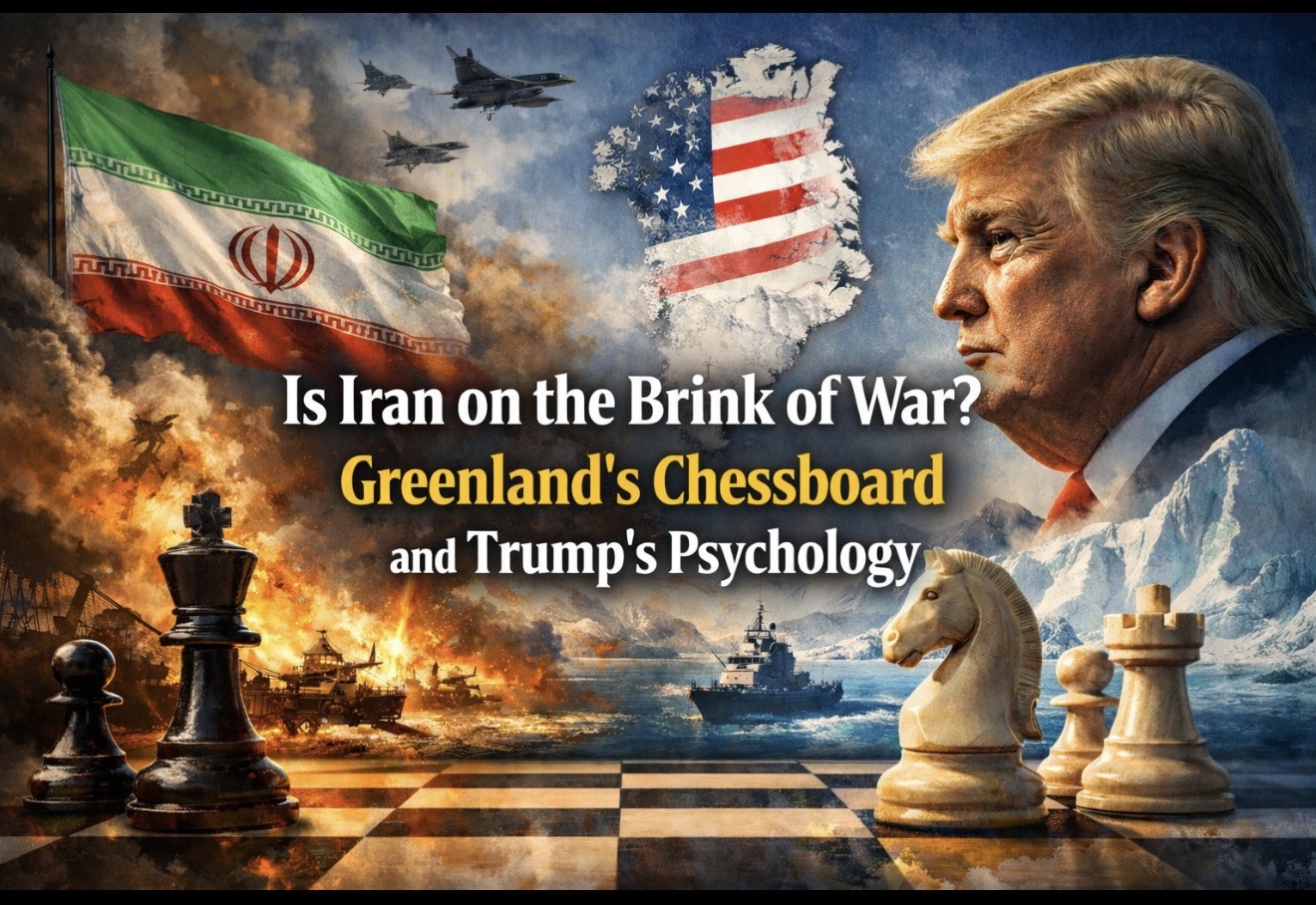
The shared lesson across Trump’s books is simple: a successful deal is one in which the other side comes to believe it has no viable alternatives. In Iran, Trump is cultivating the perception that the price of resistance continues to rise. In Greenland, he seeks to create an environment in which the future appears uncertain outside the American sphere of influence. That is why he is unlikely to launch an immediate war against Iran or attempt to legally annex Greenland. Instead, he will keep both within a framework of time, pressure, and control.
This is the essence of Trump’s psychology. He does not repeat history; he seeks to rewrite it with new language and new methods. For him, the greatest risk is not the loss of land, but the loss of control. Whether Iran or Greenland, every square on Trump’s new chessboard revolves around a single principle: that control remains in his hands—even if achieving it requires no war at all.