

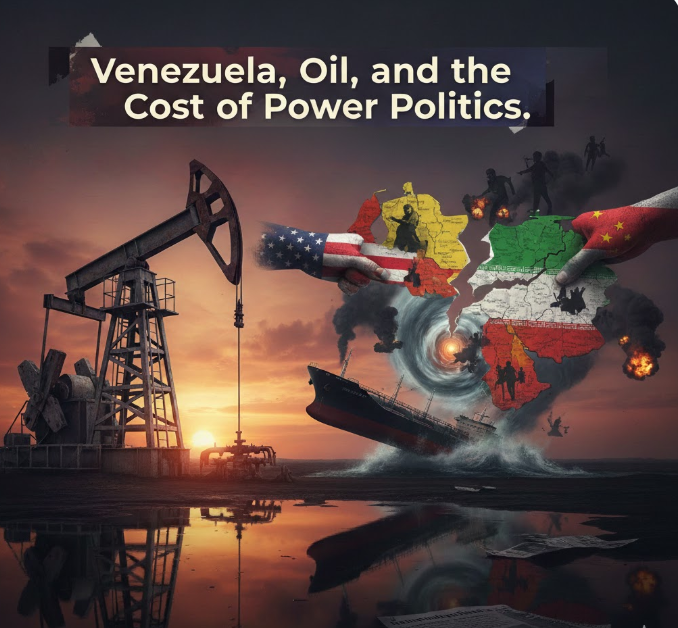
Bismillah, in the name of Allah, the Most Merciful, the Most High.
I begin a new journey, along with the goals that come with it.
I am starting this channel and writing these articles with a simple intention: to educate, to spread
awareness, and to inspire minds that feel lost, confused, or overwhelmed. This is a space for a different
lens, a fresh perspective on daily news, on stories that are suppressed or distorted, on ideologies,
beliefs, propaganda, psychological warfare, and global politics.
But in the midst of all this noise, I do not want to lose myself.
So this channel will not just reflect headlines. It will reflect thought. My views, my questions, my
reflections, and my understanding of what is unfolding around us. Not to dictate truth, but to invite
critical thinking. Not to provoke hate, but to provoke awareness.
On Narratives, Noise, and Coexistence
Recently, in world news, you have seen the slander, the manipulation of narratives, the selective
outrage, and the deliberate silencing of certain voices. We are shown what to see, told what to believe,
and pressured into choosing sides without ever being given the full picture.
It feels all so dystopian.
And yet, at the same time, we are all living in this world together, trying to coexist, trying to get
along, trying to find meaning in the middle of uncertainty.
We wake up to headlines designed to divide us, narratives crafted to keep us anxious, angry, or
distracted. Slowly, without realizing it, we begin to see each other not as people, but as positions.
Labels replace conversations. Reactions replace understanding.
But coexistence was never meant to be easy. It was meant to be conscious.
We are not here to think the same, believe the same, or move in the same direction. We are here to
learn how to disagree without dehumanizing, to question without hatred, and to exist without losing our
sense of self.
In a world that constantly demands allegiance, choosing thought becomes an act of resistance.
When we talk about dystopia, power, narrative control, and coexistence, we are not speaking in
abstractions. We are speaking about real countries, real people, and real consequences.
Venezuela and the Present Moment
This brings us to the present moment and the focus of today’s discussion: Venezuela.
In recent days, headlines have been dominated by reports surrounding the detention and forced
transfer of Venezuela’s sitting president, Nicolás Maduro. Many are calling this moment
unprecedented. Some narratives frame it as justice, others as liberation, and some quietly as a
strategic play.
At first, the language was familiar: drugs, corruption, criminal networks. The same words we have
heard before.
But as the dust begins to settle, the underlying truth becomes harder to ignore. This was never only
about drugs. It was never only about democracy. It was about oil.
Oil, Alignment, and Power Blocs
Venezuela holds some of the largest proven oil reserves in the world. This raises a serious question:
before the United States escalated pressure and moved toward what many describe as hostile
intervention, was Venezuela redefining its oil relationships elsewhere?
The answer is yes. For years, Venezuela had been deepening energy cooperation with countries
outside the U.S. sphere of influence, most notably China and Iran.
China extended billions of dollars in loans to Venezuela, many backed directly by oil shipments. Iran,
facing its own sanctions, entered oil-for-fuel and refinery assistance arrangements with Venezuela.
Tankers moved quietly. Technology was exchanged. Both nations, isolated by Western pressure, found
utility in cooperation.
This was not symbolic diplomacy. It was structural. Oil was used as currency, leverage, and long-term
alignment.
For much of the world, this reflects a functioning democracy: the ability to pursue free markets and
resource distribution. This is something that should be respected globally and treated with diplomacy.
However, it has become clear that the United States seeks to reinforce its position as the world’s
dominant power.
The Cost and the Message
But at what cost? People died in the strike that captured Maduro. They became statistics, as seen
repeatedly in global conflicts.
The message appears clear: negotiate on our terms or face war.
Is this now the global playbook for the United States and countries like Israel? Where is the diplomacy?
Where is the compassion? And what is the greater agenda?
When a resource-rich country redirects its strategic assets toward rival power blocs, it stops being
viewed as unstable and begins to be seen as uncontrolled.
This is when framing shifts. Conversations intensify around drugs, corruption, criminal networks, and
threats to regional stability. These issues may exist, but the timing of outrage is rarely accidental.
The question is not whether Venezuela had internal problems. The question is why those problems
became intolerable only after oil relationships moved in directions the United States opposed.
A Pattern, and an Ethical Question
This pattern is not unique to Venezuela. History shows that when oil, trade routes, or alliances drift
away from dominant powers, concern turns into pressure, pressure into sanctions, and sanctions into
intervention.
This leads to the ethical core of the debate. If a country sells its resources to China or Iran instead of
the United States, does that justify destabilizing its political system? Does economic alignment justify
regime change?
If such actions become normalized, what message does this send to nations asserting sovereignty?
From their perspective, the lesson is clear: align with power or prepare to be corrected.
This is not how global peace is built. This is how global fear is maintained. When fear becomes policy,
coexistence turns into competition, diplomacy into dominance, and democracy into a tool used only
when convenient.
