

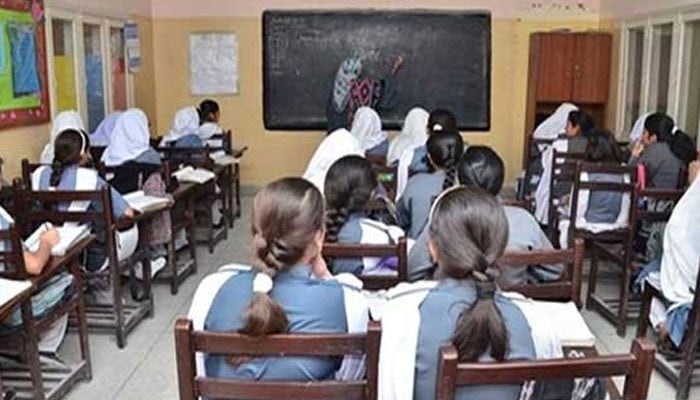
The education sector in Sindh, Pakistan, has been plagued by corruption and bureaucratic red tape in 2025. The Sindh Textbook Board’s decision to award a Rs 5 billion contract to preferred publishers has sparked an investigation by the anti-corruption agency, but it has been hindered by the involvement of influential personalities.
According to Sajid Yousuf, chairman of the Urdu Bazaar Trades Association, a mafia has been ruling the Sindh Textbook Board, with a few favored private publishers being awarded contracts to print textbooks. This has led to a crisis in the education sector, with students suffering due to delayed publication of textbooks.
The situation in Sindh’s education sector has been further complicated by the lack of permanent officers in the eight educational boards of the province. In 2025, the posts of controllers, secretaries, and audit officers were not filled, leading to delays in the announcement of results for matric and intermediate students.
The University of Karachi’s University Union, International, held a meeting with the vice-chancellor, Dr. Khalid Mahmoud Iraqi, and members of the organizing committee to finalize plans for the annual Youth Day celebrations. Professor Aijaz Farooqui, president of the University Union, International, said that the powerful mafia has been operating in the education sector for the past 54 years, deliberately delaying the publication of textbooks and threatening those who speak out against them.
Sajid Yousuf alleged that the mafia uses various tactics, including delaying the publication of government-issued textbooks and using low-quality paper for private publishers. He said that the mafia’s actions have resulted in corruption and a lack of transparency in the education sector.
The situation in Sindh’s education sector has been further complicated by the out-of-school children crisis, with an estimated 75-80 million children out of school in the province. According to official estimates, millions of children have dropped out of school due to various social, economic, and administrative reasons.
In other news, a police crackdown on dacoits in Orangi Sector 9 led to the arrest of two suspects. Severe fog in various parts of Punjab disrupted daily life, with several motorways sections being closed temporarily.
In international news, Pakistan’s ambassador to the United States, Muhammad Zubair, said that Pakistan has achieved a new height of international recognition after its victory in the war. The foreign minister said that dialogue and diplomacy are the only ways to resolve issues.
In sports news, cricketer Shahid Afridi said that he is willing to engage in discussions with the establishment to improve ties with the provincial government.
In a separate incident, a wounded deer was found in the Psorar Sojo Wali area of Sheikhupura. According to local residents, the deer was injured by stray dogs.
In political news, PPP Chairman Bilawal Bhutto Zardari met separately with Sindh Chief Minister Syed Murad Ali Shah and IG Sindh Javed Ali Omar.
In a separate incident, four bodies were found in a men’s hol in Miani Chawla, Karachi.
The PTI said that Imran Khan’s statement was an attempt to cover up the government’s failures, adding that the government’s formula to fool the nation has failed. Rana Sanaullah said that the PTI leadership is claiming to be in favor of dialogue, but the actual intention is to gain power.
In economic news, the government announced plans to privatize state-owned enterprises, saying that the process would be an important step towards economic reforms. The foreign minister reiterated that dialogue and diplomacy are the only ways to resolve issues.
In a separate incident, a wounded deer was found in the Psorar Sojo Wali area of Sheikhupura. According to local residents, the deer was injured by stray dogs.
In a statement, the National Disaster Management Authority (NDMA) issued a warning about severe fog in various parts of the country.
The article concludes that the education sector in Sindh has been plagued by corruption and bureaucratic red tape, leading to a crisis in the education sector and a decrease in the number of students attending schools. The situation has been further complicated by the lack of transparency and accountability in the education sector, as well as the out-of-school children crisis.
