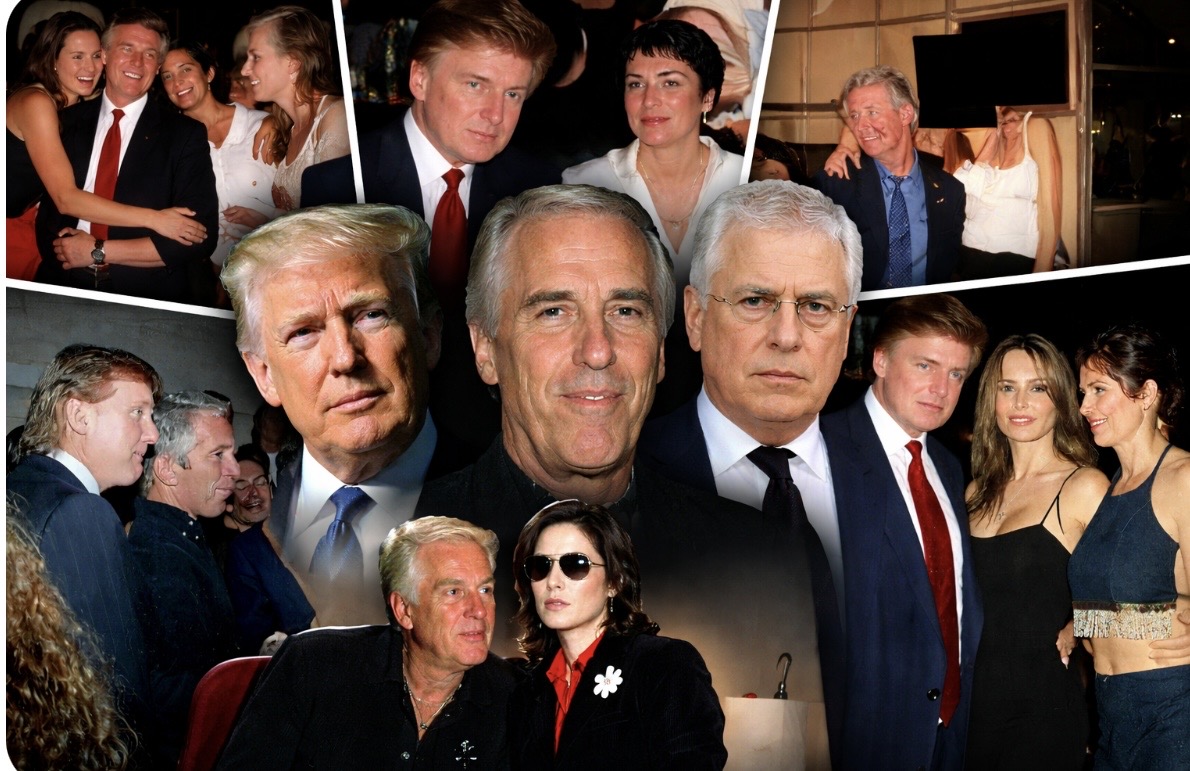
Jeffrey Epstein: A Shadow Moving Through the Palaces of Power
By Raja Zahid Akhtar Khanzada
Some stories begin with an individual and end with the face of a system. Others are not biographies at all but psychological studies of power itself. The story of Jeffrey Epstein belongs to this second category. A name that outwardly belonged to a wealthy financier was, in reality, a shadow moving through closed rooms of power where decisions are not made by votes but by silence, where the law lives in books and authority resides in files, where politics, capital, fame, and fear do not exist separately but breathe in the same confined space.
Whether it is the current American president Donald Trump or former president Bill Clinton, Britain’s Prince Andrew or the globally renowned musician Michael Jackson, Britain’s former prime minister Tony Blair or the glittering stars of Hollywood, the darker threads of many powerful lives appear to orbit a single name: Jeffrey Edward Epstein. He was neither a politician, nor an artist, nor a monarch, yet he stood among them all. A conduit. A medium. A mirror in which power could see its true reflection and still refuse to acknowledge it.
The Epstein files are no longer merely a criminal record in the United States. They have become a map. A map where the roads of politics pass through the palaces of capital, where celebrity outruns the law, and where covert pressure outweighs constitutional principle. Papers, photographs, videos, recordings, and officially sealed memoranda stored in the guarded rooms of the U.S. Department of Justice continue to speak in their own muted language. What they say is unmistakable: this is not the story of a single offender, but of an entire structure.
Jeffrey Epstein was not an ordinary wealthy man. His connections stretched from Wall Street to the White House, from European royal households to Hollywood salons, from legislative corridors to the rumored inner circles of secret power. His private jets, his private island, and the gatherings held behind closed doors revealed a world not open to everyone, where entry was not granted by invitation alone but by proximity and usefulness.
In American history, there are names that grow more alive after death. Epstein is one of them. Ostensibly a successful investor, he was in truth a figure walking the narrow space between power, fame, and crime, unsettling the most influential circles in the world. His life posed a question. His death became an even larger one.
Earlier this month, when the Epstein files briefly appeared on the website of the U.S. Department of Justice and then quietly vanished, it was not merely a technical error. It was a tremor in the chambers of state memory where power stores its secrets. It was a glimpse of the fear that arises even before the full truth is allowed to surface.
Within those files, several well known names emerged: Bill Clinton, Andrew Mountbatten Windsor, Mick Jagger, Michael Jackson, and U.S. President Donald Trump. According to court records, Epstein allegedly introduced a fourteen year old girl to Trump at the Mar a Lago resort in Florida. The record states that Epstein nudged Trump with his elbow, gestured toward the girl, and joked, “She’s a good one, isn’t she?” Trump reportedly smiled and nodded. Both men laughed. The victim later said she was so young at the time that she did not even understand the source of her discomfort.
This is the moment where the tone of history changes. Because this is not merely about an allegation, but about the emotional numbness of power. A moment in which a child’s silence becomes a moral failure of the state itself.
In the same context, recordings surfaced in which Epstein described himself as a close friend of Trump. In these tapes, he claimed that Trump maintained illicit relationships even while serving his first presidency in the White House. These are claims, unverified and unsupported by evidence. Epstein offered no proof. Yet their weight comes from the fact that they were spoken by someone who had access to the innermost circles of influence. He also alleged that Trump had been unfaithful to his wives Ivana Trump and Marla Maples, and attributed to him remarks and behaviors of such a graphic nature that they cannot be reproduced in full. According to Epstein, Trump was known to fixate on the wives of friends and possessed an ability to manipulate and alienate them in ways that served his own desires.
These statements are not judgments. They are not verdicts. But they do paint a portrait of a society in which success and character are measured on separate scales, where morality exists in speeches and authority operates behind locked doors.
Epstein was first convicted in 2008 on charges related to the sexual trafficking of underage girls. Astonishingly, he escaped a severe sentence. A secret plea deal, limited confinement, and extraordinary privileges. It was at this point that the first serious question emerged: who was protecting him, and why?
In 2019, Epstein was arrested again. This time, the charges were far more serious. A federal court. Powerful names. Intense media scrutiny. And then, one night, he was found dead in his cell in a New York jail. Officials ruled it a suicide. Much of the world did not accept that explanation. Surveillance cameras malfunctioned. Guards were reportedly asleep. Critical questions went unanswered. Epstein’s death ignited a new debate: was he silenced before he could speak?
The Epstein files are, in essence, a record of a network built over decades. They contain documents, photographs, videos, flight logs, emails, and internal memoranda. Together, they point to a system that was not accidental but carefully maintained.
These files are not merely a list of names. They represent a truth divided into three layers. Some names are fully exposed. Some appear wrapped in partial truths. And others exist only in blacked out lines, missing pages, and deliberate silences.
From this point onward, the story is no longer only about crime. It becomes a story about power, fear, and unspoken agreements.
Part Two
From here, the story enters a deeper and more unsettling circle. A realm where names grow fewer and shadows multiply. Where documents are blacked out before they are allowed to speak. Where the truth is not fully concealed, but revealed only halfway, ensuring that the remaining half can never quite be proven. This is where the Epstein files become most disturbing, because what is withheld outweighs what is shown.
Several names have already surfaced in these files: former U.S. President William Jefferson Clinton, current President Donald John Trump, Prince Andrew Albert Christian Edward of the British royal family, the globally renowned musician Michael Joseph Jackson, Mick Jagger, Diana Ernestine Ross, actor Chris Tucker, and a number of billionaire financiers. But simply listing these names does injustice to the story. The central question is not who appeared in a photograph, but what was being preserved behind the photograph.
At the center of this network stood Jeffrey Edward Epstein himself. Around him operated Ghislaine Noelle Maxwell, emerging as its logistical manager. She is the woman who was convicted, yet whose silence continues to leave the story incomplete. Her testimony never formed a full picture. It feels as though someone knocked on the door of truth, only to be denied entry.
In the spheres of entertainment, finance, and culture, figures such as Michael Jackson, Mick Jagger, Diana Ross, and Chris Tucker appeared in photographs connected to Epstein. Each time, the same clarification followed: appearing in a photograph is not a crime. That is true. But the more pressing question remains. Why did Epstein have access to these circles at all. Which door opened for him repeatedly. And what shield protected him time and again.
In the world of finance, names such as Leon David Black, William Henry Gates III, and Leslie Herbert Wexner serve as reminders that financial power provided Epstein with a form of social armor. In global politics, references to figures such as Ehud Barak and Anthony Charles Lynton Blair demonstrate that this network was not confined to American borders. In the context of the Trump family, the names Ivanka Marie Trump and Jared Corey Kushner also surfaced in social settings. No direct allegations were proven against them, yet proximity to power is rarely neutral.
Then comes the second tier. These are the names that never fully entered public view, yet without which the story remains incomplete. Alan Morton Dershowitz, a powerful American attorney whose name repeatedly surfaced in allegations and counterclaims. Sarah Kellen, associated with the administrative operations of the Epstein network and frequently mentioned in victim testimonies. Maria Farmer, the first voice to sound the alarm years earlier, only to be ignored. Virginia Louise Giuffre, whose testimony led to global legal scrutiny of Prince Andrew. Glenn Dubin, a financier whose name appeared in social connections. Lawrence Henry Summers, former U.S. Treasury Secretary and president of Harvard University, whose association with Epstein raised questions about academic and financial elites. Jean Luc Brunel, the French modeling agent later found dead in prison, becoming yet another symbol of a silenced ending.
And then there is the third and most unsettling tier. The names that have not surfaced at all. Politicians, corporate executives, Gulf and European elites, and possibly individuals linked to intelligence services, whose identities were redacted or whose pages vanished entirely. It is here that the name Mossad emerges as a whisper. There is no official confirmation. Yet in global discourse, the question continues to circulate: was Epstein merely an individual, or an instrument.
This is why the presence of cameras in Epstein’s residences, on his private island, and aboard his aircraft is not viewed solely through the lens of sexual crime. The deeper issue is power. Images and videos become a silent currency, capable of softening laws, reshaping decisions, and binding powerful individuals to one another. No signatures. No formal agreements. And yet state policies shift.
Within the context of the Muslim and Gulf world, certain names also appeared in discussions of reported associations and social environments. Saudi Crown Prince Mohammed bin Salman does not appear in any criminal file, yet investigative American journalism raised questions about how a figure like Epstein gained access to Middle Eastern elites. Similarly, the names Ahmed Al Khateeb, Khalid Al Falih, and certain Saudi investment circles were mentioned in non accusatory contexts. In the United Arab Emirates, the name of Mohammed Alabbar surfaced in discussions of Dubai’s real estate and investment environment. The bin Laden family name appeared solely to indicate social and financial circles, with no allegation or connection to Osama bin Laden or terrorism.
Taken together, these references suggest that Epstein’s network was not limited to the West. It was a global web of capital, politics, and influence. It is against this backdrop that speculation regarding Mossad takes shape. These are not accusations, but questions. Questions not posed in courtrooms, but in the conscience of history.
It is often said that Epstein was not merely a criminal, but a conduit. A collector of powerful people’s vulnerabilities. Images, videos, secret relationships. These elements move beyond personal deviance and begin to resemble a system of potential blackmail. A system in which silence becomes the most valuable currency.
After his arrest in 2019, the U.S. Department of Justice launched a renewed investigation. Accomplices, financial networks, and properties were all under review. But Epstein’s sudden death left that investigation unfinished. Congress spoke of legislation. Promises of transparency were made. Yet what was released was incomplete. Pages were redacted. Names were removed. Images disappeared.
According to POLITICO, thousands of documents briefly appeared on the Department of Justice website before vanishing without explanation. This was the same eighth data set intended for phased release. The material that surfaced consisted not of original documents, but of references to memoranda. If those memoranda were ever released in full, they might clarify why prosecutors chose not to pursue charges against others connected to Epstein’s network.
A spokesperson for former President Bill Clinton demanded the release of all remaining material. Republican Congressman Thomas Massie raised the possibility of contempt proceedings. Senate Minority Leader Chuck Schumer announced plans for a resolution. Yet the silence of the Department of Justice persisted.
This entire narrative leads to a fundamental question. Is the state afraid of its own truth. Are those closest to power subject to the same law as everyone else. Or does the law itself fall silent in the presence of power.
The Western world, long viewed by many in the developing world as a model of morality, transparency, and rule of law, has appeared in a different light after the Epstein files. President Trump remains in office today, and the questions surrounding him are no longer about an individual alone, but about the system itself.
For today’s reader, this is not merely a scandal. It is a mirror. Faces change within it, but the face of power remains the same. Perhaps that is why Jeffrey Epstein remains alive even after death, because the real story continues to breathe inside sealed files.