

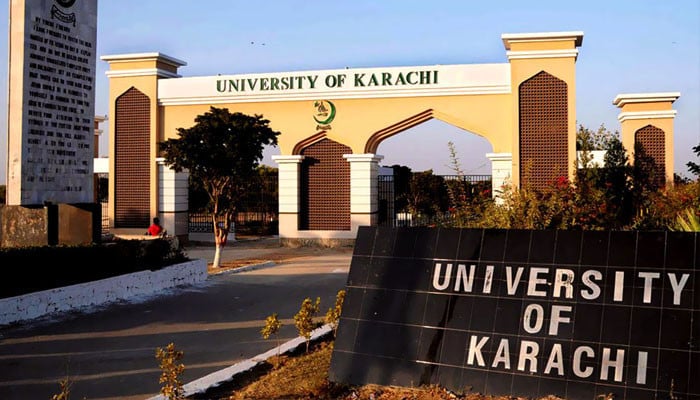
The 23rd session of Karachi University’s Senate convened on Tuesday at the Chinese Teachers Memorial Auditorium, Karachi University, under the chairmanship of provincial Minister for Universities and Educational Boards, Muhammad Ismail Rahoo. The assembly unanimously approved the proceedings of the 22nd session (held on December 23, 2024) and discussed the annual statement of the financial year 2023-2024, the revised budget for 2024-2025, and the proposed budget for 2025-2026.
Following detailed deliberations, the Senate approved the annual statement of the financial year 2023-2024, the revised budget for 2024-2025, and the proposed budget for 2025-2026. On this occasion, the laws governing the Karachi University Endowment Fund and the Pension and Endowment Fund were also approved. The aim of these laws is to make the university’s financial resources transparent, effective, and sustainable, and to ensure the security of employees’ pension matters.
Addressing the session, Provincial Minister Muhammad Ismail Rahoo stated that Karachi University is the largest and most populous university in Sindh, with a complex task of managing its operation and financial affairs. He added that the Sindh government is seriously and practically working to resolve the financial and administrative issues plaguing most of the public universities in the province. Rahoo emphasized that the government of Sindh is increasing grants for universities regularly and is well aware that the increase in inflation, salaries, and pensions has put pressure on universities.
He reassured that the Senate will make every possible effort to resolve the issues that arise during the session and that the proposal of a Bailout Package for Karachi University is also being considered. Rahoo emphasized that Karachi University is a shared asset of all of us, and the government, university administration, and educational experts will have to work together to improve its national and international ranking. He stated that the policy of the Sindh government is not limited to increasing the number of universities but also focuses on providing quality and higher education.
Vice-Chancellor of Karachi University, Professor Dr. Khalid Mahmood Iraqi, while addressing the session, said that despite severe financial difficulties, Karachi University’s educational and research performance is gradually improving, and its international ranking has also improved. He added that due to increasing inflation and government-level salary increases, most universities in the country are facing financial pressures, but the Sindh government’s increase in grants is commendable.
Dr. Iraqi stated that scholarships are being provided to students under the Higher Education Commission’s policy, online facilities have been expanded, new construction projects are underway, and improvements have been made in transportation, sports, and healthcare facilities, while the examination system has been made more transparent and effective. He announced that 66 professors and 71 associate professors have been permanently appointed to various faculties, departments, and centers on the basis of merit, which will further strengthen the university’s academic standards.
The session was attended by the Secretary of the Universities and Boards Department, Muhammad Abbas Baloch, and the Regional Director of the Federal Higher Education Commission, Saleem Ahmed. Rescue officials reported that the incident occurred due to high speed, and the injured were shifted to the hospital.
In other news, global media and Western sources have raised questions about the Indian narrative: Mashahid Hussain Syed has said that the flood-affected people have been provided with housing schemes in Karachi and other cities. According to sources, most non-filers have been sent notices, and women are also included in the list.
