

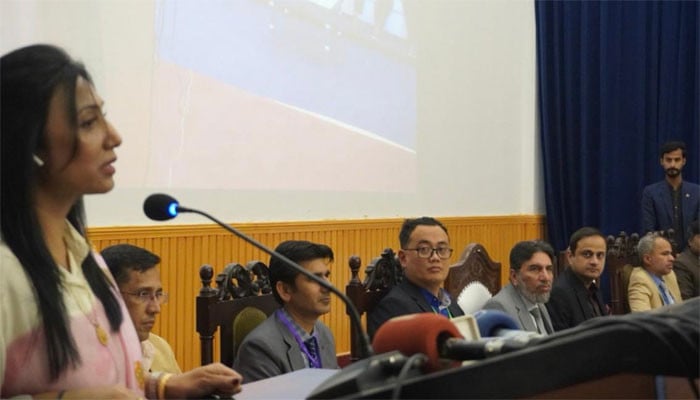
The 2-day AI conference, “Navigating Barriers: The Importance and Applications of Artificial Intelligence in Various Fields,” concluded on Friday, December 19, with a plethora of recommendations for the betterment of AI in Pakistan. The conference, held at the University of Engineering and Technology (UET) in Lahore, was a groundbreaking event that brought together experts from across the globe to discuss the latest advancements in AI and its potential applications.
The conference was attended by special guest Karachi Mayor Murtaza Wahab, who praised the UET for its commitment to promoting research, innovation, and technology. He emphasized the need to provide opportunities to young people, as a happy and motivated youth can drive progress and growth.
UET Vice-Chancellor Engineer Prof. Dr. Sumera Hussain (Sitara-e-Imtiaz, Tamgha-e-Imtiaz) thanked the Karachi Mayor for his visit and praised the conference’s success as a testament to the university’s continued growth and development, which is made possible with the support of the Sindh government. She acknowledged the efforts of conference convener and Dean of the Faculty of Information and Computing Sciences, Prof. Dr. Atif Jamal, Director of Students Affairs and Security, Engineer Dr. Saddam Ali Khichi, and student volunteers, who worked tirelessly to make the conference a success.
The conference’s recommendations emphasized the importance of AI in enhancing human capabilities, provided it is used in an ethical, professional, and responsible manner. The recommendations included the provision of regular training to faculty members and students on the use of AI tools such as chat GPT, Jamnai, and other modern AI tools to enable them to develop innovative and interdisciplinary solutions. Experts also agreed that AI should be used in a coordinated manner to make predictions, prevent crimes, ensure security, and solve social problems.
In the defense and strategic context, the recommendations emphasized the need to invest in AI and machine learning-based technologies instead of traditional arms, and that ethical AI is a significant global challenge that requires an international framework, code of ethics, and audit systems.
In the corporate world, the recommendations suggested that industries can maintain their stability by forming eco-systems, conducting research and development, strategic partnerships, and promoting embedded AI in university systems. Experts also noted that AI will augment the capabilities of materials engineers and other professionals, rather than replacing them, and that future energy systems will be intelligent, autonomous, and self-improving, creating new opportunities for Pakistan and other developing countries.
In a related development, the Sindh government has approved a market survey report on agricultural medicines and pesticides, which highlights serious shortcomings in the market. The report has been approved under the Pakistan Public Resources for Inclusive Development Programme.
In other news, the police have arrested the influential accused involved in the Mirpur Mathelo jirga, and the search for the other accused is ongoing. Prime Minister Shehbaz Sharif has directed federal ministers to resolve the exporters’ issues on a priority basis to increase exports. Sindh government spokesperson Saadiya Javed has said that MQM-Pakistan leader Farooq Sattar cannot mislead the public further through his script.
The court has handed down a written verdict, stating that the two accused have committed the crime, and sentenced them to 10 years in prison under Section 409 of the Pakistan Penal Code, and 7 years in prison under the Anti-Corruption Practices Act. The court has also imposed a fine of PKR 1 crore on both accused.
In a related development, the police have reported that three accused were arrested during a raid in Nazimabad on December 13, who were involved in a major case of tax evasion in Malir.
