

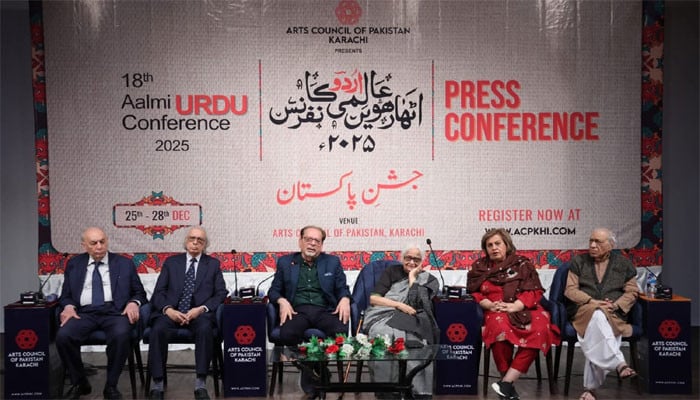
The Arts Council of Pakistan in Karachi hosted the 18th World Urdu Conference 2025, a 4-day event themed ‘Jashn-e-Pakistan,’ in Auditorium II. The conference was addressed by President Arts Council, Muhammad Ahmed Shah, renowned poet Zehra Nigah, educationist and scholar Pirzada Qasim Raza Siddiqui, Vice President Munawar Saeed, Joint Secretary Noor e Huda Shah, and Secretary Arts Council Ajaz Farooqui. A large number of journalists attended the briefing session.
On this occasion, President Arts Council Muhammad Ahmed Shah said that the 4-day World Urdu Conference 2025 would begin on Thursday, December 25, and would be held till December 28 at the Arts Council. He stated that the conference would pay tribute to the contributions of renowned writers, including Fatima Surayya Bajia, Mustafa Ahmed Yusufi, and Intizar Hussain, among others.
The President expressed his gratitude to the media for covering the World Culture Festival for 40 days straight, making it a global phenomenon. He emphasized that the media plays a vital role in cultural activities throughout the year, whether in Sukkur, Hyderabad, Quetta, Lahore, or Kashmir. He stated that the Pakistan Literature Festival is taking place across the country, and the World Culture Festival has made Karachi the cultural hub of the world.
Mohammad Ahmed Shah also mentioned that Sindh Chief Minister had said that Karachi was once the capital of Pakistan, and now it is the cultural capital of Pakistan. He emphasized that a nation’s culture and literature are its identity, and that is why Pakistan’s art and culture are essential to its existence.
The President further stated that the World Urdu Conference was started 18 years ago, and it is now the largest Urdu conference in the world. He mentioned that the conference was started during a time when ethnic cleansing was prevalent in the country. He emphasized that dialogue and literature played a crucial role in raising awareness and promoting peace.
The President also spoke about the importance of film propaganda, stating that India has been using it as a tool of war. He claimed that Pakistan has responded to Indian propaganda with equal force.
Before the press conference, President Muhammad Ahmed Shah expressed his condolences to the families of the victims of the APS attack in Peshawar. He stated that the attack was a dark day for Pakistan and that the country would never be defeated by such acts of terrorism.
The renowned poet Zehra Nigah spoke about the importance of literature in promoting peace and culture. She emphasized that Urdu is the language of unity and that it has the power to bring people together.
The Joint Secretary of Arts Council, Noor e Huda Shah, spoke about the importance of the World Urdu Conference, stating that it has become a symbol of peace and cultural unity. She emphasized that the conference has been a success for 18 years and that it would continue to promote cultural and literary activities.
The Secretary of Arts Council, Ajaz Farooqui, stated that the conference has been a success due to the efforts of President Muhammad Ahmed Shah. He emphasized that the conference has become a platform for promoting cultural and literary activities.
The conference also featured a tribute to the victims of the APS attack, and a candlelight vigil was held in their memory.
In other news, the Indian government has been facing criticism for its handling of the Pulwama attack, and the Indian media has been accused of bias.
The Pakistan government has been accused of not doing enough to prevent the attack, and the opposition has been criticizing the government’s response.
The conference also featured a tribute to the Indian poet and writer, Faiz Ahmed Faiz, who was a vocal critic of the Indian government’s policies.
The conference also featured a discussion on the impact of social media on literature and culture, and the role of technology in promoting cultural and literary activities.
The conference also featured a tribute to the Pakistani poet and writer, Habib Jalib, who was a vocal critic of the Pakistani government’s policies.
The conference also featured a discussion on the importance of literature in promoting peace and cultural unity, and the role of literature in shaping public opinion.
The conference also featured a tribute to the Indian poet and writer, Makhdoom Mohiuddin, who was a vocal critic of the Indian government’s policies
