

***
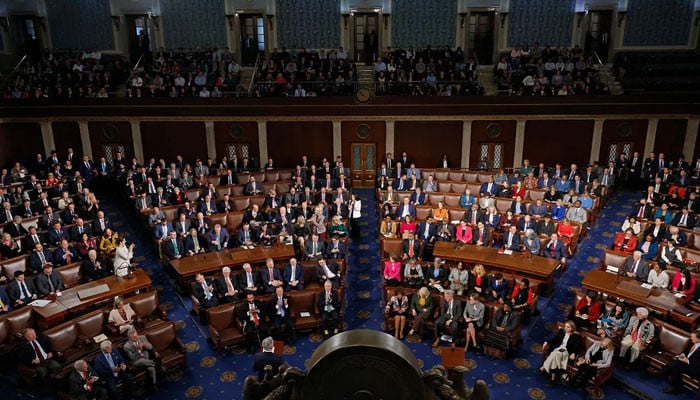
The U.S. House of Representatives has overwhelmingly approved the country’s largest-ever defense authorization bill, allocating a staggering $901 billion for national security. The legislation, which passed with a vote of 312 in favor and 112 against, now moves to the Senate for final consideration.
The new defense package includes substantial provisions aimed at improving military welfare, such as increased salaries and better housing allowances for service members. It also earmarks $800 million in military aid for Ukraine, to be dispersed over the next two years. A significant priority within the bill is the full funding of key Israeli missile defense initiatives, specifically the Iron Dome and David’s Sling systems.
However, the massive military expenditure comes at the cost of domestic initiatives, with the bill enforcing a $1.6 billion cut in funding previously designated for climate change mitigation and diversity programs. Following Senate approval, the bill is expected to be signed into law by President Donald Trump.
### Geopolitical and Humanitarian Flashpoints
Global tensions remain heightened across multiple fronts.
In the Middle East, Israel moved to formalize its presence in the West Bank by legalizing 19 new Jewish settlements. Concurrently, the region is grappling with a severe humanitarian crisis in Gaza, where Storm Byron has caused widespread devastation. Heavy rains, high winds, and the collapse of fragile structures have resulted in the deaths of at least 14 Palestinians, including several children.
In response, the United Nations Special Representative for Palestine called on countries supplying weaponry to Israel—specifically the United States, Germany, the United Kingdom, and Italy—to take financial responsibility for the subsequent reconstruction of Gaza. Separately, U.S. Special Forces reportedly conducted a raid last month in the Indian Ocean, intercepting and seizing defensive equipment onboard a vessel traveling from China to Iran.
Further international friction was noted in Eastern Europe, where Russia conducted attacks on two Ukrainian ports, leaving one person injured. Meanwhile, the internationally recognized 2023 Nobel Peace Prize laureate, Narges Mohammadi, was detained by authorities in Iran.
### International Diplomacy and Legal Battles
In diplomatic news, President Trump announced a breakthrough in Southeast Asia, stating that Thailand and Cambodia had mutually agreed to cease all hostilities and armed clashes beginning immediately. Turkish President Recep Tayyip Erdoğan also met with Russian President Vladimir Putin on the sidelines of a meeting in Turkmenistan. In a high-profile international appointment, former Iraqi President Barham Salih was named the new head of the United Nations Refugee Agency (UNHCR).
The Trump administration is also facing substantial legal opposition domestically. Twenty U.S. states have filed a lawsuit in federal court challenging the President’s directive to impose a controversial $100,000 fee on the H-1B visa category. Furthermore, the administration announced the termination of Temporary Protected Status (TPS) for Ethiopian migrants.
In a law enforcement report, three Indian-origin truck drivers were arrested in Brampton, Canada, following a fatal shooting incident allegedly involving two rival trucking organizations, with one suspect still at large.
### Other Global Developments
In the realm of science, international scientists expressed acute concern following the detection of hundreds of ice quakes around the rapidly melting ‘Doomsday Glacier’ in Antarctica.
Meanwhile, a deeply localized issue sparked national controversy in India when Hussain Mastan Mirza, daughter of the notorious Mumbai underworld figure Haji Mastan, publicly appealed to Prime Minister Narendra Modi and Home Minister Amit Shah to help her secure recognition of her identity.
Finally, while domestic economic activities were reportedly stagnant, Pakistan’s Prime Minister maintained that his government had retained hope and was focused on revitalization efforts.
