General Faiz’s Sentence, Imran Khan’s Future, and the Next Chapter of the Power Game
By Raja Zahid Akhtar Khanzada
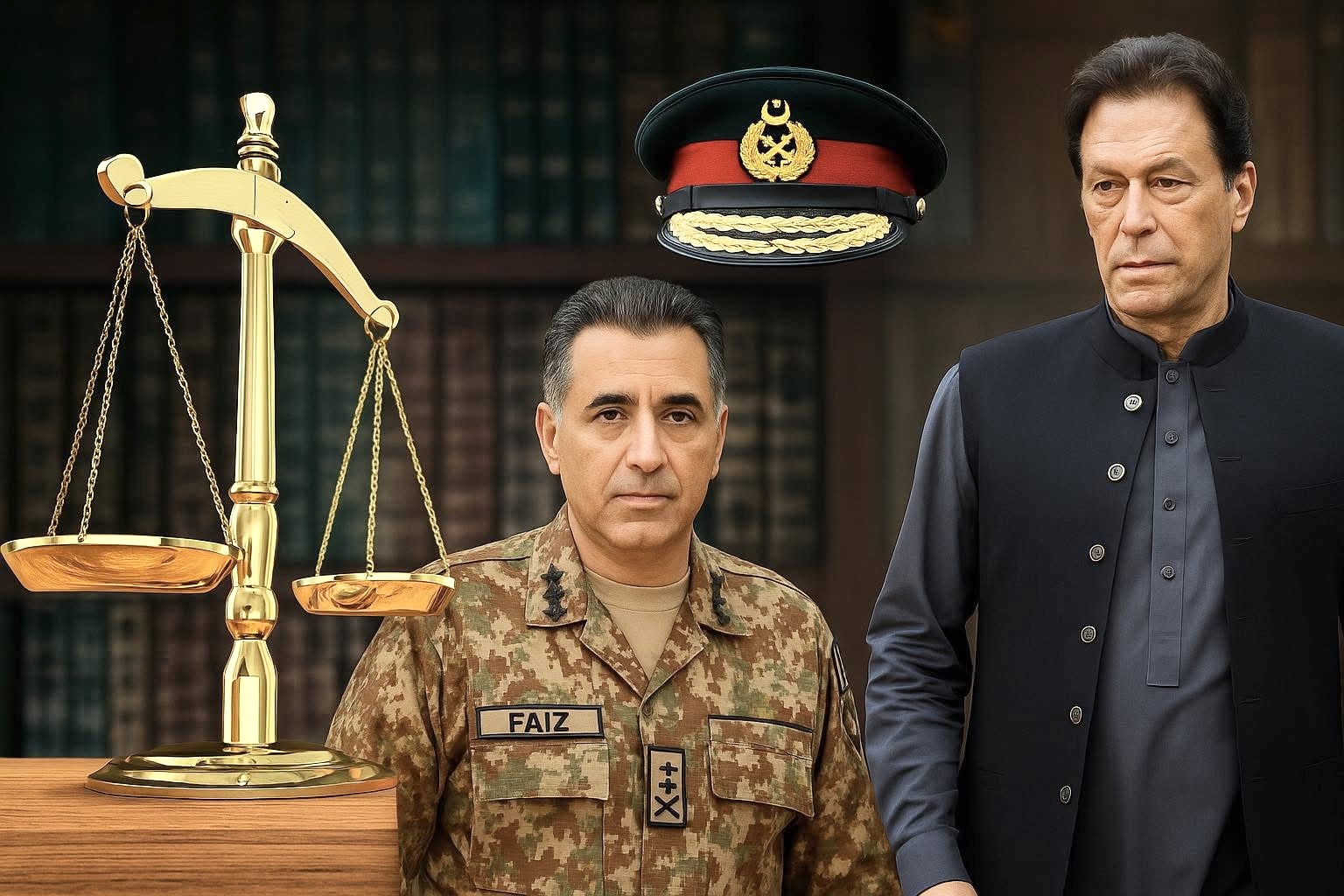
In the politics of power, there are decisions that appear on paper as just a few lines, yet quietly redraw the entire map of fear, hope, and authority for decades to come. The conviction of retired Lieutenant General Faiz Hamid by a military court and his sentence of fourteen years of rigorous imprisonment is one such decision. At first glance, it looks like the accountability of a retired general. Look closer, and it becomes a newly drawn line between three pasts and three futures. One past belongs to General Bajwa, another to General Faiz, and the third to Imran Khan. And alongside them stand three futures: that of the military, of Pakistan Tehreek-e-Insaf, and of Pakistan’s fragile political equilibrium.
The Field General Court Martial proceedings stretched over nearly fifteen months. They began on August 12, 2024, marked by prolonged cross-examinations, dozens of hearings, and eventually a single sentence that changed everything. The former Director General of ISI was found guilty on four counts: interference in political activities, violation of the Official Secrets Act, misuse of authority and state resources, and causing harm to certain civilians. The military’s media wing described it as the outcome of a long and painstaking legal process. On December 11, 2025, the punishment was formally announced.
This was unprecedented in Pakistan’s seventy-eight-year history. Never before had a former DG ISI not only been court-martialed but also publicly sentenced. For decades, this office had been seen as the nerve center of a shadow government. Today, a former occupant of that chair stands convicted before the same institution that once embodied unchallenged power. Officially, this is accountability. Yet every serious observer is asking the same questions: where does this accountability begin, where will it end, and whose political future is being quietly written into the next chapter.
Almost immediately, a flood of narratives followed. Some called it delayed justice. Others framed it as institutional cleansing. Still others saw it as another rearrangement of power, where old pieces are being removed and new ones aligned with a revised establishment narrative. Defense Minister Khawaja Asif stated bluntly that the nation would reap the harvest of seeds sown by General Faiz Hamid and General Bajwa. By invoking fate, power, and fear of God, he made it clear that this sentence was not meant for one man alone but for a way of thinking that treated politics, the state, and institutions as pieces on a single chessboard. It was, in effect, a collective indictment of an era, even if only one individual has been punished so far.
Among analysts, another phrase keeps resurfacing: this is only the first step. Many see the verdict as a prelude to tougher action against Imran Khan. Their argument is simple. If the military has punished the figure widely seen as central to the 2018 elections, the Faizabad sit-in, political engineering, and the backdrop of May 9, then it becomes far easier to use his record, and potentially his testimony, to move upward toward political leadership.
The final paragraph of the ISPR statement is especially telling. It explicitly notes that certain aspects of the accused’s conduct, including efforts to foment political agitation and instability in collaboration with political elements, are being examined separately. That single phrase, separately, unlocks the door to future cases, narratives, and possible testimonies. The court martial, in this reading, is not the end of the story but the legal groundwork for what comes next.
It is in this context that Senator Faisal Vawda’s claim takes on heightened significance. He has asserted that retired Lieutenant General Faiz Hamid will testify against PTI founder Imran Khan in the May 9 cases, revealing the internal details of meetings where, allegedly, instructions were given for political unrest. If this claim materializes, Faiz Hamid will cease to be merely a convicted general and instead become the principal witness of an entire political era. That is where the real danger for PTI begins. The question will no longer be whether more cases are filed against Imran Khan, but whether, for the first time, a powerful general states on record that he acted at the behest of an elected prime minister or political leadership. If such testimony enters the judicial record, Imran Khan’s case could be reframed from that of an individual to one cast as the state versus rebellion.
The verdict has also clarified what many now call Pakistan’s hybrid plus system. On one side are courts, the constitution, parliament, and the language of law. On the other are the unspoken rules that shape frameworks, install governments, remove them, and offer the public only revised narratives each time. From Hassan Askari to Rasul Bakhsh Rais, many scholars interpret this decision as evidence of the system’s consolidation. The message, in their view, is unambiguous. The framework will be set by the establishment. Anyone who steps outside it, whether in uniform or without, will eventually pay a price. The only difference lies in the label. One becomes an example through exemplary punishment. Another becomes a political case.
The central issue is not whether Faiz Hamid was innocent or guilty. Nor is it about whether his lawyers received the verdict on time, or how many of the thousands of questions were answered. The real question is whether the status quo has genuinely been challenged, or whether one face has been sacrificed as part of a larger political design to prepare for the next phase. When government ministers name both General Faiz and General Bajwa in the same breath but action is taken against only one, it inevitably raises doubts about whether accountability is impartial or merely convenient.
At this point, the lens shifts directly to PTI and Imran Khan. If a former DG ISI has been convicted for political interference, abuse of authority, and participation in decisions against the state’s interest, then scrutiny of the political forces that benefited from those decisions becomes unavoidable. Analysts like Mazhar Abbas have long argued that if events such as the 2018 elections, the Faizabad sit-in, or May 9 involved multiple actors, then limiting accountability to a single figure is inherently unjust. Yet the signals so far suggest that the next phase of accountability may well be directed at political leadership, with Imran Khan remaining the most prominent name.
For PTI, the meaning of this verdict goes beyond the punishment of a former ally. It signals that the era of informal friendships may now be formally examined in official files. Imran Khan’s opponents are already framing the moment by saying that the man once labeled the selector has been convicted, while the leader of the so-called selected politics remains in prison. If this narrative is synchronized with the state’s machinery, PTI could find itself increasingly cornered at an institutional level.
Within the military itself, the verdict draws a clear line for serving officers. Future political engineering will no longer appear as low risk as it once did. Retirement may no longer offer immunity. Yet the other side of this message is equally important. If exemplary punishments are applied only to specific eras and individuals, the process risks being seen less as self-correction and more as political cleansing.
The question at the heart of this analysis is whether bad times for Imran Khan and PTI are still approaching or have already begun. In practical terms, Imran Khan is already in prison, facing multiple convictions. His party is hemmed in by administrative and legal barriers, and the narrative of May 9 remains firmly embedded as the state’s position. Seen this way, Faiz Hamid’s sentence is not the beginning of pressure but a new layer of justification for it. From now on, whenever May 9, instability, or alleged conspiracies are invoked, the state can say it has punished its own general, and now the turn of political leadership has come.
Ultimately, the decision carries two messages. Internally, it warns institutions not to stray beyond the framework. Politically, it signals that any collective resistance to the new order will trigger the full force of law and institutions. As Rasul Bakhsh Rais describes it, this is the consolidation of a hybrid plus system, where parliament, courts, and the establishment align to safeguard a particular direction. Those who collide with it become either cautionary punishments or cautionary tales.
Two factors will determine how dangerous this verdict proves for Imran Khan and PTI. First, the course of Faiz Hamid’s appeal and the narrative he adopts along the way. Second, the judiciary’s approach to May 9 and related cases, particularly if testimony or documents of Faiz Hamid’s stature emerge. If both align with the state narrative, a political return for Imran Khan may become extraordinarily difficult. If fractures appear, if justice seems selective, or if the process fails to convince globally, the same decisions could seed new counter narratives.
Pakistan’s history teaches that no decision is ever final, no punishment tells the whole story, and no narrative remains dominant forever. Today, Faiz Hamid’s conviction marks a dramatic turn in the power game. Under its shadow, the path for Imran Khan and PTI will undoubtedly grow harder. But to say it has ended would be premature. This is a crossroads where all routes are visible, yet history will decide who is remembered as guilty and who as a victim of narrative.
For now, one thing is clear. In this new chapter of power, there are no complete victors and no complete vanquished. The most affected remain the people, who in every era are informed of new decisions but never granted access to the deals and arrangements behind them. If this verdict truly marks the beginning of the rule of law and accountability applied evenly in all directions, it could become the foundation of a new political maturity for Pakistan. If it remains only another exemplary punishment, history will record it simply as another general’s fall, a few more politicians in the dock, the system unchanged, and the public waiting once again for a new arbiter.
The unanswered questions still hang in the air. Will this decision make Pakistan more democratic, or merely more controlled. Will it permanently close the door on Imran Khan’s return, or transform him into a new symbol of resistance. And most importantly, will future generations remember this day as one of justice, or as another calculated use of power.
The answers have not yet been written. But when they are, the conviction of General Faiz, the imprisonment of Imran Khan, and the political siege of PTI will appear together on the same page.