

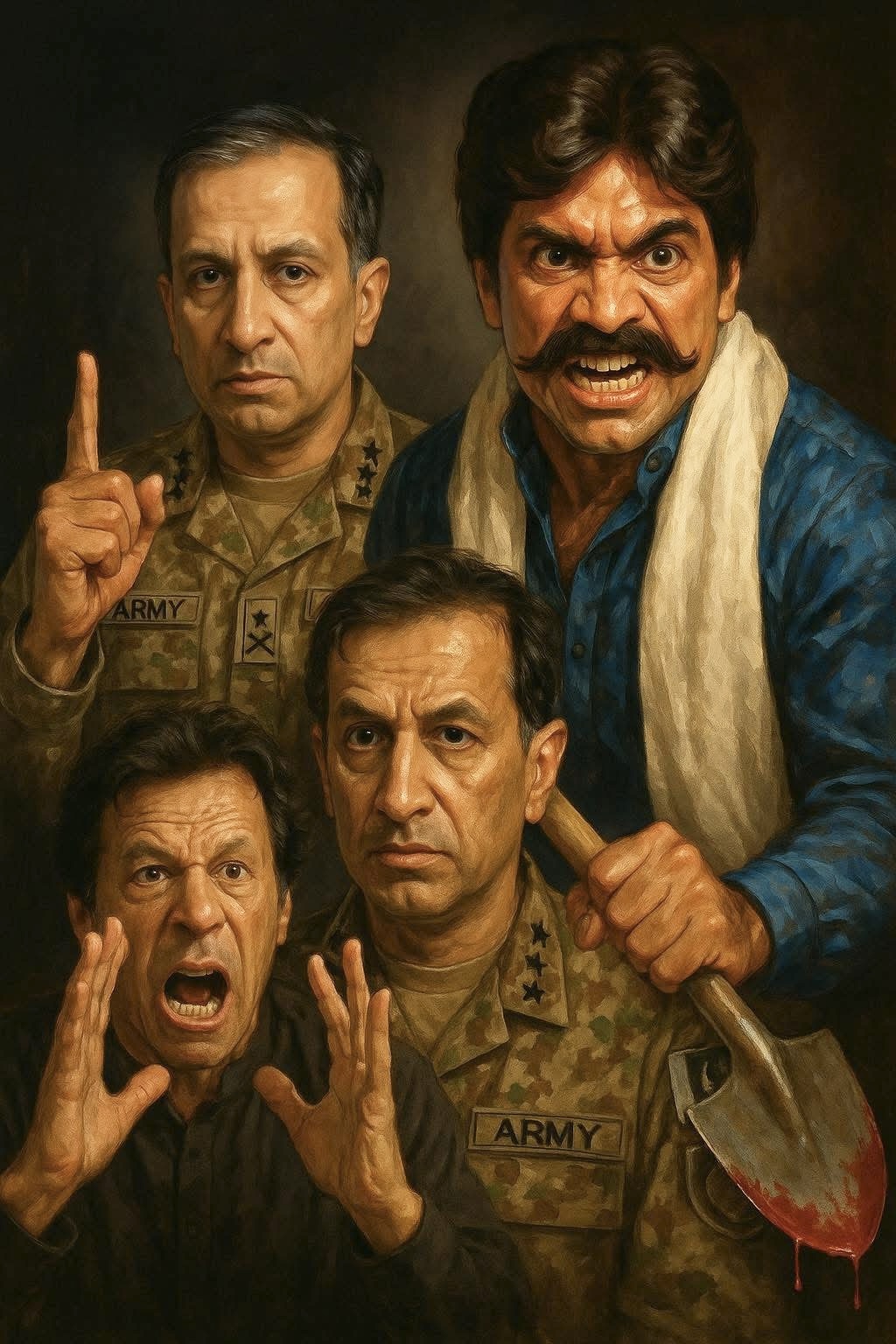
The Language of Politics, the Voice of Institutions, and the Tremor of a Press Conference
By Raja Zahid Akhtar Khanzada
There was a time when politics in Pakistan carried its own etiquette. A certain civility shaped the vocabulary of public life. In gatherings of the elders, words were weighed before they were spoken. Somewhere along the road, that tradition fractured. A different kind of language entered the political arena, the kind that even the alleys and marketplaces once hesitated to embrace.
During Nawaz Sharif’s tenure, I often sat in the press gallery of the National Assembly and heard Sheikh Rashid deliver sharp and piercing lines that chipped away at the boundaries of decorum. It hurt to listen. I wondered how far an elected representative could allow his public tone to fall. Some friends from Punjab would smile and tell me that I needed to understand Punjabi politics and that I should watch the films of Sultan Rahi. I followed their advice, and as I watched Sudhir and Sultan Rahi on screen, I began to grasp how a style of speech can seep into generations of political storytelling.
Years later, when I listened to Imran Khan’s speeches, I found an evolved version of that same tone. I once told a close friend in the PTI that the aspect I liked least about Khan’s politics was his language. He laughed and replied that the tone was exactly what made him magnetic. Perhaps he was right, because that same tone eventually echoed through the words of nearly every admirer. Soon a torrent of harshness began pouring into national politics. The bridges of tolerance collapsed. Television debates sank into abuse. Social media became a battleground of invective. Differences of opinion gave way to orchestrated hostility.
Yet what unfolded today felt like the most startling moment in this long decline.
The press conference delivered by the spokesperson for Pakistan’s military seemed to elevate this trend to a new and unsettling height. The language of Lieutenant General Ahmed Sharif Chaudhry, the tone, the intensity, the choice of words, all came as a surprise because the military is trained to maintain composure even in the face of an enemy. His position demands restraint, dignity, and unshakable poise. Today, all of that appeared to slip away within moments.
When I read the headline from the BBC, I sat still for a while. They wrote that such language was inappropriate for someone representing a national institution. It was one of the strongest remarks international media has made about a Pakistani military spokesperson. The BBC further reported that without naming Imran Khan, the spokesperson went so far as to describe him as exhibiting signs of mental illness.
These were not simply harsh words. In a country where the divide between politics and the state already runs deep, they were an incision.
I have watched dozens of press conferences from military spokespersons over the years. The subjects were serious. The tone was always measured. But today’s briefing circled almost entirely around one individual. Imran Khan was described as anti state, as a prisoner of his own ego, as someone trapped in the illusions of his mind, as self obsessed. The most jarring moment was when the spokesperson used the words barking and dog while referring to the Chief Minister of Khyber Pakhtunkhwa.
This was the kind of language we once heard only from politicians, never from the military’s briefing room.
Another reason for my astonishment lies elsewhere.
I have met Field Marshal Syed Asim Munir twice in the United States and had the opportunity to observe his temperament up close. In Washington, the Pakistani community asked him difficult and emotional questions. Some of the exchanges were tense. Not once did he raise his voice or utter a disrespectful word. I watched as several of his own supporters reacted sharply to the mention of Imran Khan’s name. He immediately signaled them to remain silent and allowed the questioner to speak fully. I still remember the calm in his face and the discipline in his tone.
Later in Tampa, during a question and answer session, a Pakistani attendee challenged him repeatedly and in an agitated manner about the potential exchange involving Dr Aafia and Shakil Afridi. The interruptions were relentless, yet the Field Marshal answered every question with patience.
Outside the hotel afterward, he was preparing to leave but stood with us for nearly twenty minutes. He listened. He responded. His tone never wavered. His speech carried the balance that is rare among people holding high office.
After witnessing that demeanor, today’s press conference made me feel for the first time that a new style of expression may be emerging within the institution, one that departs sharply from its traditional composure. This is neither good for the institution nor for the state.
The BBC noted that the spokesperson declared that the time for political theatrics was over. Such a line may well be delivered by a politician or a journalist, but when it comes from the military, it carries a different weight. It also came alongside the familiar assertion that the institution has no involvement in politics.
He went further, saying that during meetings in prison, Imran Khan urges visitors to disregard the constitution and all boundaries in favor of an anti state narrative. He added that the business of lies and deceit in Pakistan would no longer continue. This language and this fervor blur the delicate line between politics and the state, a line essential for any mature democratic order.
On social media, confusion and alarm dominated the reaction. One user wrote that the skin of the hard state had suddenly thinned. Another called the press conference foolish. Others argued that such tone is not appropriate for state institutions. Talat Hussain wrote that this is the moment when those claiming neutrality must decide where they stand. Someone else reminded us that Fatima Jinnah, Bacha Khan, Akbar Bugti, Benazir Bhutto, and Nawaz Sharif had also been branded national security threats in their times. History may not repeat itself, but vocabulary often does.
My question is simple. Should an institution that endures the most demanding battlefields lose its linguistic balance in the noise of domestic politics? Does institutional greatness grow from dignity or from anger?
I remember the Field Marshal’s composure today because leadership is measured not by the exercise of power but by the restraint of tone. The words spoken by those carrying the weight of an entire army become part of the permanent record of history.
Today’s episode reminded me that in our country, power has grown immensely, yet patience has grown very little. The dignity of the state survives only when the voice of reason stands above the voice of provocation, and reason is never accompanied by insult.
