

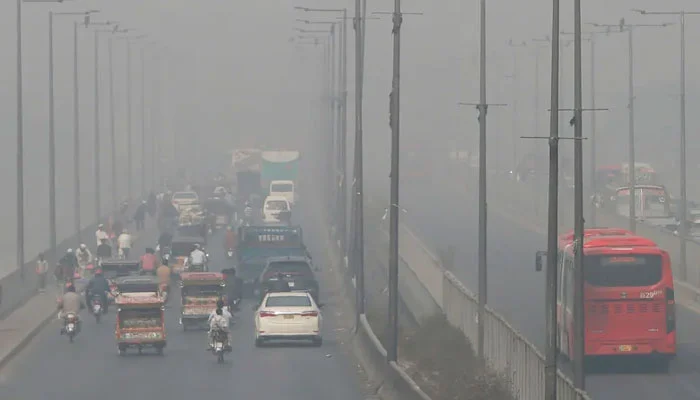
LAHORE – Millions of residents in Pakistan’s central Punjab province are once again grappling with a severe public health crisis as toxic smog blankets the region. Air quality has deteriorated to such an extent that it is classified as “extremely unhealthy” across multiple districts.
According to the Air Quality Index (AQI) recorded this morning, the Qadir Puran area of Multan was the most polluted, registering an alarming 719 particulate matter (PM).
Other major cities are also suffering: Kasur recorded 668, Faisalabad 562, Gujranwala 550, and both the provincial capital Lahore and Sheikhupura registered 480. The air quality in Lodhran and Rahim Yar Khan is also reported as extremely hazardous.
According to the smog monitoring and forecasting system, a significant factor in the current crisis is the wind direction, which is blowing from east to west. This pattern is carrying polluted air from the Indian regions of Haryana, Ludhiana, Patiala, and Jalandhar into Pakistan. This cross-border pollution is directly impacting the air quality in Lahore, Faisalabad, Kasur, and Gujranwala.
In response, 12 provincial departments are actively implementing a joint action plan to combat the smog. Authorities are enforcing a “zero-tolerance” policy against burning crop residue, and more than 10,000 notices have been issued. Over 1,200 teams are monitoring for violations, and in recent actions, more than 190 factories and kilns have been fined or sealed for contributing to the pollution.
