

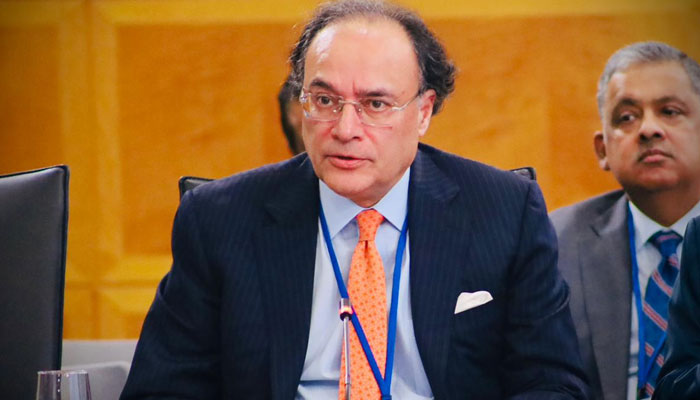
In a confident assertion of progress, Federal Finance Minister Muhammad Aurangzeb has stated that Pakistan has now become a safe and viable country for foreign investment, marking a significant step towards economic stability.
Speaking in an interview on Geo News’ “Capital Talk” program, the minister candidly discussed both the achievements and the profound challenges facing the economy. He identified climate change as a primary threat, noting that the increasing frequency of floods and smog has direct economic consequences. “This year’s floods caused 80% of the damage in Punjab,” he revealed, which impacted the GDP growth estimate, previously projected at 4.2%.
He delivered a stark warning: if the dual threats of climate change and rapid population growth are not managed, the national goal of expanding the economy to three trillion dollars could be jeopardized.
However, Mr. Aurangzeb stressed that Pakistan is now standing on its own feet, capable of managing relief and rescue operations with its own resources. He clarified that for long-term reconstruction, the country would prefer grants over new loans.
The finance minister highlighted the growing international recognition of Pakistan’s economic reforms. “The World Bank praised our presentation on tax reforms,” he noted, which emphasized how technology is successfully reducing corruption. He shared an encouraging anecdote: “Egypt’s finance minister said, ‘I am either sending my team to you, or you send your team to us.'”
On the domestic front, he pointed to a 100% increase in tax collection from wholesalers and retailers last year, along with additional revenue recovered from the sugar, cement, and tobacco industries. He also mentioned that income tax has been reduced for the lower and middle salaried classes, with hopes to provide relief to other classes in the future.
Addressing concerns about some companies exiting the country, he explained these are often due to global corporate decisions or increased local competition. He balanced this by pointing to new arrivals, stating, “While some companies have left, others have also come to Pakistan,” citing Abu Dhabi Ports and other UAE firms. Furthermore, the Pakistan Stock Market has attracted 95,000 new investors.
Concluding on a note of stability, he added that $4 billion in backlog payments have been cleared in the last two years, and the government is now moving toward deregulating sugar and wheat prices, with a formal policy expected in 2026.
