

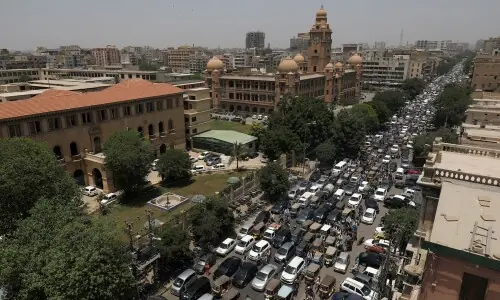
KARACHI, PAKISTAN—The Sindh government has adopted a stringent approach to road safety, amending the Motor Vehicles Ordinance, 1965, to introduce a new system of traffic penalties that includes both hefty fines and a demerit points system.
Senior Sindh Minister Sharjeel Inam Memon announced the changes on Thursday, stating that the measures target high-risk violations such as overspeeding, driving without a licence, signal violations, wrong-way driving, overloading, and reckless behaviour.
Escalating Penalties to Save Lives
Under the revised penalty structure, high fines and significant demerit points are being imposed to serve as a stronger deterrent. The revised penalties for overspeeding are particularly notable:
- Motorcycles: Rs5,000 fine.
- Cars: Rs15,000 fine.
- Heavy Vehicles: Rs20,000 fine. All overspeeding offenses will incur eight demerit points.
Other key infractions will now carry severe penalties:
- Driving without a licence: A fine up to Rs50,000 and six demerit points.
- Reckless driving: A fine of Rs25,000 and eight demerit points.
The new system also introduces fines for infractions like one-wheeling, riding without a helmet, using tinted windows, driving in the wrong lane, and carrying passengers on vehicle roofs.
Minister Memon was quick to address the underlying motivation: “These measures are not intended to collect revenue. They are aimed at saving lives and making roads safer for everyone.” He cautioned that repeated violations tracked by the new system could ultimately lead to the suspension or cancellation of a driver’s licence.
Modernizing Enforcement
The government is also focusing on modernization to support the new regulations. Mr. Memon noted that efforts are underway to introduce a digital monitoring system and enhance the capacity of the traffic police. He highlighted that the demerit points system, which is used to track and punish repeat offenders, is an internationally accepted method already in use in several other countries.
The Minister appealed to citizens to support the new regulations, emphasizing that public compliance is essential to reduce accidents, improve traffic flow, and ensure road safety. He confirmed that public awareness campaigns would be launched to educate citizens about the new laws.
