

Ramallah:
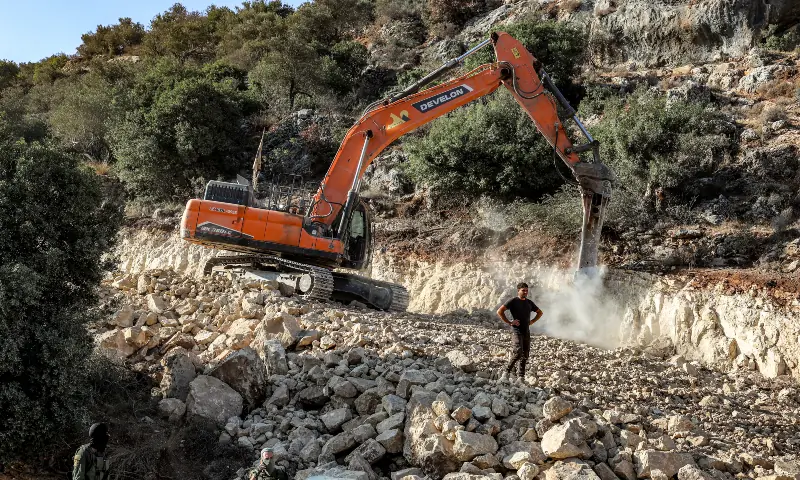
As US President Donald Trump unveiled a plan this week to end the Gaza conflict and suggested a potential path to a Palestinian state, the reality on the ground in the Israeli-occupied West Bank painted a far more bleak picture. For residents like Ashraf Samara in the village of Beit Ur al-Fauqa, Israeli bulldozers were actively carving up the land, effectively burying their hopes for statehood.
Surrounded by armed security guards, Israeli machinery was pushing earth to create new routes for Jewish settlements, creating fresh physical barriers and restricting movement for Palestinians.
“This is to prevent the residents from reaching and using this land,” said Samara, a member of his village council. He warned that the move would “trap the villages and the residential communities” by confining them exclusively to their residential areas. Every new road built to ease movement for Jewish settlers simultaneously creates new hurdles for Palestinians—who are generally barred from using these routes—to reach nearby towns, workplaces, or agricultural land.
Rapid Settlement Expansion and Discriminatory Infrastructure
The expansion of Israeli settlements in the West Bank has accelerated rapidly under Prime Minister Netanyahu’s government, even as major European countries like Britain and France recently joined nations recognizing a Palestinian state. Palestinians and most of the international community consider these settlements illegal under international law, a stance Israel disputes.
Hagit Ofran, a member of the Israeli activist group Peace Now, asserted that the new roads around Beit Ur al-Fauqa are a direct attempt by Israel to control more Palestinian land. “They are doing it in order to set facts on the ground,” she said, noting that Israel has allocated seven billion shekels ($2.11 billion) to build roads in the West Bank.
This network of roads, which stretches deep into the territory occupied since the 1967 war, was described by the Israeli rights group B’Tselem in 2004 as “Israel’s Discriminatory Road Regime,” designed in part to stifle Palestinian urban development.
Netanyahu Vows to ‘Bury’ Statehood Idea
The contradiction between Trump’s plan and the Israeli government’s actions is stark. Before the Trump plan was announced, Prime Minister Netanyahu explicitly declared: “There will never be a Palestinian state.”
This declaration came as he approved a major project to expand construction between the occupied West Bank settlement of Maale Adumim and Jerusalem. His finance minister, Bezalel Smotrich, stated unequivocally that this project would “bury” the very idea of a Palestinian state.
While Trump’s plan, which Netanyahu approved, outlines a potential—though condition-heavy—pathway to Palestinian statehood, Ofran argues that the current infrastructure work tells the real story. “What the government is now doing is setting the infrastructure for the million settlers that they want to attract to the West Bank,” she warned. “If you have a road, eventually, almost naturally, the settlers will come.”
