

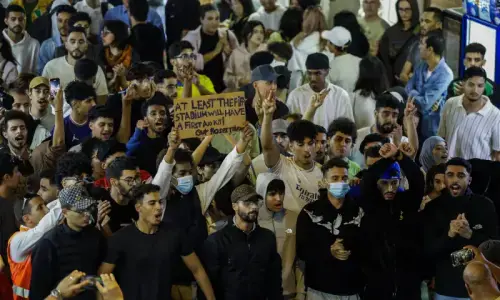
Rabat, Morocco:
The North African kingdom of Morocco is facing a deepening social crisis, with protests over inequality and poor public services set for a sixth consecutive night. The unrest follows a night of fatal clashes in the southern city of Agadir, where three demonstrators were killed, intensifying public anger across the usually stable nation.
The protests, which erupted last Saturday, are fueled by popular frustration over social inequality as Morocco pours massive investment into infrastructure to host the Africa Cup of Nations next month and the 2030 World Cup. Chants from the demonstrators have made their priorities clear: “We don’t want the World Cup, health is a priority” and “We have stadiums, but what about hospitals?” The demonstrations initially gained momentum following reports late last month of the deaths of eight pregnant women at a public hospital in Agadir.
In his first public statement since the unrest began, Prime Minister Aziz Akhannouch appealed for calm, expressing his government’s willingness to “engage in dialogue” and “respond to the (protesters’) demands.” The Premier described the three deaths during Wednesday night’s protests as “regrettable.”
An interior ministry spokesman stated that all three demonstrators were killed after they attempted to storm a local law enforcement station. Earlier official reports had indicated that officers opened fire on a group accused of wielding “bladed weapons” near Agadir.
The Digital Mobilization and Divide
The demonstrations were called by the group GenZ 212, whose organizers remain unknown but who mobilized rapidly on the online messaging platform Discord, now boasting over 150,000 members.
While the movement has called for “freedom, dignity and social justice,” and urged Akhannouch to step down, it has also asserted its “love for the homeland and king,” referring to Morocco’s monarch Mohamed VI.
Despite its calls for peaceful protest, the interior ministry has confirmed that more than 400 people have been arrested since the rallies began. Officials reported nearly 300 injuries, mostly among security forces, and significant material damage, including the vandalism of 80 public and private establishments and 271 government vehicles.
Clashes have erupted in several cities. In Sale, north of Rabat, a journalist observed masked demonstrators setting fire to two police cars and a bank branch. Local resident Hicham Madani distanced the core movement from the violence: “The young people I saw vandalising and breaking things in Sale have nothing to do with GenZ 212. They are young thugs who came with the intention of vandalising.”
GenZ 212 has consistently rejected “all forms of violence, vandalism or rioting” and reminded protesters to respect the peaceful nature of the movement ahead of Thursday’s gatherings, which were scheduled to begin at 1600 GMT.
