

Lahore:
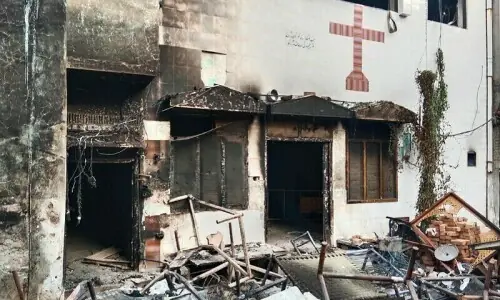
Two years after the devastating attacks on Christian communities and churches in Jaranwala, victims and minority rights activists gathered at the Human Rights Commission of Pakistan (HRCP) on Thursday to condemn the state’s failure to deliver justice, calling the government’s promises a “futile” exercise.
Shakeel Bhatti, a victim and member of the Minority Rights Movement, expressed profound disillusionment, stating that the high-level pledges by the Punjab government to make the Jaranwala attacks an “example” had fallen flat. “We waited for two years, we went to courts, [the] joint investigation team (JIT) and police officers but it all proved futile as only one person in the case was imprisoned,” he said. Bhatti revealed the shocking reality that when the main accused who had burned Saint John’s Church was released, “the local people welcomed him with flower petals, garlands and drum beats.”
He emphasized the scale of the destruction—27 churches, countless copies of the Bible, and numerous homes burnt and looted—yet lamented the lack of proper investigation. “Nobody is ready to listen to us. On the other hand, any group or specific party can carry out any such attack at will without any hurdle.”
Judicial Conduct and Investigation Failure
Bhatti pointed to severe issues within the judicial process. He cited an incident where a judge of the Anti-Terrorism Court (ATC) in FIR number 78/23 threatened to jail the complainant after inquiring about ‘Maal Muqadma’ (case property/evidence) and being informed that the police were responsible for providing it. “If judges have this attitude, where would the people like us go for justice?” he questioned.
Bhatti, a complainant in one of the cases, detailed the deliberate sealing of his and four other FIRs by a judge, which a concerned DSP termed a “routine matter.” Victims had approached the Regional Police Officer (RPO) 15 to 20 times to request a change in investigation, but nothing materialized.
Christian rights activist Lala Robin Daniel corroborated the investigative failures, stating that there was widespread looting before the arson attacks, yet local people and their damaged houses were not included in the investigation of 23 FIRs. He informed the conference that while five FIRs were state-registered, in private complaints, complainants were forced to state that blasphemy was the cause of attacks, even though two Christian boys were initially accused.
Daniel revealed that 46 Christians were arrested following the attacks, with about 10 tortured so severely they could not walk properly. Conversely, 300 attackers arrested at the site were not even “touched.” He also highlighted that despite 3,200 footages being available, including those recorded on policemen’s mobile phones, no forensic analysis was conducted, and police officials were not made witnesses in any case.
State Policy and Minority Representation
Journalist and rights activist Munizae Jahangir criticized the state’s ambiguous stance. She said that despite the involvement of the then caretaker prime minister, who failed to visit the burnt houses during his trip, the incident failed to become a test case for the government. “It seems that only one institution in Pakistan is majority while all the rest are in minority,” she remarked, urging the state to clarify “whether it’s standing by us or by those who carried out the attacks.” Jahangir linked such incidents to the policies of Gen Zia, which raised certain religious groups for the state’s interests, who then began “hounding the minorities.”
Samson Salamat of Rawadari Tehreek raised the issue of political representation, noting that the 38 so-called minority representatives in the assemblies are chosen by political parties, not by the Christian community itself. “The minority representatives did not represent the Christians but the political parties or their leaders while the Christians had no voice in the assemblies.”
The vulnerability of the victims was further underscored by Shakeel Bhatti’s complaint that after protesting, written threats were delivered to their houses, warning of renewed attacks if they did not cease their protests. The conference concluded that the initial promise of justice remains unfulfilled, leaving the minority community in a state of increased insecurity.
